What Is a Percent to PPM Calculator?
This calculator converts a concentration expressed as a percentage (%) into parts per million (ppm). Both are dimensionless ways of describing how much of one substance is present in a mixture, but ppm is used for very small concentrations where percentages would be awkward fractions. The conversion is universal and applies to any field — chemistry, water treatment, agriculture, food science and air quality monitoring.
How to Use It
Enter the concentration in percent and the tool instantly returns the equivalent value in parts per million. For example, a cleaning solution labeled "0.5%" can be re-expressed as 5,000 ppm, which is often the unit used on safety data sheets and lab protocols.
The Formula Explained
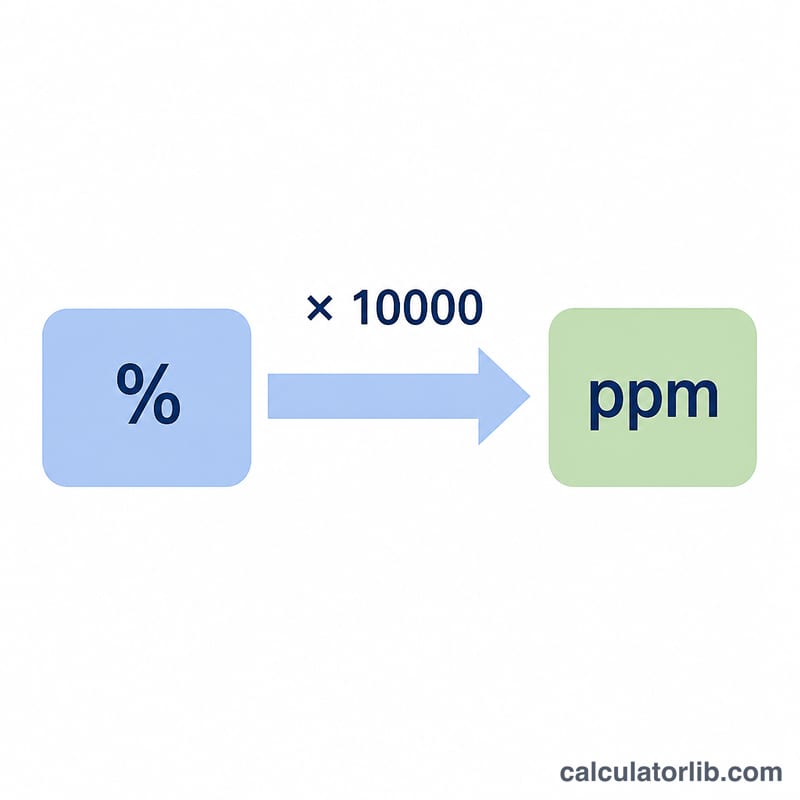
Percent means "parts per hundred," while ppm means "parts per million." Since one million is 10,000 times one hundred, you simply multiply by 10,000:
$$\text{ppm} = \text{percent} \times 10{,}000$$
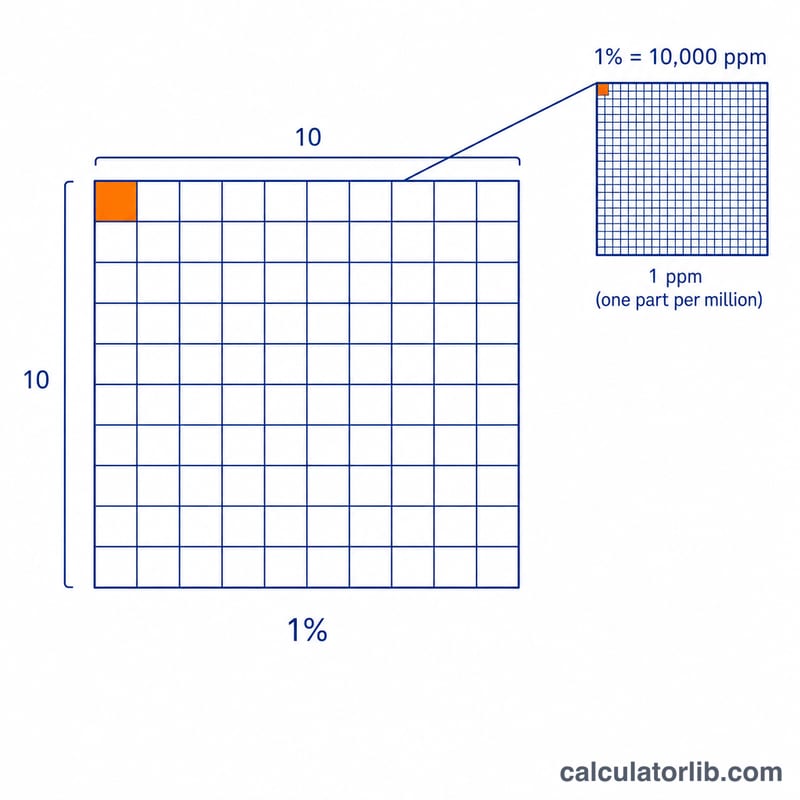
This works because \(1\% = 10{,}000\ \text{ppm}\). To go the other direction, divide ppm by 10,000 to recover the percentage.
Worked Example
Suppose a solution is 2.5% by mass. Multiply by 10,000: $$2.5 \times 10{,}000 = 25{,}000\ \text{ppm}$$ So a 2.5% concentration equals 25,000 parts per million.
Common Concentrations Expressed in Percent and PPM
The conversion is ppm = percent × 10,000, because 1% = 1 part in 100 and 1 ppm = 1 part in 1,000,000. The values below are approximate. Real products and natural waters vary, and the basis (w/w, w/v or v/v) is noted for each.
| Substance | Approx. percent | Approx. ppm | Typical basis |
|---|---|---|---|
| Household bleach (sodium hypochlorite, NaOCl) | about 5–6% | about 50,000–60,000 ppm | Usually stated as % w/w or w/v on labels; strength varies by brand and declines with age |
| Hydrogen peroxide, common drugstore solution | about 3% | about 30,000 ppm | Typically w/v or w/w; the two are nearly equal for dilute aqueous solutions |
| Seawater salinity (dissolved salts) | about 3.5% | about 35,000 ppm | w/w (about 35 g of salts per kg of seawater); varies by location |
| Drinking-water chlorine residual | about 0.00002–0.0004% | about 0.2–4 ppm | Expressed as mg/L in water (w/v), treated as ppm |
| Atmospheric carbon dioxide (CO₂) | about 0.042% | about 420 ppm | v/v (mole fraction in air, often written ppmv); the value rises slowly over time |
Check: \(0.042\% \times 10{,}000 = 420\ \text{ppm}\), and \(0.0004\% \times 10{,}000 = 4\ \text{ppm}\).
Interpreting Your PPM Result
PPM is a dimensionless ratio: one part of a substance per one million parts of the whole, or \(10^{-6}\). A percent is a ratio per hundred, so 1% equals 10,000 ppm. The ppm number says nothing by itself about the unit basis, so always know what the "parts" refer to.
- Mass basis: 1 ppm = 1 mg per kg (w/w).
- Dilute aqueous solutions: water has a density near 1 g/mL, so 1 L weighs about 1 kg and 1 ppm is approximately 1 mg/L. This is why water-quality results in mg/L are often called ppm.
- Where the equivalence breaks down: in concentrated solutions (brines, strong bleach, syrups) or non-aqueous liquids (oils, alcohols, solvents), the density differs noticeably from 1 g/mL. Then 1 mg/L no longer equals 1 mg/kg, and the two ppm values diverge. For example, a solution of density 1.2 g/mL has 1 mg/L ≈ 0.83 mg/kg.
- Bases are not interchangeable: w/w (mass per mass), w/v (mass per volume) and v/v (volume per volume) give different numbers for the same mixture unless densities are accounted for. The calculator applies pure arithmetic (percent × 10,000) and assumes the percent and the resulting ppm share the same basis.
- Gases: ppm for gases is usually by volume (ppmv, equal to mole fraction for ideal gases), not by mass.
Percent versus ppm: percent is convenient for bulk or major components (3% peroxide, 3.5% salinity). ppm is used for trace levels, where percent would need many leading zeros (0.0004% is easier to write as 4 ppm).
Smaller units: the next smaller unit is parts per billion (ppb), where 1 ppm = 1,000 ppb. So 0.2 ppm = 200 ppb, and 1% = 10,000 ppm = 10,000,000 ppb.
FAQ
Is this conversion the same for mass and volume? Yes — the numerical factor of 10,000 is the same whether you are working with mass percent (% w/w) and mg/kg, or volume percent. Just keep your basis consistent.
How do I convert ppm back to percent? Divide the ppm value by 10,000. For instance, \(3{,}000\ \text{ppm} \div 10{,}000 = 0.3\%\).
What is 1 ppm in percent? 1 ppm equals 0.0001%, since \(1 \div 10{,}000 = 0.0001\).