What is the Electrical Resistance Unit Conversion Calculator?
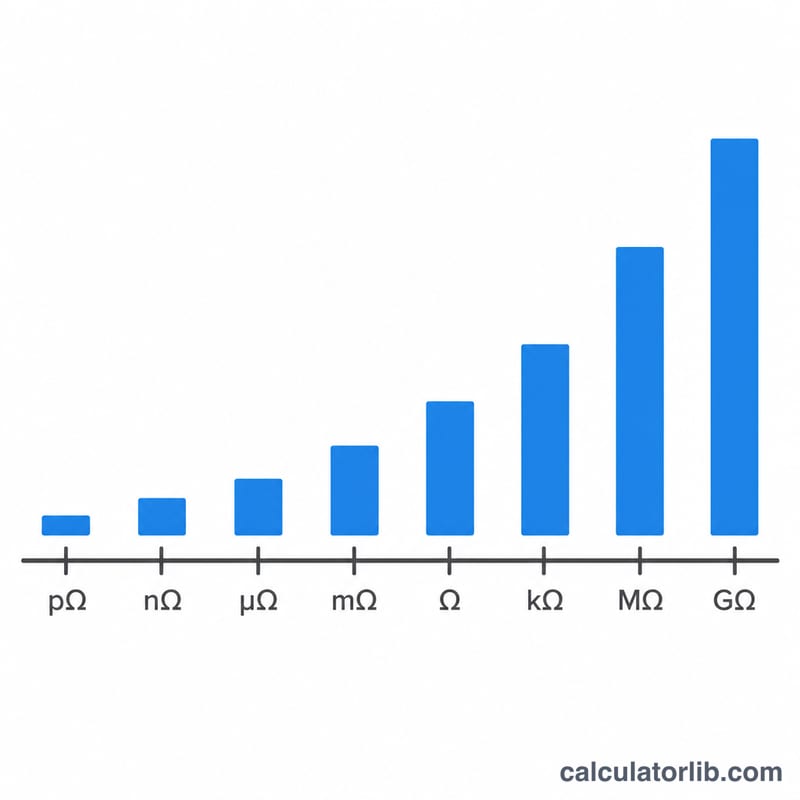
This tool converts a single electrical-resistance value into every common resistance unit at once. It supports the full SI ladder from picoohm to gigaohm, the CGS-emu abohm, and volt per ampere (V/A), which is dimensionally identical to the ohm by Ohm's law. It is a pure physics conversion and works the same everywhere in the world.
How to use it
Enter your resistance value, pick the unit it is currently expressed in, and choose how many significant digits you want to display. Press calculate and all ten unit outputs appear simultaneously. The significant-digits setting only changes how results are rounded for display, never the underlying math.
The formula explained
Every conversion is anchored to the SI base unit, the ohm. First the input is normalized: ohms = resistanceValue x scaleFactor(fromUnit). Then each target unit is produced by dividing by that unit's own scale factor: outputValue = ohms / scaleFactor(targetUnit). The scale factors are constants (1e-12 for picoohm, 1e3 for kiloohm, and so on), so there is never a divide-by-zero. Note that abohm and nanoohm both equal 1e-9 ohm, and V/A equals the ohm exactly.
$$R_{\Omega} = \text{Resistance} \times f_{\text{Input unit}}$$$$R_{\text{target}} = \dfrac{\text{Resistance} \times f_{\text{Input unit}}}{f_{\text{target}}}$$$$\text{where}\quad \left\{ \begin{aligned} R_{\Omega} &= \text{Resistance} \times f_{\text{Input unit}} \\ f &= 10^{-12},\,10^{-9},\,10^{-6},\,10^{-3},\,1,\,10^{3},\,10^{6},\,10^{9} \end{aligned} \right.$$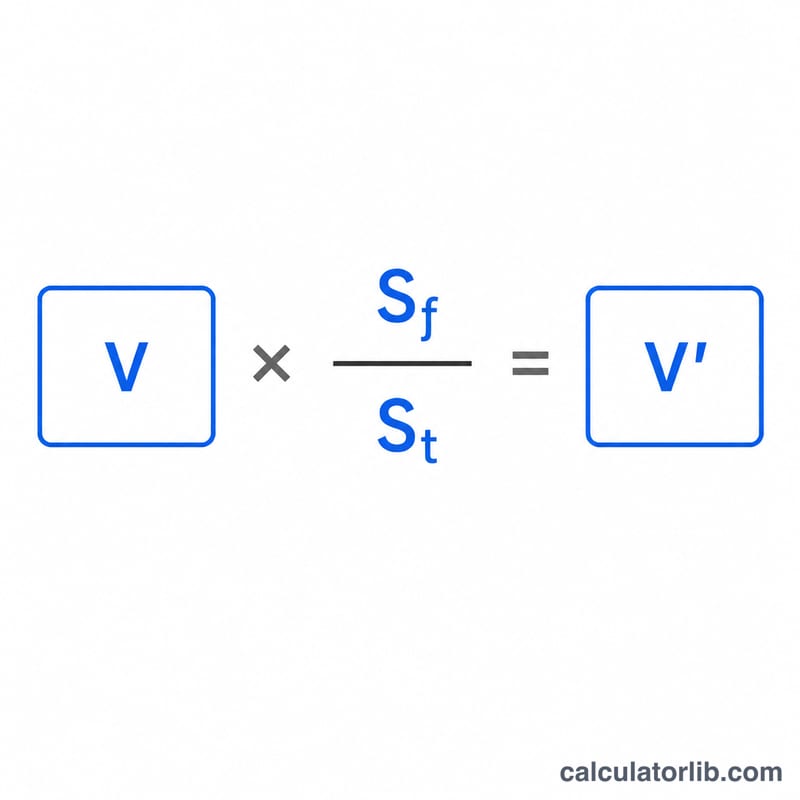
Worked example
Convert 4.7 kiloohm. Normalize: \(4.7 \times 10^{3} = 4700\) ohm. Then milliohm = \(4700 / 10^{-3} = 4{,}700{,}000\) mohm, megaohm = \(4700 \times 10^{-6} = 0.0047\) Mohm, and microohm = \(4{,}700{,}000{,}000\) microohm. Convert 1 ohm and you get \(10^{12}\) picoohm, \(10^{9}\) nanoohm, \(10^{9}\) abohm, and 1 V/A.
Typical Resistance Values by Component
Resistance in real equipment spans more than twenty orders of magnitude, which is exactly why a converter is useful: the same physical quantity is quoted in microohms on a busbar test report, in kilohms on a schematic, and in gigaohms on an insulation tester. The table below gives approximate order-of-magnitude ranges for orientation only — they are not specifications. Always use the manufacturer's datasheet or the governing test standard for any real design, acceptance test or safety decision.
| Component or situation | Typical approximate range | Same range in ohms (Ω) | Notes |
|---|---|---|---|
| Superconductor below critical temperature (DC) | Effectively 0 | \(\approx 0\) | No measurable DC resistance; persistent currents decay immeasurably slowly |
| Bolted busbar joint / clean contact interface | ~1–100 µΩ | \(10^{-6}\)–\(10^{-4}\) | Measured with a micro-ohmmeter (4-wire / Kelvin method) |
| Copper conductor, 1 m of 1 mm² cross-section at 20 °C | ~17 mΩ | \(1.7 \times 10^{-2}\) | From \(\rho_{Cu} \approx 1.68 \times 10^{-8}\ \Omega\cdot\text{m}\); rises roughly 0.4 % per °C |
| Current-sense (shunt) resistors | ~50 µΩ – 100 mΩ | \(5 \times 10^{-5}\)–\(10^{-1}\) | Low values for high-current shunts, higher values for low-current sensing |
| Relay, switch and connector contacts (new) | ~1–100 mΩ | \(10^{-3}\)–\(10^{-1}\) | Grows with oxidation, fretting and wear over service life |
| Standard fixed resistors, E-series preferred values | ~1 Ω – 10 MΩ | \(1\)–\(10^{7}\) | E6/E12/E24/E96 preferred-number series defined in IEC 60063 (international standard) |
| Pull-up / pull-down resistors on logic lines | ~1–100 kΩ | \(10^{3}\)–\(10^{5}\) | I²C buses commonly use ~2.2–10 kΩ depending on bus capacitance and speed |
| Digital multimeter DC voltage input impedance | ~10 MΩ | \(10^{7}\) | A very common design convention, not a universal rule — some ranges or instruments use 1 MΩ or >10 GΩ |
| Insulation resistance of healthy cable or winding | ~1 GΩ and above | \(\geq 10^{9}\) | Measured at a specified DC test voltage (e.g. 500 V or 1000 V); minimum acceptance values are set by the applicable national or IEC standard, not by a single global figure |
| Good electrical insulators (PTFE, ceramics, dry air gaps) | ~\(10^{12}\) Ω and above | \(\geq 10^{12}\) | Strongly dependent on humidity, surface contamination and temperature |
Reading the table with this converter
To place any of these ranges on a common scale, enter the value with its native unit and read the ohm equivalent. For the copper conductor row:
$$R = 16.8\ \text{m}\Omega \times 10^{-3} = 0.0168\ \Omega$$
Entering 16.8 with the input unit set to milliohm therefore gives 0.0168 Ω.
Two unit names in the list are worth remembering while using the table. The volt per ampere (V/A) is identical to the ohm by definition, since \(R = V/I\), so a conversion between them is a 1:1 relabelling. The abohm is the CGS-electromagnetic unit of resistance and equals exactly \(10^{-9}\) Ω, i.e. one nanoohm — it appears mainly in older literature and is not an SI unit.
FAQ
Why is V/A the same as the ohm? Ohm's law states \(R = V / I\), so a resistance of one volt per ampere is by definition one ohm.
What is an abohm? It is the CGS electromagnetic unit of resistance, where \(1\ \text{abohm} = 10^{-9}\ \text{ohm}\), making it numerically equal to the nanoohm.
Does the significant-digits option change the conversion? No. It only controls display rounding; the conversion itself always uses full double precision.