What is the Fabric Yardage Calculator?
This calculator tells you how much fabric to buy for a sewing or quilting project. You can either enter the total length of fabric you need in inches, or describe the individual pieces you want to cut — their length, width, and how many — and the calculator works out the most efficient layout across the bolt width and returns the result in yards, feet, and meters.
How to use it
If you already know the total length, type it in the first field and the rest is ignored. Otherwise leave the total length blank and fill in the size of one piece, the number of pieces, and the width of the fabric bolt (commonly 44, 54, or 60 inches). Click calculate to see the yardage.
The formula explained
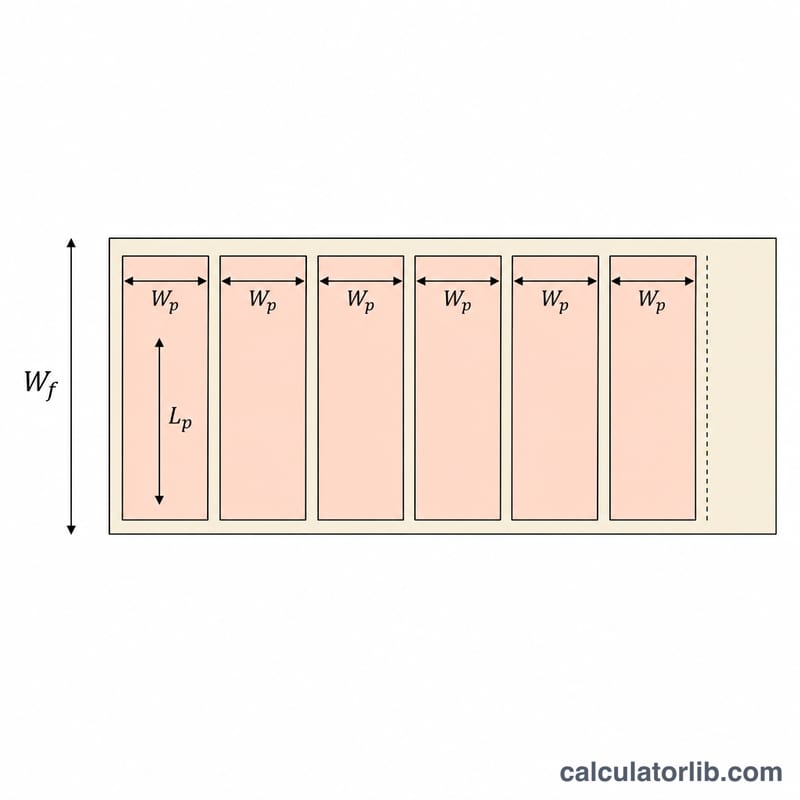
The tool first finds how many pieces fit side by side across the fabric width, \(\lfloor W_f / W_p \rfloor\), then divides the piece count by that to get the number of rows (rounded up). Multiplying rows by piece length gives the total inches, which is divided by 36 to convert to yards:
$$\text{Yards} = \frac{\left\lceil \frac{N}{\lfloor W_f / W_p \rfloor} \right\rceil \times L_p}{36}$$Here \(N\) = number of pieces, \(W_f\) = fabric width, \(W_p\) = piece width, and \(L_p\) = piece length, all in inches.
Worked example
Suppose you need 12 pieces, each 10 in long and 10 in wide, from 44 in wide fabric. Pieces per row: \(\lfloor 44/10 \rfloor = 4\). Rows: \(\lceil 12/4 \rceil = 3\). Total length:
$$3 \times 10 = 30\,\text{in} = \frac{30}{36} \approx 0.83\,\text{yd}$$So buy about 1 yard to be safe.
Standard Fabric Bolt Widths
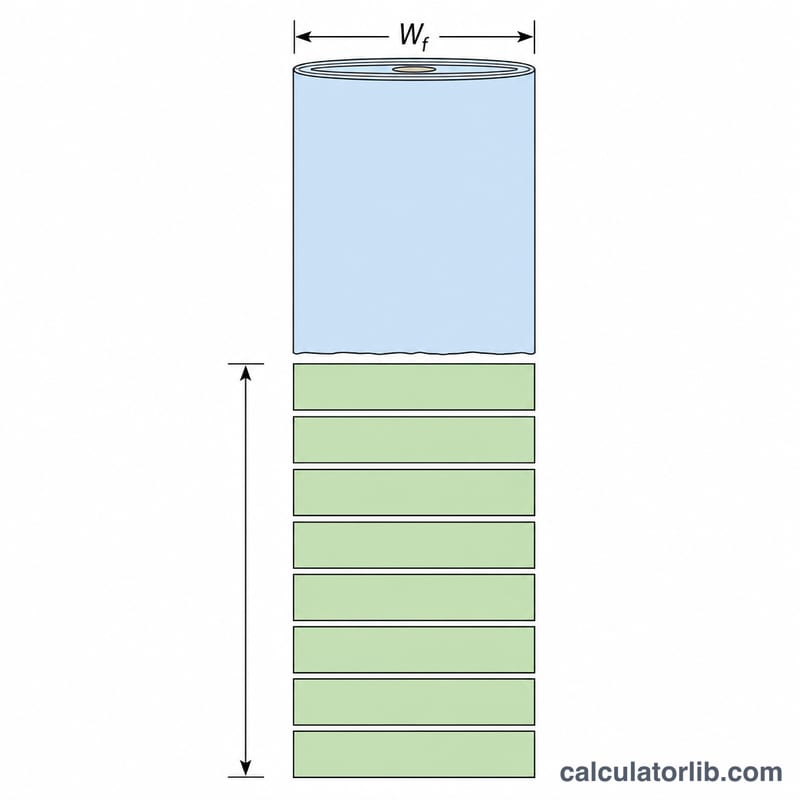
Fabric comes off a bolt or roll in a fixed width. You buy it by length. Yards and inches are the norm in the United States. Many other countries sell fabric by the metre and give widths in centimetres. The widths below are common industry sizes, but mills vary, so always check the label or measure the bolt. The usable width is what's left after you trim the selvedges, the tightly woven, often printed edges on each side. It is usually 1–2 in (about 2.5–5 cm) narrower than the stated width, and you should plan your cuts on this usable width.
| Nominal width (in) | Approx. width (cm) | Typical fabrics | Usable width note |
|---|---|---|---|
| 36 | 91 | Some interfacings, linings, specialty and vintage cottons, muslin | Often about 34–35 in after trimming the selvedges |
| 42–45 | 107–114 | Quilting cotton, broadcloth, many prints and craft cottons | Usually about 40–42 in after trimming the selvedges; quilters often plan on 40 in |
| 54 | 137 | Home decor fabric, upholstery, drapery, canvas, some wools | Often about 52–53 in usable; large repeats can reduce the width you can use |
| 58–60 | 147–152 | Apparel knits (jersey, interlock), fleece, minky, many garment fabrics | Knits may have little selvedge but can curl at the edges; plan on about 56–58 in |
| 90 | 229 | Wide quilt backing, some muslin and sheeting | Trim the selvedges; useful for backing a quilt in one seamless piece |
| 108 | 274 | Wide quilt backing, sheeting | Trim the selvedges; usually enough to back a queen-size quilt without seams |
Centimetre values are rounded from 1 in = 2.54 cm. For example, \(44 \times 2.54 = 111.76 \approx 112\) cm.
Tips for Buying the Right Amount
- Add seam allowances first. Before you enter piece dimensions, add the seam allowance to every edge of each piece. In quilting this is often 1/4 in per seam. Garment patterns often use 5/8 in (common in US patterns) or about 1–1.5 cm. If a finished piece is 10 in square and you sew 1/4 in seams, enter 10.5 in × 10.5 in.
- Use the usable width, not the full bolt width. Enter the width left after you trim the selvedges. For quilting cotton, enter about 40–42 in, not 44–45 in. If you overstate the width, the calculator may fit more pieces across each row than you can really cut.
- Round up to the next standard cut. US shops usually cut in steps of 1/8 yd (4.5 in) or 1/4 yd (9 in). Shops that sell by the metre often cut in 10 cm steps. For example, a total length of 90 in works out to \(90 \div 36 =\) 2.5 yd, which is already a standard cut. If you get 2.4 yd, buy 2.5 yd.
- Allow extra for directional prints, nap and pattern repeats. Napped fabrics such as velvet, corduroy and faux fur, and one-way prints, need every piece cut in the same direction. That stops you nesting pieces efficiently. Matching motifs across seams, like plaids, stripes or large repeats on curtains and upholstery, can add roughly 10–25% to the yardage. Check the repeat length on the label and add at least one extra repeat per panel you need to match.
- Pre-shrink natural fibres. Cotton and other natural fibres often shrink about 3–5% when first washed, mostly along the length. Buy a little extra to cover this, and wash and dry the fabric the way you'll wash the finished item before you cut.
- Buy a little extra for cutting errors. Fabric that's cut off-grain, a mis-measured piece or a flaw in the bolt can leave you short. Dye lots also differ, so a matching piece may be hard to find later. Many sewists add about 1/4 yd (or 10–20 cm) beyond the calculated amount, more for large projects.
These are general guidelines. Always follow your pattern's own yardage chart and seam allowances when it gives them.
FAQ
Should I add extra for seams and shrinkage? Yes — add roughly 10% extra, and pre-wash if the fabric may shrink.
What if pieces are wider than the fabric? The calculator assumes at least one piece fits per row; rotate the piece or choose wider fabric if it does not.
How many inches are in a yard? Exactly 36 inches, or 3 feet.