What Is the Fertility by Age Calculator?
This calculator shows the typical chance of becoming pregnant naturally within one year of trying, based on age. Female fertility declines gradually with age as the number and quality of eggs decrease, so age is one of the strongest predictors of how quickly conception is likely to occur. The figures here are population averages and are intended for general education only — they are not a medical diagnosis or a prediction for any individual.
How to Use It
Enter your age in years and press calculate. For ages 19 to 39 the tool returns the share of women in your age group who became pregnant within one year of trying. For other ages no figure is shown, because the source study covers only women aged 19 to 39. Use the result as a rough benchmark, not a guarantee.
The Formula Explained
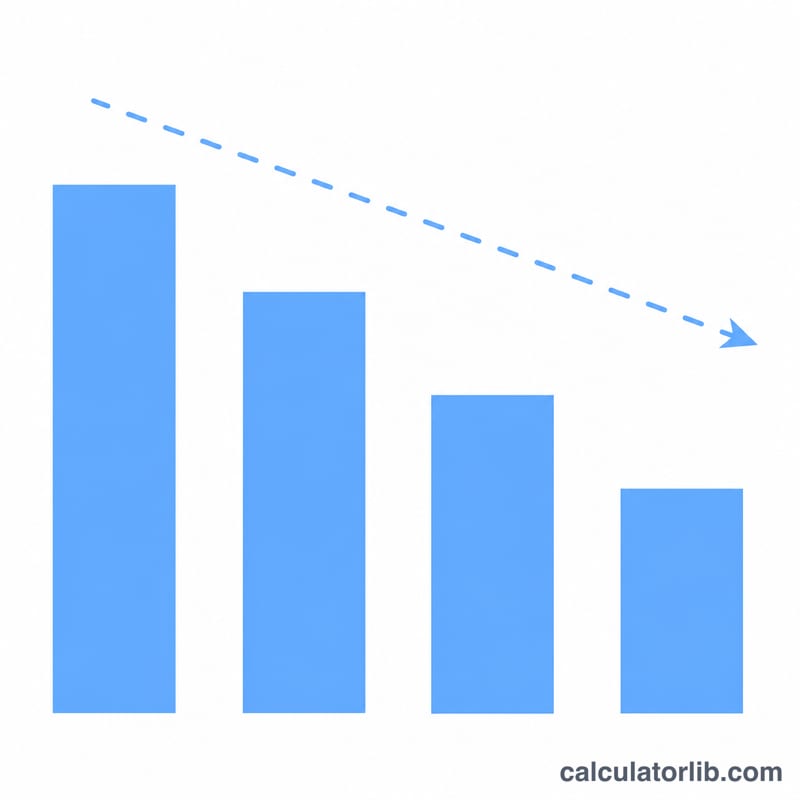
No probability model is used. The calculator looks up your age group in a published study (Dunson et al., Obstetrics & Gynecology, 2004), which estimated the share of women still not pregnant after one year of trying at 8% for ages 19–26, 13–14% for ages 27–34 and 18% for ages 35–39. The chance of pregnancy within 1 year is 100% minus that share.
Worked Example
A 32-year-old falls in the 27–34 group. In the study, 13–14% of women in this group were not pregnant after a year of trying, so her chance of pregnancy within 1 year is 100% − 13–14% = 86–87%.
Fertility Odds by Age Band Compared
Figures from Dunson et al. (2004) for women trying to conceive:
| Age group | Not pregnant after 1 year | Chance of pregnancy within 1 year |
|---|---|---|
| 19–26 | 8% | 92% |
| 27–34 | 13–14% | 86–87% |
| 35–39 | 18% | 82% |
| 40 and over | Not covered by this study; no figure is shown | |
Important: these are averages from one study, and other studies report somewhat different numbers. ACOG and ASRM note that fertility decreases gradually but significantly from about age 32 and more rapidly after age 37. Individual chances can be higher or lower than the figure for the age group.
Interpreting Your Result
- Chance within 1 year is the share of women in your age group who became pregnant within a year of trying (for example, 86% means about 86 in 100 women).
- Ages not covered: the study includes only women aged 19 to 39, so no figure is shown for other ages. The NHS notes that more than 8 in 10 couples where the woman is under 40 conceive naturally within a year.
- Real-world variation: actual chances depend on overall health, ovulation and cycle regularity, timing of intercourse relative to the fertile window, medical conditions, lifestyle factors, and partner factors such as sperm quality and the partner's age. Age alone is only one input.
- When to seek help: the NHS advises seeing a doctor if you have not conceived after a year of trying, and ACOG and ASRM recommend that women older than 35 have an evaluation after 6 months of trying without success. Earlier evaluation is often considered when there are known risk factors or irregular cycles.
This is general information, not medical advice. A healthcare professional can assess your individual situation.
FAQ
Are these numbers exact? No. They are simplified averages from fertility research; real odds depend on health, cycle regularity, partner fertility, and timing of intercourse.
Why does fertility drop after 35? Egg quantity and quality decline more rapidly after the mid-30s, lowering both conception rates and increasing miscarriage risk.
Should I see a doctor? If you are under 35 and have tried for 12 months, or 35+ and tried for 6 months, consult a fertility specialist for personalized assessment.