What Is the Daily Fiber Intake Calculator?
This calculator estimates how much dietary fiber you should eat each day based on how many calories you consume. It uses the widely cited dietary guideline of 14 grams of fiber per 1,000 calories, which is the basis for the Dietary Guidelines for Americans recommendation. Fiber supports digestion, helps regulate blood sugar, lowers cholesterol, and keeps you feeling full.
How to Use It
Enter your average daily calorie intake in kilocalories (kcal) and press calculate. The result shows your target fiber intake in grams per day. If you don't track calories precisely, use a typical estimate — around 2,000 kcal for many adults, or use a calorie calculator first.
The Formula Explained
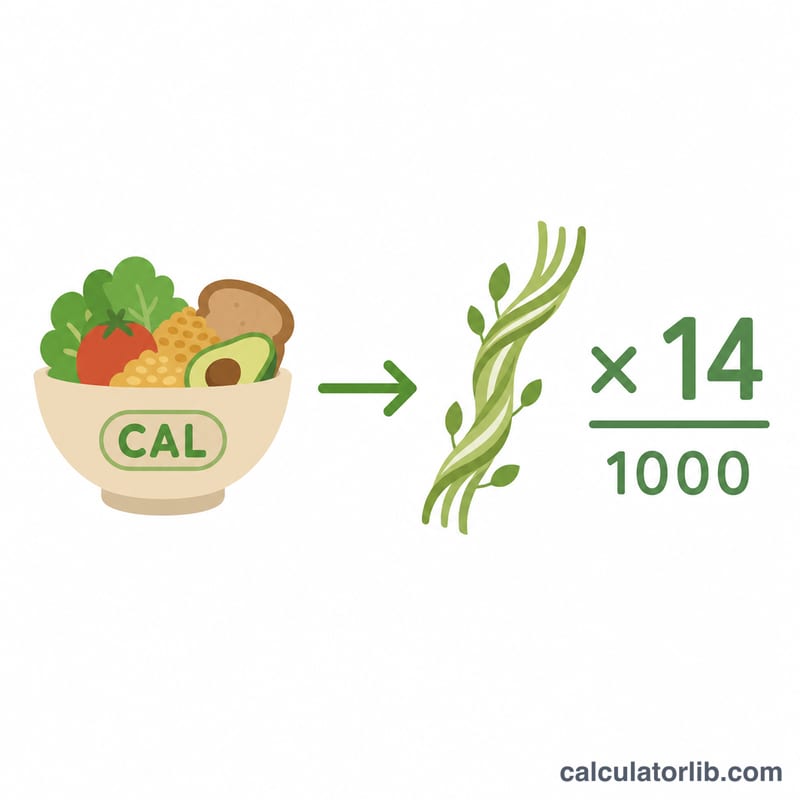
The math is simple: divide your calorie intake by 1,000 to get the number of "thousand-calorie" units, then multiply by 14 grams.
$$\text{Fiber (g)} = \frac{\text{Calories}}{1000} \times 14$$
This scales fiber needs to energy intake, so people who eat more naturally need more fiber.
Worked Example
Suppose you eat 2,000 calories per day. Then $$\text{fiber} = \frac{2000}{1000} \times 14 = 2 \times 14 = 28 \text{ grams}$$ of fiber per day. For a 2,500-calorie diet, the target rises to 35 grams.
Fiber Targets at Different Calorie Levels
The calculator uses the dietary guideline of 14 g of fiber per 1,000 kcal consumed:
$$\text{Fiber (g/day)} = \frac{\text{Calories (kcal)}}{1000} \times 14$$
For example, at 1,800 kcal: \(\frac{1800}{1000} \times 14 = 1.8 \times 14 = 25.2\) g per day.
| Daily calories (kcal) | Fiber target (g/day) |
|---|---|
| 1,200 | 16.8 |
| 1,500 | 21 |
| 1,800 | 25.2 |
| 2,000 | 28 |
| 2,200 | 30.8 |
| 2,500 | 35 |
| 3,000 | 42 |
The target scales linearly with energy intake: every additional 1,000 kcal adds 14 g of fiber.
Recommended Fiber Intake by Age and Sex
The values below are Adequate Intakes (AI) for total fiber, set by the Institute of Medicine (now the National Academies) and used in the Dietary Guidelines for Americans. They apply to the United States and Canada and are derived from the same 14 g per 1,000 kcal basis. They are general population standards, not individual prescriptions.
| Group | Adequate Intake (g/day) |
|---|---|
| Children 1–3 years | 19 |
| Children 4–8 years | 25 |
| Males 9–13 years | 31 |
| Females 9–18 years | 26 |
| Males 14–50 years | 38 |
| Females 19–50 years | 25 |
| Men 51 years and older | 30 |
| Women 51 years and older | 21 |
Older adults have lower targets because they typically eat fewer calories. Other countries and health bodies may publish different reference values, so check your local guidelines.
Interpreting Your Result
- A population-level guideline. The 14 g per 1,000 kcal figure is a benchmark for groups of people, not a prescription for any one person. Your result is a reference point for comparing against your usual diet.
- Typical intakes are lower. Average fiber intake among US adults is about 15–16 g per day, well below the targets in the table above.
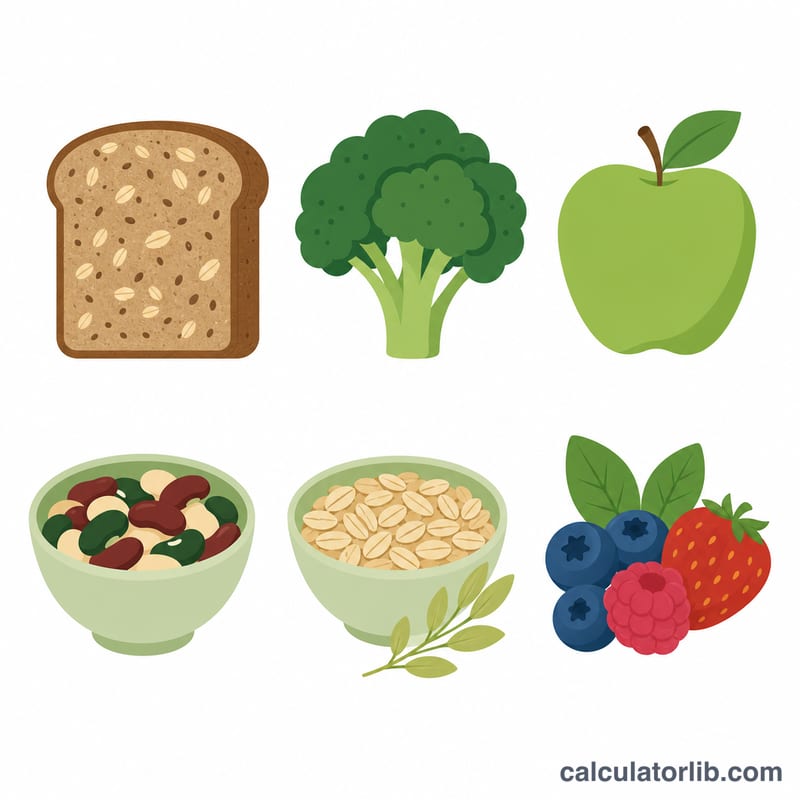
- Soluble vs. insoluble fiber. Soluble fiber dissolves in water to form a gel-like material and is found in foods such as oats, beans, lentils, apples and citrus fruit. Insoluble fiber does not dissolve and adds bulk; it is found in foods such as whole wheat, wheat bran, nuts and the skins of many vegetables. Most plant foods contain both types in varying proportions.
- Total dietary fiber from food. The guideline refers to total dietary fiber from foods. It is not a target for isolated or supplemental fiber products.
This is general information, not medical advice. For questions about your own diet or health, consult a doctor or registered dietitian.
FAQ
Is more fiber always better? Up to a point. Most adults fall short of recommendations, but very high intakes increase water needs and can cause bloating if added too quickly.
How should I increase fiber? Gradually, over a few weeks, while drinking plenty of water. Focus on whole grains, beans, fruits, vegetables, nuts, and seeds.
Does this replace medical advice? No. This is a general estimate. People with digestive conditions should consult a doctor or dietitian for personalized targets.