What This Calculator Does
This tool computes the average flow velocity of a fluid moving through a round pipe when you know the volumetric flow rate in U.S. gallons per minute (GPM) and the inside diameter of the pipe in inches. Velocity is essential for sizing pipes, avoiding erosion or water hammer, and checking that a system stays within recommended speed limits (typically 5–8 ft/s for water).
How to Use It
Enter the flow rate in GPM and the inside pipe diameter in inches, then read the velocity in feet per second (with a metric m/s equivalent). Use the inside diameter, not the nominal pipe size, for accurate results.
The Formula Explained
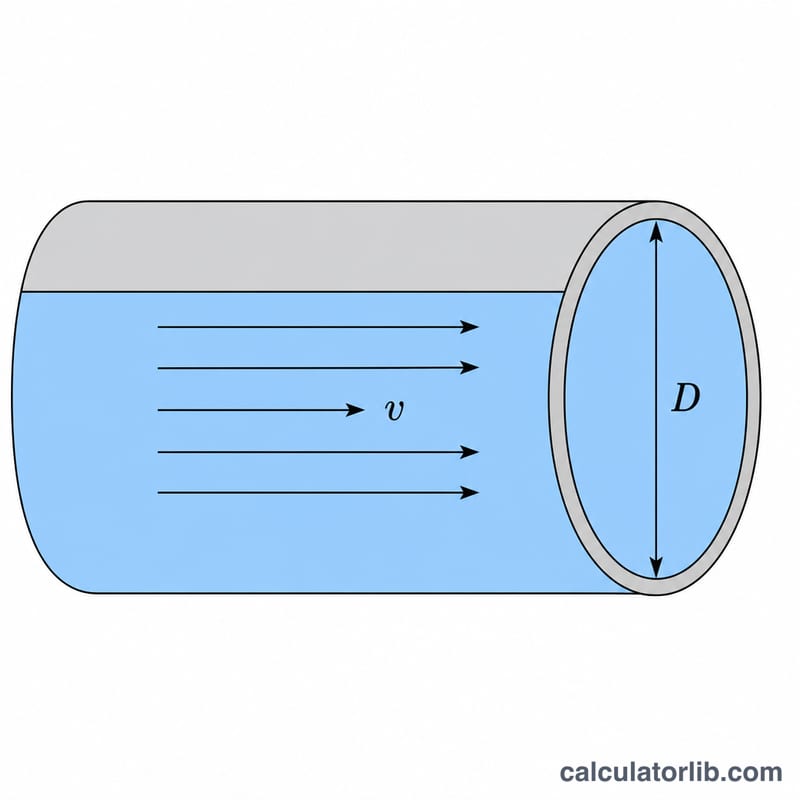
Velocity is flow rate divided by cross-sectional area: $$v = \frac{Q}{\frac{\pi}{4} \cdot D^{2}}$$ To keep units consistent, GPM is converted to cubic feet per second (1 gallon = 0.13368 ft³, divided by 60 seconds), and the diameter is converted from inches to feet (÷12). The area of a circle is \(\frac{\pi}{4} \cdot D^{2}\). Dividing flow by area gives velocity in ft/s.
Worked Example
For 50 GPM in a 2-inch pipe: $$Q = 50 \times \frac{0.13368}{60} = 0.11140 \text{ ft}^3/\text{s}$$ Diameter = \(2/12 = 0.16667\) ft, so area $$A = \frac{\pi}{4} \times 0.16667^{2} = 0.021817 \text{ ft}^2$$ Velocity $$v = \frac{0.11140}{0.021817} \approx \mathbf{5.11 \text{ ft/s}}$$ (about 1.56 m/s).
Typical Recommended Water Velocity Ranges
The velocities below are commonly cited engineering rules of thumb for water in full pipes. They are not legal limits. Actual limits depend on the governing plumbing or process code, the pipe material, the water temperature, noise and erosion concerns, and manufacturer guidance. Always confirm against the standard that applies to your project.
| Service / Condition | Typical velocity (ft/s) | Typical velocity (m/s) |
|---|---|---|
| Pump suction lines | 2–4 | 0.6–1.2 |
| Pump discharge / process lines | 4–8 | 1.2–2.4 |
| Building / domestic supply (general) | 4–8 | 1.2–2.4 |
| Copper tubing, cold water (often recommended) | about 5–6 | about 1.5–1.8 |
| Common upper cap for domestic piping | about 8 | about 2.4 |
| Gravity drain / return lines | 2–4 | 0.6–1.2 |
| Minimum to limit sediment settling | about 2–3 | about 0.6–0.9 |
Velocities well above these ranges can cause noise, erosion-corrosion (especially in copper and with hot water), and water hammer. Very low velocities can allow solids to settle. Metric values are converted at 1 ft/s = 0.3048 m/s.
Common Pipe Inside Diameters by Nominal Size
The calculator needs the actual inside diameter, not the nominal size. The table lists widely published values for Schedule 40 steel and PVC pipe (ASTM/ANSI dimensions used in the US) and for Type L copper tube.
| Nominal size | Schedule 40 steel/PVC ID (in) | Type L copper ID (in) |
|---|---|---|
| 1/2" | 0.622 | 0.545 |
| 3/4" | 0.824 | 0.785 |
| 1" | 1.049 | 1.025 |
| 1-1/4" | 1.380 | — |
| 1-1/2" | 1.610 | — |
| 2" | 2.067 | — |
| 2-1/2" | 2.469 | — |
| 3" | 3.068 | — |
| 4" | 4.026 | — |
| 6" | 6.065 | — |
Actual inside diameters change with schedule, wall thickness, and material (for example Schedule 80, SDR-rated PVC/HDPE, or copper Type K/M). Confirm the ID with the manufacturer's data sheet before relying on a velocity result.
Velocity Comparison for Common Flow Rates and Pipe Sizes
Velocities below use the equivalent form of the formula, \(v = 0.4085 \cdot \text{GPM} / D^2\), with \(D\) the inside diameter in inches and \(v\) in ft/s. Schedule 40 inside diameters are used: 1" = 1.049 in, 1-1/2" = 1.610 in, 2" = 2.067 in, 3" = 3.068 in.
Example: 50 GPM in 2" Schedule 40 pipe gives \(v = 0.4085 \times 50 / 2.067^2 = 20.425 / 4.2725 \approx\) 4.78 ft/s.
| Flow (GPM) | 1" (1.049 in) | 1-1/2" (1.610 in) | 2" (2.067 in) | 3" (3.068 in) |
|---|---|---|---|---|
| 10 | 3.71 | 1.58 | 0.96 | 0.43 |
| 25 | 9.28 | 3.94 | 2.39 | 1.08 |
| 50 | 18.56 | 7.88 | 4.78 | 2.17 |
| 100 | 37.12 | 15.76 | 9.56 | 4.34 |
Velocity scales with \(1/D^2\), so doubling the diameter cuts velocity to one quarter. Values above about 8 ft/s, such as 25 GPM in 1" pipe, usually exceed common design guidance for water, while very low values may fall below the roughly 2–3 ft/s often used to keep solids moving.
FAQ
Should I use nominal or actual diameter? Always use the actual inside diameter, which is smaller than the nominal size for most pipe schedules.
What velocity is too high? For water, keep velocity under roughly 5–8 ft/s on supply lines to limit noise, erosion, and pressure loss.
Does this work for any liquid? Yes — velocity depends only on flow rate and area, so the same formula applies to any liquid, though pressure-loss behavior differs by viscosity.