What this calculator does
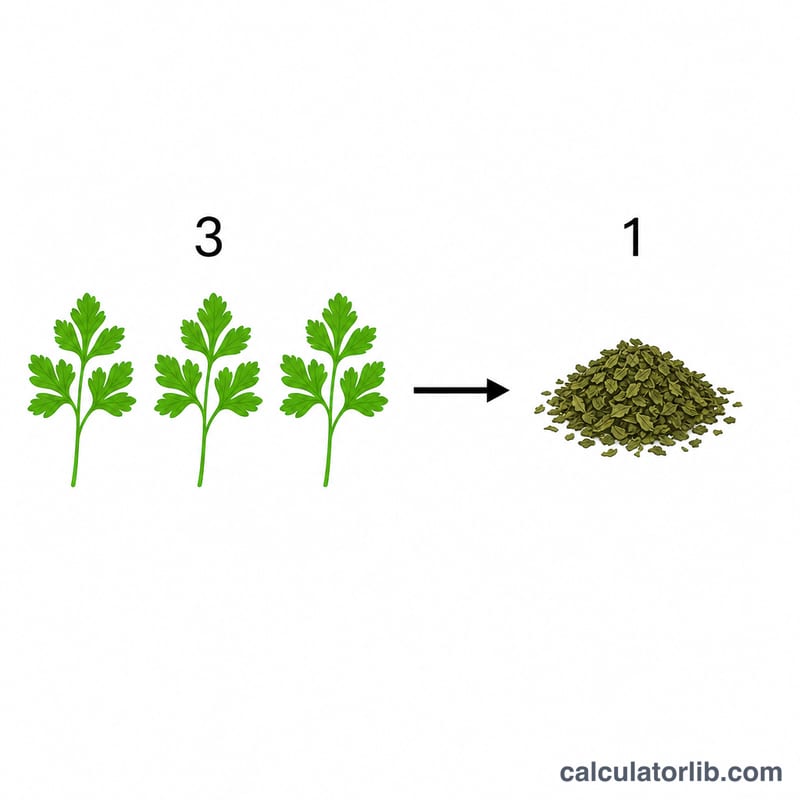
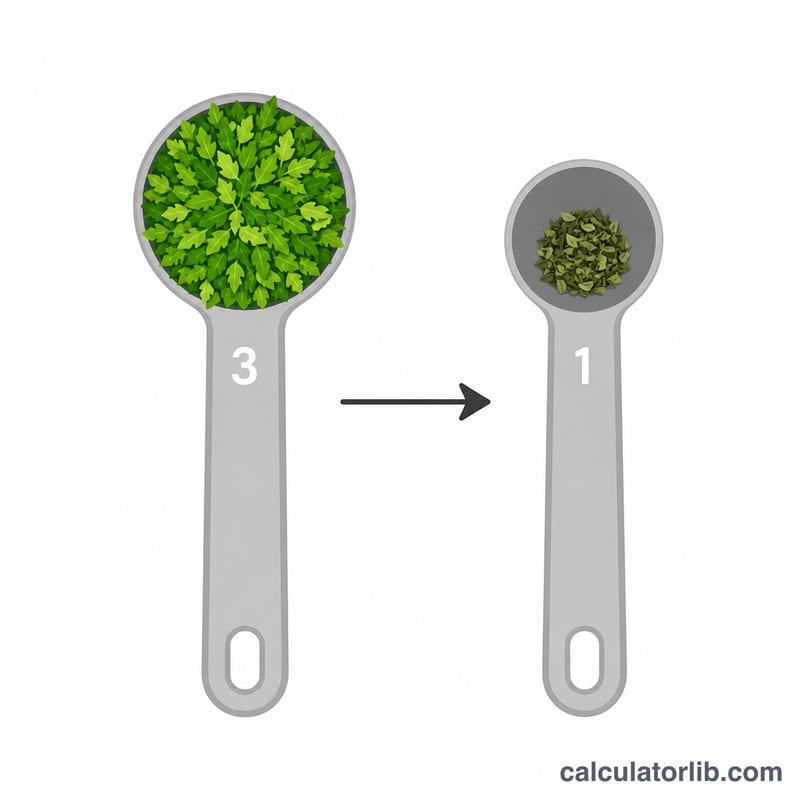
Recipes often list fresh herbs while your pantry only has the dried version (or vice versa). Because drying removes water and concentrates flavor, dried herbs are far more potent than the same volume of fresh. This calculator applies the widely used culinary rule of thumb — a 3:1 ratio — to tell you how much dried herb to use in place of fresh.
How to use it
Enter the amount of fresh herb your recipe calls for, choose a unit (tablespoons, teaspoons, cups, or grams), and read off the dried equivalent. The result tells you roughly how much dried herb to substitute so the seasoning strength stays the same.
The formula
The conversion is simply:
$$\text{Dried Amount} = \frac{\text{Fresh Amount}}{3}$$This reflects the common kitchen guideline that 1 part dried herb has about the same flavor intensity as 3 parts fresh herb. It works in either direction: to go from dried back to fresh, multiply by 3.
Worked example
Suppose a recipe asks for 3 tablespoons of fresh basil but you only have dried. Divide: \(3 \div 3 = 1\). So you would use about 1 tablespoon of dried basil. For 6 teaspoons of fresh thyme, \(6 \div 3 = 2\) teaspoons of dried thyme.
Fresh to Dried Herb Quick Conversion Table
The standard rule of thumb is a 3:1 ratio: three parts fresh herb equals one part dried herb, because drying concentrates flavor. Divide the fresh amount by 3 to get the dried amount. Use the same unit on both sides. Since 1 tbsp = 3 tsp and 1 cup = 16 tbsp = 48 tsp, you can also convert to teaspoons when that is easier to measure.
| Fresh amount | Dried (same unit) | Dried in teaspoons / tablespoons |
|---|---|---|
| 1 tsp | 1/3 tsp | about 1/3 tsp (a generous pinch) |
| 1 tbsp (3 tsp) | 1/3 tbsp | 1 tsp |
| 2 tbsp (6 tsp) | 2/3 tbsp | 2 tsp |
| 3 tbsp (9 tsp) | 1 tbsp | 1 tbsp (3 tsp) |
| 1/4 cup (4 tbsp = 12 tsp) | 1/12 cup | 1 tbsp + 1 tsp (4 tsp) |
| 1/2 cup (8 tbsp = 24 tsp) | 1/6 cup | 2 tbsp + 2 tsp (8 tsp) |
| 1 cup (16 tbsp = 48 tsp) | 1/3 cup | 5 tbsp + 1 tsp (16 tsp) |
Going the other way, multiply the dried amount by 3 to find the fresh equivalent. Chopped fresh herbs are measured loosely packed, so treat these figures as a starting point and adjust to taste.
Herb-by-Herb Substitution Guide
These are general culinary guidelines, not exact values. Potency varies with the herb's age, how it was dried, and the brand. Start with the 3:1 ratio, then taste and adjust.
| Type | Herb | Starting ratio (fresh : dried) | Adjustment and timing notes |
|---|---|---|---|
| Delicate / soft herbs | Basil | 3:1 | Dried basil is much milder and less bright. Add a little extra if needed, and stir in late. Fresh is best as a finishing herb. |
| Parsley | 3:1 | Dried parsley has very little flavor, so you may want a touch more. It is often used mainly for color. | |
| Cilantro | 3:1 | Loses most of its character when dried. Use fresh if you can, or add a bit more dried. | |
| Chives | 3:1 | Dried chives are mild, so a touch more is often needed. Sprinkle on near the end. | |
| Dill | 3:1 | Dried dill weed works well in dips, sauces and soups. Add toward the end of cooking, and a little extra is fine. | |
| Mint | 3:1 | Works well in teas and sauces. Fresh mint is better for garnish and for salads. | |
| Tarragon | 3:1 | Fairly good dried but less aromatic. Add near the end and taste before adding more. | |
| Robust / woody herbs | Oregano | 3:1 | Dried oregano is potent and often preferred. Add early so it can bloom in the cooking liquid. |
| Thyme | 3:1 | Dries well. Add early in soups, stews and roasts. | |
| Rosemary | 3:1 | Very strong. Start with a little less than the ratio suggests, and crush or chop dried needles finely. | |
| Sage | 3:1 | Dried sage is concentrated and can overpower. Start with a little less and add gradually. | |
| Marjoram | 3:1 | Similar to oregano but gentler. The ratio usually works as is. Add early to mid-cooking. |
When to add them: Dried herbs need time and moisture to release flavor, so add them early in cooking. Fresh herbs, especially the delicate ones, lose flavor with long heat, so add them near the end or as a garnish. Store dried herbs away from heat and light, and replace them when they lose their aroma, since old herbs are weaker than this ratio assumes.
FAQ
Is the 3:1 ratio exact? No — it is a practical estimate. Some delicate herbs (parsley, chives) lose more flavor when dried, so you may want a little extra; robust herbs (oregano, rosemary) are very strong dried, so start with slightly less and taste.
Can I convert dried to fresh? Yes. Reverse the math by multiplying the dried amount by 3.
Does it work with weights? The ratio is volume-based, but it is a reasonable starting point for grams too. Always taste and adjust.