What the Heat Index Calculator Does
The heat index (or "feels-like" temperature) tells you how hot it actually feels to the human body when humidity is combined with the air temperature. When the air is humid, sweat evaporates more slowly, so your body cools less efficiently and the heat feels more intense than the thermometer suggests. This calculator uses the standard formula adopted by the US National Weather Service to convert the raw temperature and humidity into a single feels-like figure, and it works in both Fahrenheit and Celsius.
How to Use It
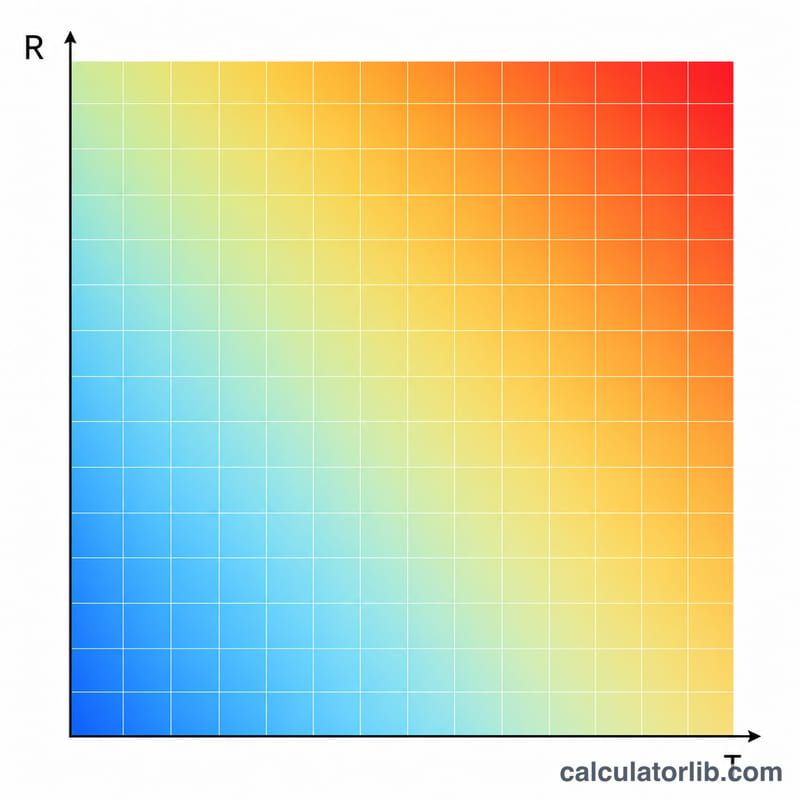
- Temperature – Enter the current air temperature.
- Relative Humidity (%) – Enter the humidity as a percentage (0–100).
- Temperature Unit – Choose Fahrenheit or Celsius. The calculator converts internally and returns the result in the same unit you selected.
The result is your heat index plus a risk category: Comfortable, Caution, Extreme Caution, Danger, or Extreme Danger, with a short note on what that means for outdoor activity.
The Formula Explained
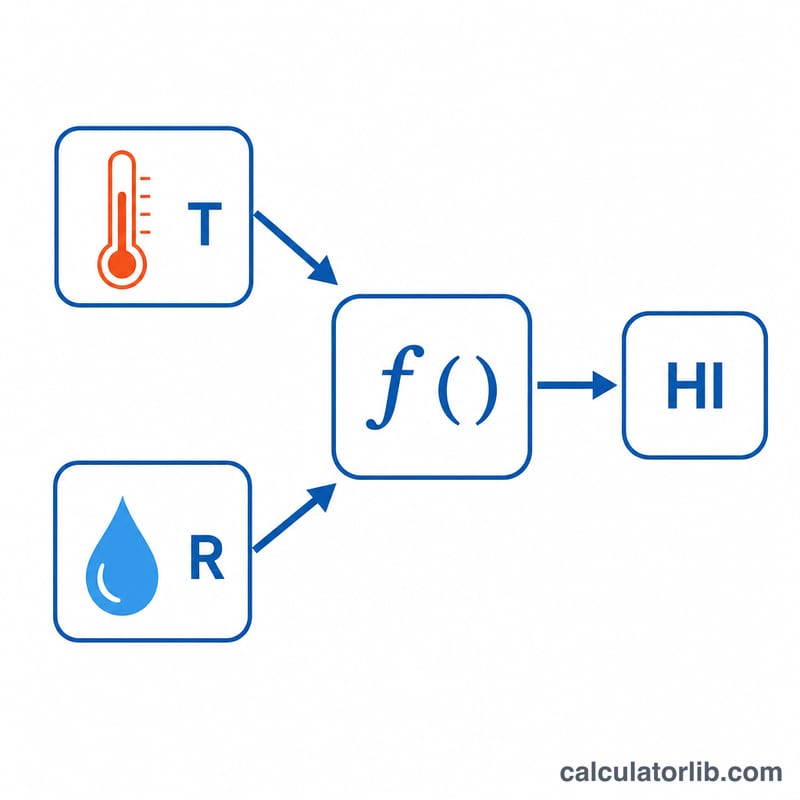
The tool first converts your temperature to Fahrenheit if you entered Celsius, then follows the NWS procedure: a simple Steadman-based estimate is computed first, and only if it is 80°F or higher is the Rothfusz regression equation below applied (with small NWS corrections for very dry or very humid air):
$$\begin{gathered} \text{HI} = -42.379 + 2.04901523\,T + 10.14333127\,\text{RH} - 0.22475541\,T\cdot\text{RH} - 0.00683783\,T^2 \\ -\,0.05481717\,\text{RH}^2 + 0.00122874\,T^2\cdot\text{RH} + 0.00085282\,T\cdot\text{RH}^2 - 0.00000199\,T^2\cdot\text{RH}^2 \end{gathered}$$Here \(T\) is temperature in °F and \(\text{RH}\) is relative humidity in percent. If you chose Celsius, the final result is converted back to °C. The category is determined from the Fahrenheit value: under 80°F is Comfortable, 80–89°F Caution, 90–102°F Extreme Caution, 103–124°F Danger, and 125°F or above Extreme Danger.
Worked Example
Suppose it is 90°F with 70% relative humidity. Plugging these into the equation gives a heat index of roughly 106°F — that's in the "Danger" range, even though the thermometer only reads 90°F. The extra 16 degrees of perceived heat comes entirely from the high humidity slowing your body's evaporative cooling. The calculator would flag this and advise limiting strenuous outdoor activity.
Interpreting Your Heat Index Result
The heat index answers one question: how hot do these conditions feel to a typical person, given that humid air slows the evaporation of sweat? A result of 105°F does not mean the thermometer reads 105°F — it means the body's ability to shed heat is roughly what it would be at 105°F in dry, shaded conditions.
What each NOAA/NWS band means
- Caution — 80 to 90°F (27 to 32°C): fatigue is possible with prolonged exposure and physical activity.
- Extreme Caution — 90 to 103°F (32 to 39°C): heat cramps and heat exhaustion are possible with prolonged exposure and physical activity.
- Danger — 103 to 124°F (39 to 51°C): heat cramps and heat exhaustion are likely, and heatstroke is possible with continued activity.
- Extreme Danger — 125°F (52°C) and above: heatstroke is highly likely.
A worked reading
Suppose the air temperature is 95°F with 60% relative humidity. Substituting \(T = 95\) and \(R = 60\) into the Rothfusz regression gives:
$$\text{HI} \approx -42.379 + 194.66 + 608.60 - 1281.11 - 61.71 - 197.34 + 665.36 + 291.66 - 64.66$$which totals a heat index of about 113°F (about 45°C). The air is 95°F, but the humidity pushes the apparent temperature 18°F higher and moves the reading firmly into the Danger band.
Important limits on the number
- The values assume shade and light wind. Direct full sunshine can raise the effective heat index by up to about 15°F (8°C). If you are working or exercising in open sun, treat your result as an underestimate.
- Strong wind is not free relief. Moving air normally helps evaporation, but when air temperature exceeds skin temperature, hot wind can add heat rather than remove it.
- It is a general-population estimate. The underlying model is built on assumptions about a typical adult of average build, wearing light clothing, at a moderate activity level. It is not a measure of any specific person's risk. Age, fitness, acclimatisation to heat, medications, chronic illness, pregnancy, hydration and clothing all shift real risk substantially — in both directions.
- It is not an occupational exposure standard. Workplace heat rules in many countries are written around wet-bulb globe temperature (WBGT), not the heat index.
For decisions about whether it is safe to be outdoors, follow the official heat advisories, heat warnings and excessive-heat alerts issued by your own national or regional weather service — those account for local climate, acclimatisation and duration in ways a single index value cannot. This section is general information, not medical advice; if you have a health condition affected by heat, or you are concerned about your personal risk or symptoms, speak with a qualified clinician, and treat suspected heatstroke as an emergency requiring immediate medical help.
Key Terms and Variables
| Term | Symbol / unit | Meaning |
|---|---|---|
| Air temperature (dry-bulb temperature) | \(T\); °F or °C | The temperature of the air measured by a shaded, dry, ventilated thermometer — the ordinary "temperature" in a forecast. This calculator accepts it in either unit and converts to °F internally, because the regression is defined in Fahrenheit. |
| Relative humidity | \(R\) or RH; % | The amount of water vapour in the air expressed as a percentage of the maximum the air could hold at that temperature. 100% means the air is saturated and sweat evaporates very slowly. |
| Dew point | °F or °C | The temperature to which air must be cooled, at constant pressure, for it to become saturated. Unlike relative humidity it does not change as air temperature rises, so meteorologists often prefer it as a direct measure of mugginess. |
| Wet-bulb temperature | °F or °C | The temperature read by a thermometer wrapped in a wet wick and ventilated — the lowest temperature achievable by evaporation alone. It equals the air temperature at 100% relative humidity. |
| Wet-bulb globe temperature (WBGT) | °F or °C | A composite heat-stress index combining natural wet-bulb temperature, black-globe temperature (solar and radiant heat) and dry-bulb temperature. It is the basis of many military, athletic and occupational heat standards. |
| Heat index / apparent temperature | HI; °F or °C | The temperature that shaded, low-wind air would need to be, at a reference humidity, to feel the same as the actual temperature and humidity combination. It is the output of this calculator. |
| Evaporative cooling | — | The heat removed from the skin as sweat changes from liquid to vapour. It is the body's main defence against heat, and it weakens sharply as humidity rises — the physical reason the heat index exceeds air temperature in muggy conditions. |
| Rothfusz regression | — | A multi-variable polynomial fit published by Lans P. Rothfusz of the US National Weather Service in 1990, which reproduces Steadman's tabulated apparent temperatures from \(T\) and \(R\) alone. It is the formula this calculator implements. |
| Steadman apparent-temperature model | — | The underlying heat-balance model published by R. G. Steadman in 1979, which derives apparent temperature from human physiology — metabolic rate, clothing resistance, skin coverage, ventilation and vapour transfer. The NWS chart is a tabulation of this model. |
How the heat index relates to WBGT and wind chill
- Heat index vs. WBGT. The heat index uses only temperature and humidity, and assumes shade with light wind. WBGT additionally measures solar and radiant heat and wind speed through its globe and natural wet-bulb sensors. That makes WBGT the better tool for outdoor work and sport in direct sun, and it is why occupational guidance (for example from ISO 7243 and from national labour authorities) is usually written in WBGT rather than heat index. The two numbers are not interchangeable — a WBGT value is typically much lower than the heat index for the same conditions.
- Heat index vs. wind chill. Wind chill is the cold-weather analogue: it combines air temperature with wind speed to express how quickly exposed skin loses heat, and it produces a feels-like value below the air temperature. Heat index combines temperature with humidity and produces a value at or above the air temperature. Together they cover the two ends of the human comfort range, and the US National Weather Service issues both under a single "feels like" heading depending on the season.
FAQ
Is the heat index accurate at low temperatures or humidity? The formula is designed for hot, humid conditions (roughly above 80°F). At cooler or very dry conditions it is less meaningful, and the result will simply read close to the actual temperature.
Does the heat index account for sun and wind? No. The standard calculation assumes shade and light wind. Direct sunlight can add up to about 15°F to the perceived temperature, so real-world conditions may feel even hotter.
Why does humidity make heat feel worse? Your body cools by evaporating sweat. High humidity means the air already holds a lot of moisture, so sweat evaporates slowly and you retain more heat — raising the feels-like temperature.