What Is the Horse Age Calculator?
The Horse Age Calculator translates a horse's age into the equivalent number of human years. Horses mature far faster than people in their early life and then settle into a steadier aging rate, so a simple multiplier doesn't capture the relationship well. This tool uses a widely cited staged formula to give a realistic estimate that owners, riders and vets can use to understand where a horse sits in its life stage.
How to Use It
Enter your horse's age in years (half-years are accepted) and the calculator returns the equivalent human age. A foal under one year is scaled most steeply, reflecting how quickly young horses develop physically and behaviourally.
The Formula Explained
The conversion is staged:
• The first year of life counts as 12 human years.
• The second year adds 7 human years (total 19 at age 2).
• Every year beyond the second adds 2.5 human years.
In equation form for a horse older than two:
$$\text{Human} = 12 + 7 + (\text{HorseYears} - 2) \times 2.5$$For horses under one year, the estimate is simply \(\text{HorseYears} \times 12\).
The full staged formula is:
$$\text{Human Age} = \begin{cases} 12 \cdot \text{Horse Age}, & \text{Horse Age} \le 1 \\[0.8em] 12 + 7\left(\text{Horse Age} - 1\right), & 1 < \text{Horse Age} \le 2 \\[0.8em] 19 + 2.5\left(\text{Horse Age} - 2\right), & \text{Horse Age} > 2 \end{cases}$$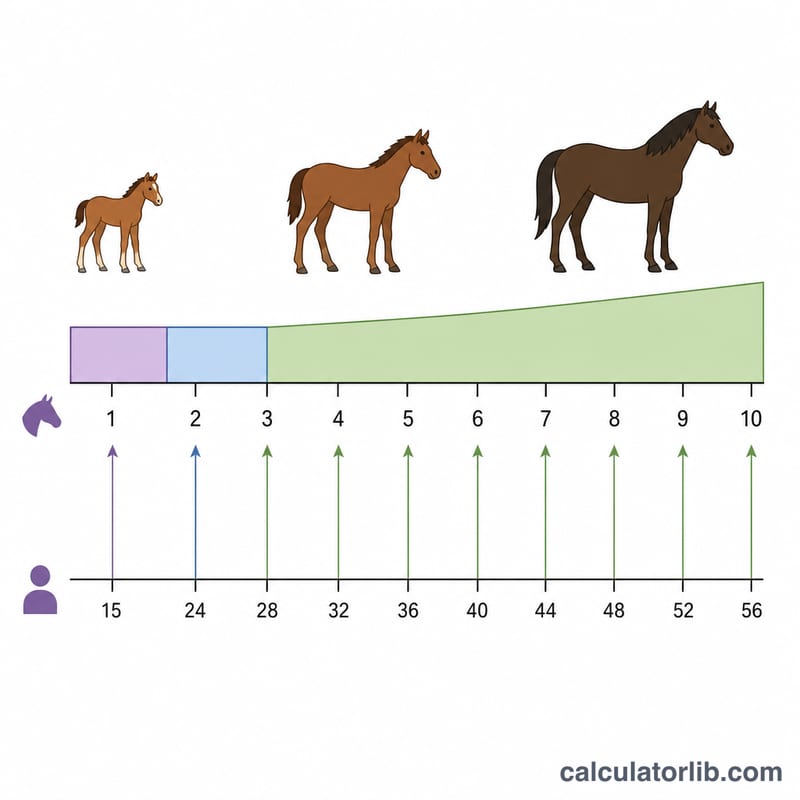
Worked Example
Take a 10-year-old horse. The first two years account for \(12 + 7 = 19\) human years. The remaining 8 years add \(8 \times 2.5 = 20\) human years. Total: \(19 + 20 =\) 39 human years — roughly a horse in solid middle age.
Horse Age to Human Age Chart
This chart uses the common 12/7/2.5 rule of thumb: the first year counts as 12 human years, the second year adds 7 (19 at age 2), and every year after that adds 2.5. It is a popular approximation, not a scientific standard.
| Horse age (years) | Human-age equivalent (years) |
|---|---|
| 1 | 12 |
| 2 | 19 |
| 3 | 21.5 |
| 4 | 24 |
| 5 | 26.5 |
| 6 | 29 |
| 7 | 31.5 |
| 8 | 34 |
| 9 | 36.5 |
| 10 | 39 |
| 11 | 41.5 |
| 12 | 44 |
| 13 | 46.5 |
| 14 | 49 |
| 15 | 51.5 |
| 16 | 54 |
| 17 | 56.5 |
| 18 | 59 |
| 19 | 61.5 |
| 20 | 64 |
| 21 | 66.5 |
| 22 | 69 |
| 23 | 71.5 |
| 24 | 74 |
| 25 | 76.5 |
| 26 | 79 |
| 27 | 81.5 |
| 28 | 84 |
| 29 | 86.5 |
| 30 | 89 |
For ages above 2, the formula is \(19 + 2.5\,(\text{age} - 2)\). Example for a 10-year-old: \(19 + 2.5 \times (10 - 2) = 19 + 20 = 39\).
Interpreting Your Horse's Human-Age Equivalent
Equine life stages are described in general terms, and the human-age equivalents below come from the 12/7/2.5 formula.
| Life stage | Typical horse age | Human-age equivalent |
|---|---|---|
| Foal | Under 1 year | Up to 12 years (12 × horse age; a 6-month-old foal is about 6) |
| Yearling / youngster | 1 to 3 years | 12 to 21.5 years |
| Adult prime | About 5 to 15 years | 26.5 to 51.5 years |
| Senior | About 15 to 20+ years | 51.5 to 64+ years (a 20-year-old is 64) |
Worked example for a horse older than 2: a 7.5-year-old horse gives \(19 + 2.5 \times (7.5 - 2) = 19 + 13.75 = 32.75\) human years.
Ages 3 to 4 sit between youngster and prime, and many horses are still maturing physically and mentally then. Treat all the ranges as approximate.
- Breed, size, workload, genetics, nutrition and dental and hoof care all affect how quickly a horse ages. Ponies and smaller horses often stay sound longer than some large breeds.
- The formula is a simple rule of thumb, so it can overstate or understate how old an individual horse feels.
- A horse in its late teens or twenties may benefit from closer attention to teeth, weight, joints and diet.
This is general information, not veterinary advice. Ask a veterinarian about your horse's health, care and workload.
FAQ
Is this exact? No. Aging varies by breed, size, diet, workload and health. It is a useful approximation, not a medical figure.
At what age is a horse "senior"? Many horses are considered seniors around 15–20 horse years, which corresponds to roughly 51–64 human years here.
Why is the first year worth so much? Foals grow and mature extremely rapidly in their first year, comparable to early human childhood and adolescence combined.