What the Inverse Cosine Calculator Does
This calculator finds the angle whose cosine equals a value you supply. The cosine function takes an angle and returns a ratio between -1 and 1; the inverse cosine (written arccos or cos⁻¹) reverses that process, taking the ratio back to an angle. Enter any number from -1 to 1 and the tool instantly returns the matching angle in both radians and degrees.
How to Use It
- Cosine value (-1 to 1): Type the cosine you want to invert. Valid entries run from -1 up to 1, because cosine never produces a value outside that range.
- Read off the result, which is shown in radians and converted to degrees.
Note that arccos returns the principal value only — an angle between 0 and π radians (0° to 180°). This is the standard mathematical convention.
The Formula Explained
The calculator first computes the angle in radians using Math.acos(x), then converts to degrees:
So the radian result comes straight from the inverse cosine function, and the degree result simply multiplies the radians by \(180/\pi\) (about 57.29578). Both values describe the same angle in different units.
Worked Example
Suppose you enter a cosine value of 0.5:
- \(\arccos(0.5) = 1.047198\) radians
- $$1.047198 \times \left(\frac{180}{\pi}\right) = 60°$$
The calculator reports approximately 1.0472 radians and 60 degrees — the well-known angle whose cosine is exactly one half.
Common Arccos Values Reference Table
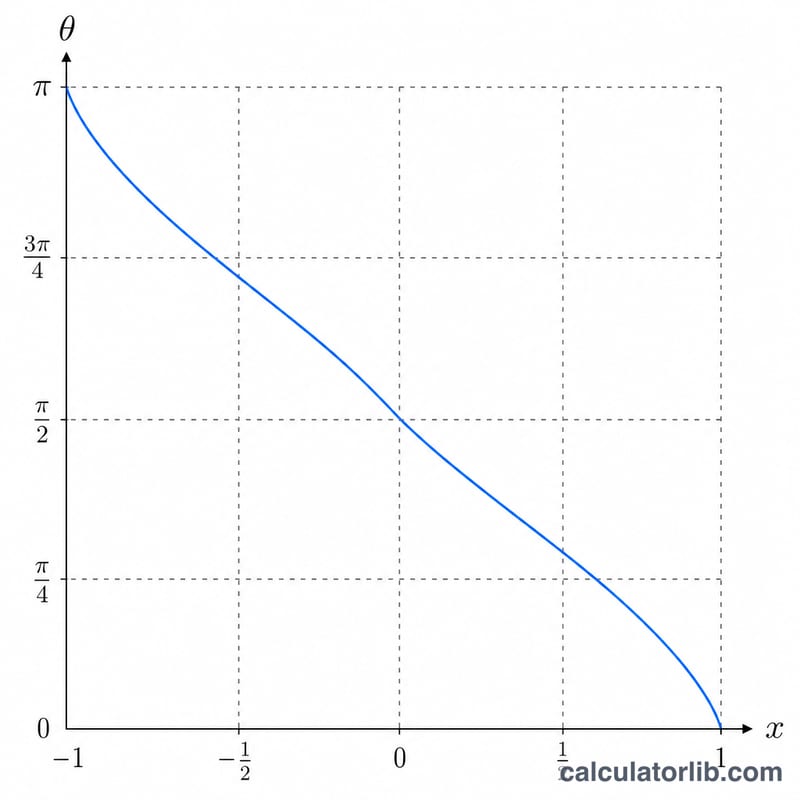
The inverse cosine answers the question: which angle has this cosine? Because the arccos function is restricted to its principal branch, every input \(x\) in the domain \([-1,\,1]\) returns exactly one angle \(\theta\) in \([0,\,\pi]\) radians, i.e. \([0^\circ,\,180^\circ]\). The nine values below are the ones that appear most often in trigonometry, geometry and physics coursework because their cosines are the "special angle" ratios of the 30-60-90 and 45-45-90 triangles.
| Cosine value \(x\) (exact) | \(x\) (decimal) | \(\arccos(x)\) (exact radians) | Radians (decimal) | Degrees |
|---|---|---|---|---|
| \(-1\) | −1 | \(\pi\) | 3.1416 | 180° |
| \(-\frac{\sqrt{3} }{2}\) | −0.866025 | \(\frac{5\pi}{6}\) | 2.6180 | 150° |
| \(-\frac{\sqrt{2} }{2}\) | −0.707107 | \(\frac{3\pi}{4}\) | 2.3562 | 135° |
| \(-\frac{1}{2}\) | −0.5 | \(\frac{2\pi}{3}\) | 2.0944 | 120° |
| \(0\) | 0 | \(\frac{\pi}{2}\) | 1.5708 | 90° |
| \(\frac{1}{2}\) | 0.5 | \(\frac{\pi}{3}\) | 1.0472 | 60° |
| \(\frac{\sqrt{2} }{2}\) | 0.707107 | \(\frac{\pi}{4}\) | 0.7854 | 45° |
| \(\frac{\sqrt{3} }{2}\) | 0.866025 | \(\frac{\pi}{6}\) | 0.5236 | 30° |
| \(1\) | 1 | \(0\) | 0.0000 | 0° |
How to read the table. The exact radian column is exact — \(\arccos(0.5)\) is \(\pi/3\), with no rounding whatsoever, and the degree column is exact as well (60° is not an approximation). Only the two decimal columns are rounded: the decimal cosine values are shown to six decimal places and the decimal radians to four. If you type a rounded decimal such as 0.866025 into the calculator instead of the exact \(\sqrt{3}/2\), the answer will be 30° to within a few millionths of a degree, not exactly 30°.
Two useful patterns. First, the table is symmetric about \(x = 0\): flipping the sign of the input reflects the angle about 90°, because \(\arccos(-x) = \pi - \arccos(x)\). So \(\arccos(-0.5) = 180^\circ - 60^\circ = 120^\circ\). Second, arccos is strictly decreasing — larger cosine values give smaller angles — which is why the degree column runs from 180° down to 0° as \(x\) climbs from −1 to 1. Any input outside \([-1,\,1]\) has no real arccos at all, since no real angle has a cosine greater than 1 or less than −1.
Key Terms and Notation
The vocabulary around inverse trigonometric functions is where most errors start. These definitions use the standard conventions of modern mathematics, which are the same worldwide; where a convention genuinely varies, it is flagged.
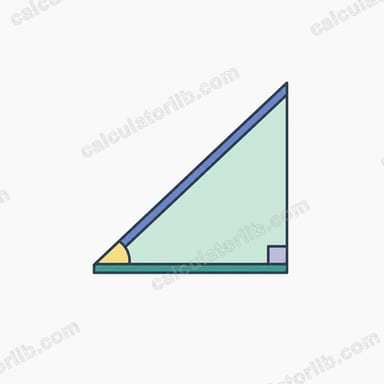
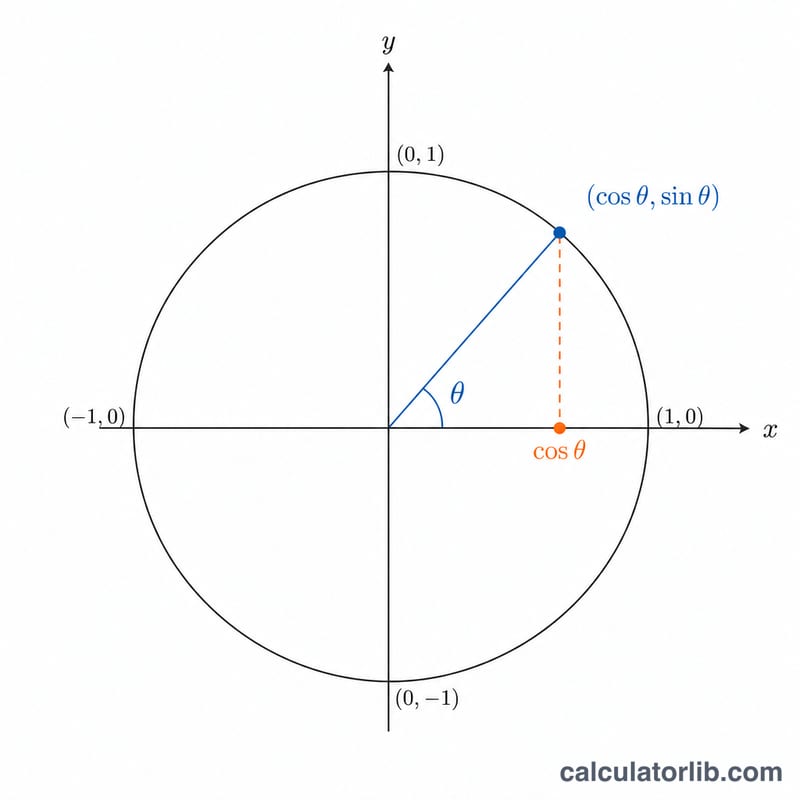
- Cosine (\(\cos\theta\)) — For an acute angle in a right triangle, the ratio of the length of the side adjacent to the angle to the length of the hypotenuse. More generally, for any angle, the \(x\)-coordinate of the corresponding point on the unit circle. Its output always lies in \([-1,\,1]\).
- Adjacent / hypotenuse ratio — The right-triangle definition \(\cos\theta = \frac{\text{adjacent} }{\text{hypotenuse} }\). Since the hypotenuse is the longest side, this ratio can never exceed 1, which is exactly why the arccos domain stops at ±1.
- Arccos, \(\cos^{-1}\), inverse cosine — The function that undoes cosine: if \(\cos\theta = x\) with \(\theta\) in the principal range, then \(\arccos(x) = \theta\). All three names mean the same thing.
- Warning: \(\cos^{-1}x \neq \dfrac{1}{\cos x}\) — The superscript −1 here denotes function inversion, not a reciprocal power. The reciprocal of cosine is the secant, \(\sec x = 1/\cos x\), a completely different function. For example \(\cos^{-1}(0.5) = 60^\circ\), whereas \(1/\cos(0.5\ \text{rad}) \approx 1.1395\). Writing \(\arccos\) avoids the ambiguity entirely.
- Domain \([-1,\,1]\) — The set of legal inputs. Entering 1.5 or −2 produces no real answer (calculators typically report a domain error), because no real angle has such a cosine. Values slightly outside the range, like 1.0000001, usually come from rounding in an earlier step.
- Range \([0^\circ,\,180^\circ]\) — The set of possible outputs, equivalently \([0,\,\pi]\) radians. Arccos never returns a negative angle and never returns an angle above 180°.
- Principal value / principal branch — Infinitely many angles share the same cosine (for instance 60°, −60°, 300° and 420° all have cosine 0.5). To be a genuine function, arccos must return just one; the agreed choice is the one in \([0,\,\pi]\), called the principal value. The full solution set for \(\cos\theta = x\) is \(\theta = \pm\arccos(x) + 360^\circ k\) for any integer \(k\) — worth remembering when solving equations, since a calculator shows you only one of those solutions.
- Radian — The SI unit of plane angle: the angle subtending an arc equal in length to the radius. A full turn is \(2\pi\) radians, so \(180^\circ = \pi\) rad and 1 rad ≈ 57.2958°. Calculus formulas such as \(\frac{d}{dx}\sin x = \cos x\) hold only in radians.
- Degree — The everyday angle unit, one 360th of a full turn. Convert with \(\text{degrees} = \text{radians} \times \frac{180}{\pi}\).
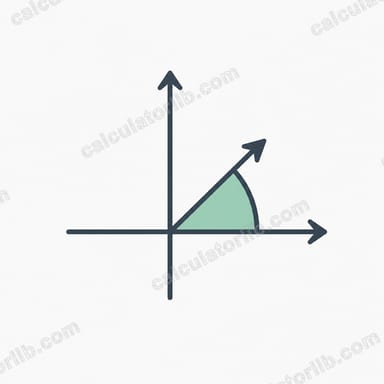
- Unit circle — The circle of radius 1 centred at the origin. A point on it at angle \(\theta\) from the positive \(x\)-axis has coordinates \((\cos\theta,\ \sin\theta)\). Arccos reads this backwards: given the \(x\)-coordinate, it returns the angle on the upper half of the circle.
- Complementary identity — For every \(x\) in \([-1,\,1]\), $$\arcsin(x) + \arccos(x) = \frac{\pi}{2} = 90^\circ.$$ For example, \(\arcsin(0.5) = 30^\circ\) and \(\arccos(0.5) = 60^\circ\), and \(30^\circ + 60^\circ = 90^\circ\). This is a fast way to check an inverse-cosine result, or to obtain one function's value from the other.
One practical note on calculator settings: a device or software library in radian mode returns 1.0472 for \(\arccos(0.5)\) while degree mode returns 60 — the same angle in different units. Most programming languages (C, Python's math module, JavaScript's Math.acos) return radians only, so convert explicitly if you need degrees.
Conventions and edge cases
Each case below was run through this calculator; the result column is what it actually returns.
| Case | Input | Result |
|---|---|---|
| Input 0.5 | 0.5 | 60° |
| Input 2 (outside −1 to 1) | 2 | Arccos is only defined for values between -1 and 1. |
Checked on 2026-11-08
Frequently Asked Questions
Why must the input stay between -1 and 1? Cosine of any real angle always falls within this range, so there is no real angle with a cosine of, say, 1.5. Values outside -1 to 1 have no valid inverse cosine.
Why is the answer always between 0° and 180°? Many angles share the same cosine, so to give a single, unambiguous result arccos returns the principal value in the range 0° to 180° (0 to π radians).
How do I convert the result back to radians or degrees myself? Multiply radians by \(180/\pi\) to get degrees, or multiply degrees by \(\pi/180\) to get radians. The calculator does both conversions for you.