What Is the Normal Force?
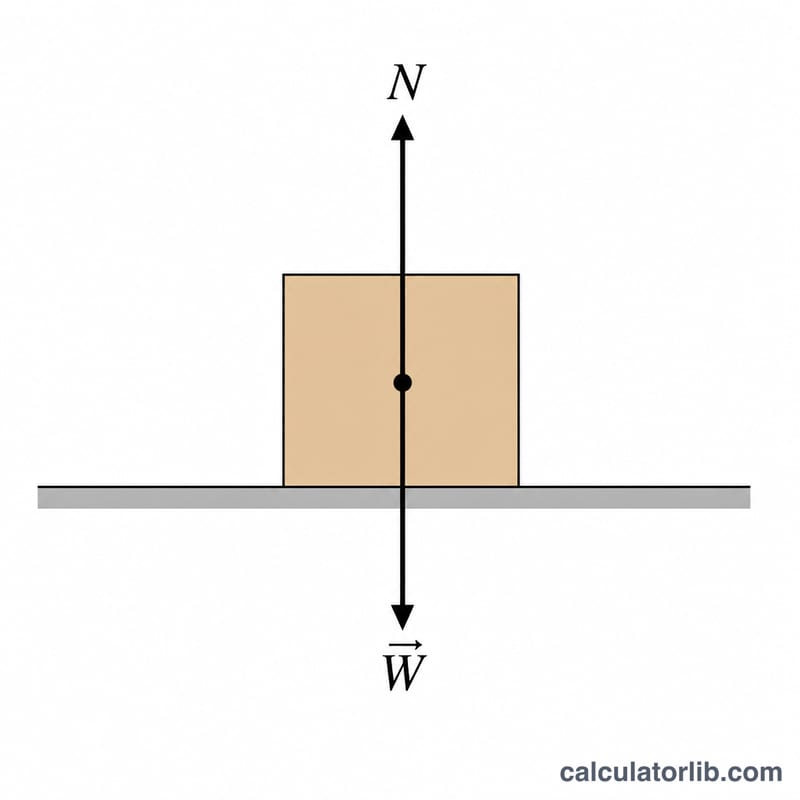
The normal force is the support force exerted by a surface perpendicular to the object resting on it. It is what prevents an object from falling through the floor or sliding ground. On a horizontal surface the normal force balances the full weight of the object, but on an inclined surface only the component of weight perpendicular to the surface must be supported, so the normal force is smaller.
How to Use This Calculator
Enter the object's mass in kilograms, the gravitational acceleration (9.81 m/s² on Earth), and the incline angle in degrees measured from the horizontal. For a flat surface, leave the angle at 0. The calculator returns the normal force in newtons along with the object's weight for comparison.
The Formula Explained
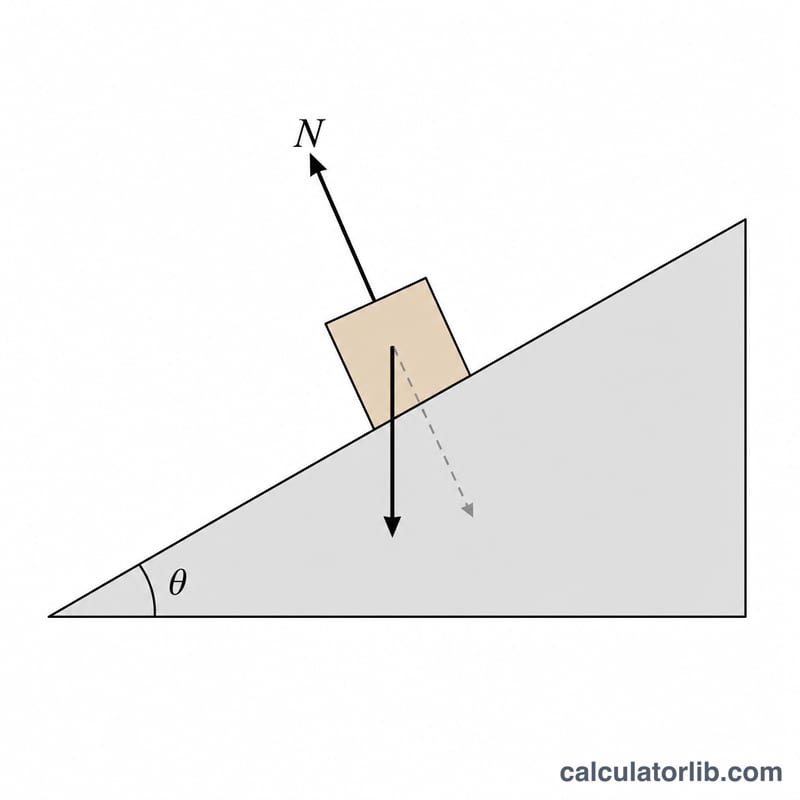
The normal force on an incline is $$N = m \cdot g \cdot \cos\!\left(\theta\right)$$, where \(m\) is mass, \(g\) is gravitational acceleration, and \(\theta\) is the incline angle. The weight of the object is \(m \cdot g\), acting straight down. Splitting that weight into components parallel and perpendicular to the slope, the perpendicular component is \(m \cdot g \cdot \cos(\theta)\) — this is what the surface must push back against. When \(\theta = 0\), \(\cos(0) = 1\) and the formula reduces to \(N = m \cdot g\).
Worked Example
A 10 kg box sits on a ramp inclined at 30° with g = 9.81 m/s². The weight is \(10 \times 9.81 = 98.1\) N. The normal force is $$98.1 \times \cos(30°) = 98.1 \times 0.8660 \approx 84.96 \text{ N}.$$ Because the surface is tilted, the normal force is less than the full 98.1 N weight.
Gravitational Acceleration Values (g)
The normal force calculator needs a value for g, the gravitational acceleration at the surface of the body you are on. Typical surface values are listed below.
| Body | g (m/s²) | Notes |
|---|---|---|
| Earth (standard) | 9.80665 | Defined standard value; commonly rounded to 9.81 |
| Moon | ≈ 1.62 | About 1/6 of Earth's |
| Mars | ≈ 3.71 | Mean surface value |
| Venus | ≈ 8.87 | Close to Earth's |
| Jupiter | ≈ 24.79 | Measured at the 1-bar cloud-top level, since there is no solid surface |
| Sun | ≈ 274 | At the visible surface (photosphere) |
All values are in metres per second squared (m/s²). On Earth, g varies slightly with latitude and altitude: it is a little higher near the poles (about 9.83 m/s²) and a little lower at the equator (about 9.78 m/s²), and it decreases as you gain altitude. For most everyday problems, 9.81 m/s² is accurate enough.
Interpreting Your Result
The normal force N is the contact force exerted by a surface on an object, directed perpendicular to that surface. It is measured in newtons (N) when mass is in kg and g is in m/s². The calculator uses \(N = m \cdot g \cdot \cos\theta\), with the angle θ measured in degrees between the surface and the horizontal.
- N is less than the weight on a slope. The weight \(mg\) acts straight down, but only the component perpendicular to the surface, \(mg\cos\theta\), is balanced by N. On a flat surface (θ = 0°), \(\cos 0^\circ = 1\), so N equals the weight.
- N = 0 at 90°. Since \(\cos 90^\circ = 0\), a perfectly vertical surface provides no normal force from the object's weight, and the object is not pressed against the surface.
- Friction depends on N. The maximum static friction is \(f_{s,\max} = \mu_s N\), and kinetic friction is \(f_k = \mu_k N\). A smaller N on a steeper slope means less available friction, which is why objects slide more easily as the angle increases.
- Assumptions. The formula assumes the only vertical load is the object's own weight, with no acceleration perpendicular to the surface. A push or pull with a component perpendicular to the surface, a lift or elevator accelerating, or any extra applied load will change N, and you would need a full force balance instead.
Example: a 10 kg block on a 30° incline with g = 9.81 m/s² gives \(N = 10 \cdot 9.81 \cdot \cos 30^\circ = 98.1 \cdot 0.8660 \approx\) 84.96 N, compared with a weight of 98.1 N.
FAQ
Does the normal force always equal weight? Only on a horizontal surface with no additional vertical forces. On an incline it is reduced by \(\cos(\theta)\).
What unit is the result in? Newtons (N), the SI unit of force.
What angle should I use for a flat floor? Use 0 degrees, which gives \(N = m \cdot g\).