What This Proportion Calculator Does
A proportion is a statement that two ratios are equal, written as a:b = c:d. This calculator solves that equation for whichever term you don't know. You supply any three of the four values — a, b, c, and d — and the tool finds the missing fourth so the two ratios match exactly. It's handy for scaling recipes, converting units, resizing images, working out map distances, and solving cross-multiplication problems in homework.
How to Use It
- Enter values for any three of the four fields: a, b, c, or d.
- Leave the field you want to solve for blank.
- The calculator detects the empty term and returns its value instantly.
For example, to solve 2:4 = 3:x, enter a = 2, b = 4, c = 3, and leave d blank.
The Formula
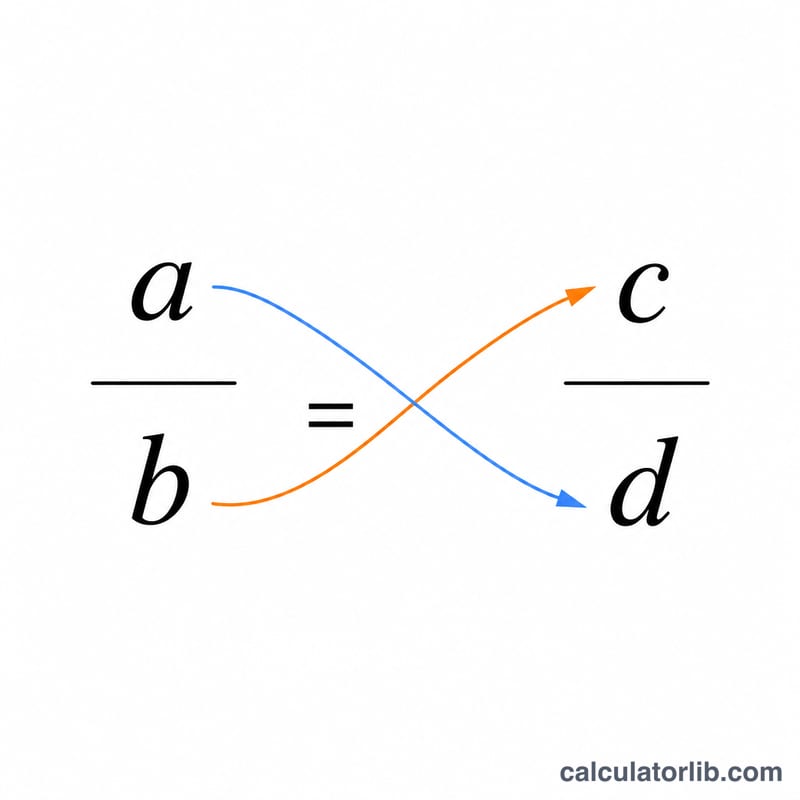
The calculator relies on cross-multiplication. Because a:b = c:d means a × d = b × c, each unknown is found by rearranging that single rule:
$$\frac{\text{A}}{\text{B}} = \frac{\text{C}}{\text{D}}$$- Solve for a: \(\text{A} = \frac{\text{B} \times \text{C}}{\text{D}}\)
- Solve for b: \(\text{B} = \frac{\text{A} \times \text{D}}{\text{C}}\)
- Solve for c: \(\text{C} = \frac{\text{A} \times \text{D}}{\text{B}}\)
- Solve for d: \(\text{D} = \frac{\text{B} \times \text{C}}{\text{A}}\)
If the value needed in the denominator is zero, the calculator can't divide and will return an error instead of an impossible result.
Worked Example
Take the proportion 2:4 = 3:d. With a = 2, b = 4, c = 3 and d left blank, the tool uses the "solve for d" formula:
- \(\text{D} = \frac{\text{B} \times \text{C}}{\text{A}}\)
- \(\text{D} = \frac{4 \times 3}{2}\)
- $$\text{D} = \frac{12}{2} = \mathbf{6}$$
So 2:4 = 3:6, which is correct — both ratios simplify to 1:2.
More Worked Examples
A proportion states that two ratios are equal, \(\frac{A}{B} = \frac{C}{D}\). Cross-multiplying gives the means–extremes rule \(A \times D = B \times C\), and rearranging that single equation isolates whichever term is missing. The three examples below cover solving for a first term, solving for a decimal third term, and a practical scaling job.
Example 1 — Solve for A in A:8 = 5:10
Start from the cross-product and divide by the coefficient of \(A\), which is \(D = 10\):
$$A \times D = B \times C \quad\Longrightarrow\quad A = \frac{B \times C}{D}$$
Substituting \(B = 8\), \(C = 5\), \(D = 10\):
$$A = \frac{8 \times 5}{10} = \frac{40}{10} = 4$$
So 4:8 = 5:10. Check: \(4/8 = 0.5\) and \(5/10 = 0.5\); both reduce to the simplest form \(1:2\), so the proportion holds.
Example 2 — Solve for C in 2.5:6 = C:15
Here the unknown is a means term. Isolating \(C\) from \(A \times D = B \times C\) gives:
$$C = \frac{A \times D}{B}$$
Substituting \(A = 2.5\), \(B = 6\), \(D = 15\):
$$C = \frac{2.5 \times 15}{6} = \frac{37.5}{6} = 6.25$$
The completed proportion is 2.5:6 = 6.25:15. Check: \(2.5 \div 6 = 0.41\overline{6}\) and \(6.25 \div 15 = 0.41\overline{6}\). Both ratios share the constant of proportionality \(k \approx 0.4167\), confirming the answer. Decimals are handled exactly the same way as whole numbers — no rounding is needed until the final answer, and rounding early is the most common source of error.
Example 3 — Scaling a recipe from 4 to 6 servings
A recipe for 4 servings uses 300 g of flour. How much flour do 6 servings need? Keep the two ratios in the same order — servings:grams on both sides — and write:
$$\frac{4\ \text{servings}}{300\ \text{g}} = \frac{6\ \text{servings}}{D}$$
The unknown is the extreme \(D\), so:
$$D = \frac{B \times C}{A} = \frac{300 \times 6}{4} = \frac{1800}{4} = 450$$
Six servings need 450 g of flour. Check: \(4/300 = 0.01\overline{3}\) and \(6/450 = 0.01\overline{3}\); equivalently both simplify to \(1:75\) — one serving per 75 g of flour. The same scale factor, \(6 \div 4 = 1.5\), applied directly to 300 g also gives \(300 \times 1.5 = 450\) g, which is a quick independent way to confirm a direct-proportion result.
Note the unit discipline: grams appear in the denominator on both sides and servings in the numerator on both sides. If you had written 4:300 = D:6 you would be mixing servings with grams across the equality and the answer would be meaningless.
Key Terms Explained
| Term | Meaning |
|---|---|
| Ratio | A comparison of two quantities by division, written \(A:B\) or \(\frac{A}{B}\). A ratio has no units of its own when both quantities share the same unit (3 kg : 6 kg = 1:2). |
| Proportion | A statement that two ratios are equal: \(A:B = C:D\), read "A is to B as C is to D". This is the equation the calculator completes. |
| The four terms A, B, C, D | A is the first term, B the second, C the third and D the fourth. Enter any three and the fourth is determined uniquely (provided the required divisor is not zero). |
| Antecedent | The first term of each ratio — A and C. They sit in the numerators. |
| Consequent | The second term of each ratio — B and D. They sit in the denominators. |
| Means | The two inner terms when the proportion is written A:B = C:D, namely B and C. |
| Extremes | The two outer terms, A and D. |
| Means–extremes product rule | In any true proportion the product of the means equals the product of the extremes: \(B \times C = A \times D\). This is the identity every solution here is built on. |
| Cross-multiplication | The mechanical application of that rule: multiply each numerator by the opposite denominator to clear the fractions and get a simple linear equation. |
| Constant of proportionality (k) | The shared value \(k = \frac{A}{B} = \frac{C}{D}\). Two ratios form a proportion exactly when they have the same \(k\). In the recipe example \(k = 1/75\) serving per gram. |
| Direct proportion | When one quantity increases, the other increases by the same factor: \(y = kx\). Doubling the servings doubles the flour. This tool solves direct proportions only. |
| Inverse proportion | When one quantity increases, the other decreases by the same factor: \(xy = k\), so \(A \times B = C \times D\). Example: 4 workers take 6 hours, 8 workers take 3 hours. Do not use the direct-proportion form above for these — the correct rearrangement is \(D = \frac{A \times B}{C}\). |
| Equivalent ratios | Ratios that reduce to the same simplest form, such as 4:8, 5:10 and 50:100 — all equal to 1:2. Any two equivalent ratios form a valid proportion. |
| Simplified ratio | A ratio divided through by the greatest common divisor of its terms, e.g. 18:24 becomes 3:4. |
| Scale factor | The multiplier that carries one ratio to the other: \(C \div A\) (equivalently \(D \div B\)). A scale factor above 1 enlarges, below 1 reduces. Scaling 4 servings to 6 is a scale factor of 1.5. |
How to Solve a Proportion by Hand
- Write the proportion as two fractions. Convert \(A:B = C:D\) into \(\frac{A}{B} = \frac{C}{D}\). Keep the same kind of quantity in the numerator on both sides and the same kind in the denominator on both sides — this ordering is what makes the result meaningful.
- Identify the unknown term. Exactly one of the four positions is blank; label it with a letter so you can track it through the algebra. Which position it occupies determines the final rearrangement, not the method.
- Cross-multiply. Multiply both sides by \(B\) and by \(D\) to clear the denominators. This gives the means–extremes identity $$A \times D = B \times C$$ a single linear equation in the unknown.
- Isolate the unknown. Divide both sides by whatever multiplies the unknown. The four cases are:
\(A = \dfrac{B \times C}{D}\), \(\;B = \dfrac{A \times D}{C}\), \(\;C = \dfrac{A \times D}{B}\), \(\;D = \dfrac{B \times C}{A}\).
Notice the pattern: the unknown equals the product of the two terms it is not paired with in the cross-product, divided by its own partner. - Compute, keeping units consistent within each ratio. Do the multiplication first, then the division, and carry full precision until the end. Convert units before substituting — if one ratio is in centimetres and the other in metres, fix that first, or the answer will be off by a factor of 100. Ratios of like quantities (cm:cm) are unitless; ratios of unlike quantities (servings:grams) carry a compound unit that the answer inherits.
- Verify by substituting back. Put your answer into the original proportion and reduce both ratios. They must simplify to the same lowest terms — or, as a decimal check, \(A \div B\) must equal \(C \div D\) to full precision. For 4:8 = 5:10 both sides reduce to 1:2 and both decimals are 0.5, so the solution is confirmed. A second check is to test that the cross-products match: \(4 \times 10 = 40\) and \(8 \times 5 = 40\).
- Watch for the undefined case. Each rearrangement divides by one specific term, and division by zero is undefined. Solving for \(A\) fails if \(D = 0\); for \(B\) if \(C = 0\); for \(C\) if \(B = 0\); for \(D\) if \(A = 0\). Note that a zero in the numerator is fine and simply forces the unknown to 0 — for example 0:5 = C:20 gives \(C = (0 \times 20)/5 = 0\). But 5:0 = 3:D has no solution, because a ratio with a zero consequent has no finite value to match. If the calculator reports an undefined or invalid result, check whether the dividing term you entered is zero.
A useful shortcut once you trust the method: compute the scale factor \(C \div A\) (or \(D \div B\)) and multiply the known partner by it. For 2.5:6 = C:15 the factor is \(15 \div 6 = 2.5\), so \(C = 2.5 \times 2.5 = 6.25\) — the same answer the cross-multiplication gives, reached in one step.
Frequently Asked Questions
Can I leave more than one field blank? No. The calculator expects exactly three values and one empty field. Leaving two or more blank produces a "Please leave one field blank to calculate" message.
Why do I sometimes get a divide-by-zero error? Solving for a term requires dividing by another value. If that divisor is zero — for instance solving for d when a = 0 — the result is undefined, so the calculator reports an error rather than a wrong answer.
Does it work with decimals? Yes. You can enter whole numbers or decimals, and the calculated value is returned as a precise decimal where needed.