
What This Calculator Does
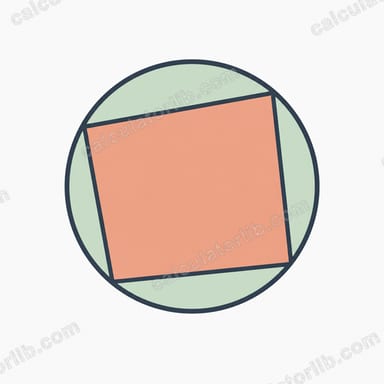
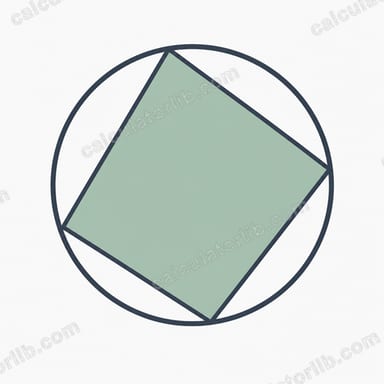
The Cyclic Quadrilateral Calculator finds the area of a four-sided shape whose vertices all lie on a single circle. You enter the four side lengths — Side A, Side B, Side C, and Side D — and the tool instantly returns the area using Brahmagupta's formula. As a bonus it also reports the semiperimeter and the full perimeter, so you get the complete picture from just four numbers.
The Inputs You Provide
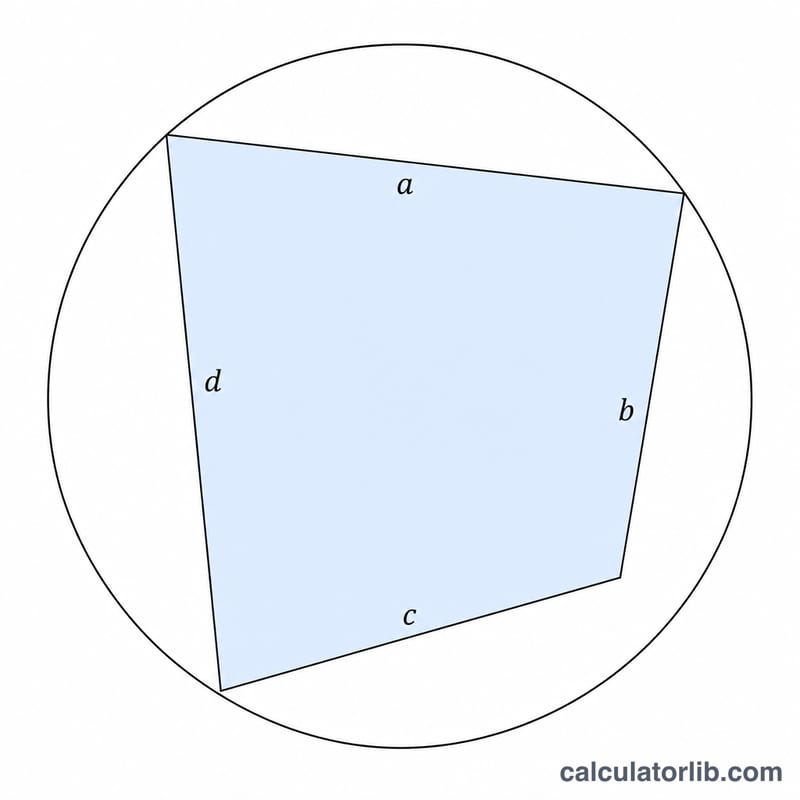
- Side A, B, C, D: the lengths of the four sides of the quadrilateral, in any consistent unit (cm, m, inches, etc.).
The shape must be cyclic — meaning a circle can pass through all four corners. For such shapes the area depends only on the side lengths, which is why no angles are needed.
The Formula Explained
The calculator uses Brahmagupta's formula:
$$A = \sqrt{(s - a)(s - b)(s - c)(s - d)}, \quad \text{where } s = \frac{a + b + c + d}{2}$$Here s is the semiperimeter — half the total of all four sides. The tool computes the perimeter \((a + b + c + d)\), divides by 2 to get s, then subtracts each side from s, multiplies the four results together, and takes the square root. It is the quadrilateral version of Heron's formula for triangles.
Worked Example
Suppose Side A = 4, Side B = 5, Side C = 6, and Side D = 7.
- Perimeter = \(4 + 5 + 6 + 7 = 22\)
- Semiperimeter \(s = 22 / 2 = 11\)
- \((s - a) = 7\), \((s - b) = 6\), \((s - c) = 5\), \((s - d) = 4\)
- Product = \(7 \times 6 \times 5 \times 4 = 840\)
- Area = \(\sqrt{840} \approx 28.98\) square units
Frequently Asked Questions
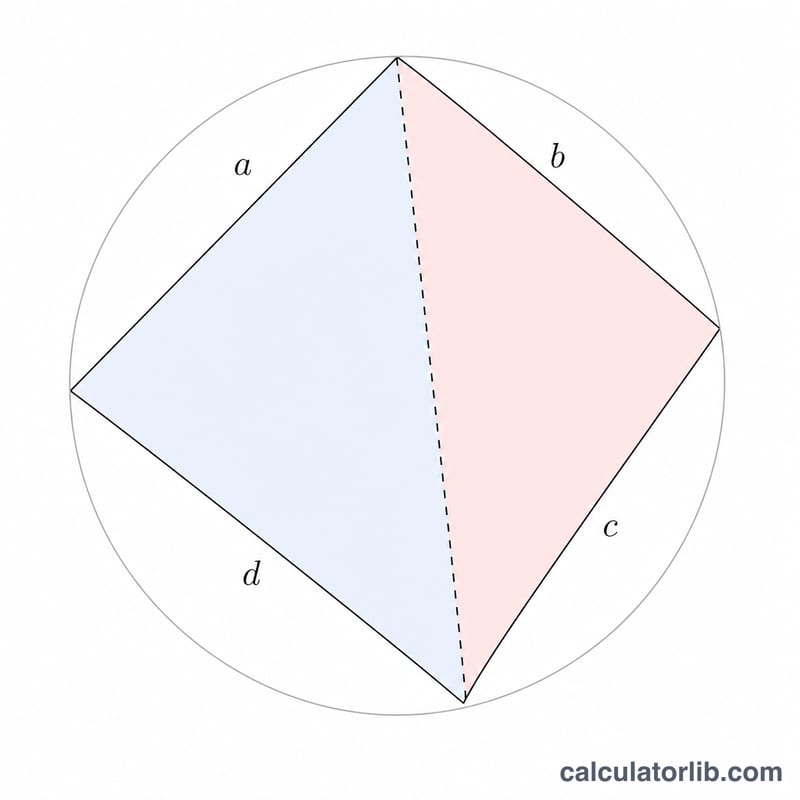
What is a cyclic quadrilateral? It is a four-sided polygon that can be inscribed in a circle — all four vertices touch the circle's edge. Brahmagupta's formula only gives the correct area for this type of shape.
Why did I get an error or "NaN"? If one side is too long relative to the others, a term like \((s - \text{side})\) becomes negative, making the product negative and the square root undefined. Check that no single side exceeds the sum of the other three.
Does the order of the sides matter? No. Because the formula multiplies the four \((s - \text{side})\) terms together, you can enter the sides in any order and still get the same area.