What the Prostate Volume Calculator Does
This calculator estimates the size of the prostate gland in cubic centimetres (cm³, equivalent to millilitres) using three simple measurements taken from imaging, usually transrectal ultrasound (TRUS) or MRI. It applies the widely used prolate ellipsoid formula and also gives you reference PSA density thresholds, which clinicians worldwide use to interpret prostate-specific antigen results in context. It is an educational and clinical-support tool, not a diagnosis.
The Inputs You Need
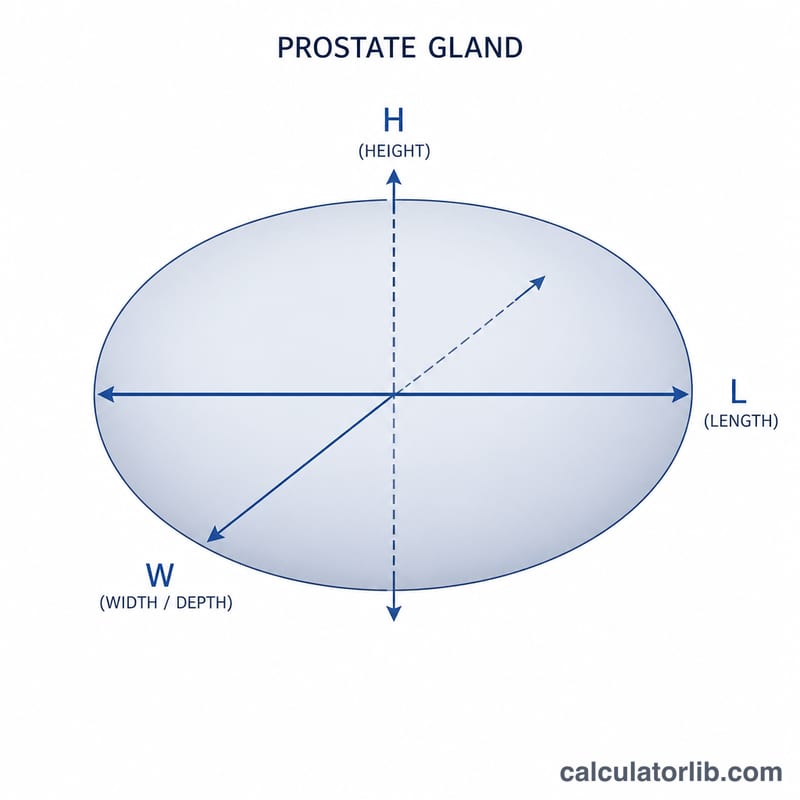
- Length (cm): the longest measurement of the prostate, typically front-to-back (anteroposterior) or top-to-bottom (craniocaudal).
- Width (cm): the transverse measurement, side to side.
- Height (cm): the remaining perpendicular dimension.
All three values must be in centimetres. They are usually reported directly on an ultrasound or MRI scan report.
The Formula Explained
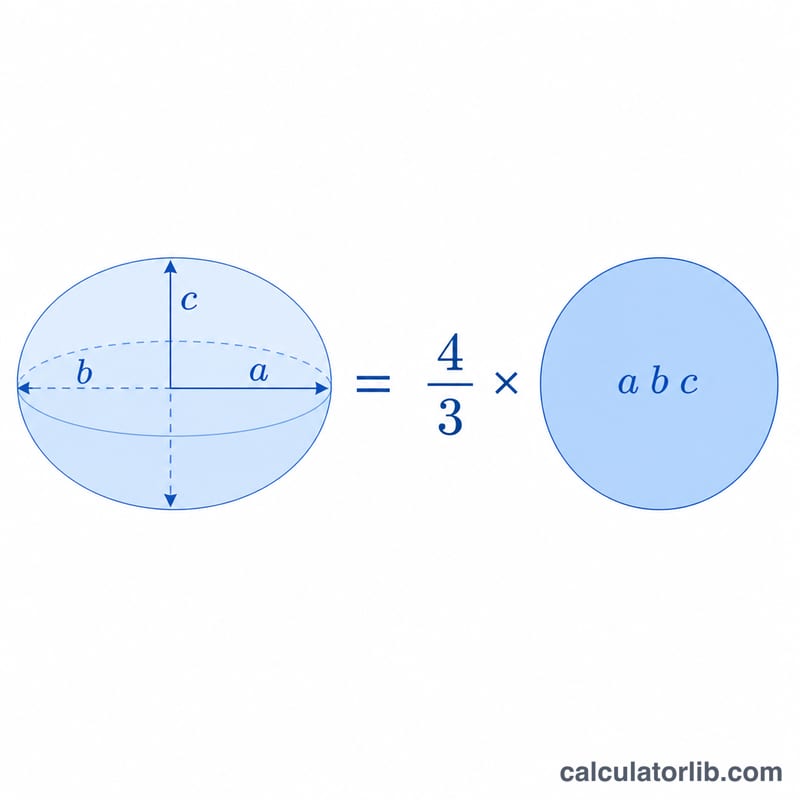
The calculator uses the prolate ellipsoid approximation:
Volume = Length × Width × Height × 0.523
The constant 0.523 is π/6 (≈0.5236), which converts the bounding box of the three diameters into the volume of an ellipsoid — the shape that best approximates a healthy prostate.
From the volume, the tool also shows the PSA level at which PSA density would reach the commonly used cut-off of 0.15 ng/mL/cm³, so you can compare it with a measured PSA:
- PSA at a PSA density of 0.15 ng/mL/cm³: Volume × 0.15 (ng/mL)
PSA density is calculated by dividing a patient's serum PSA by the prostate volume; values around 0.15 ng/mL/cm³ or higher are generally considered more concerning for clinically significant disease.
Worked Example
Suppose a TRUS report gives Length = 4.5 cm, Width = 4.0 cm, and Height = 3.5 cm.
Volume = 4.5 × 4.0 × 3.5 × 0.523 = 32.9 cm³.
For this gland, a PSA density of 0.15 ng/mL/cm³ corresponds to a PSA of 32.9 × 0.15 ≈ 4.9 ng/mL: a measured PSA above that value gives a PSA density above the cut-off.
Interpreting Your Prostate Volume Result
The calculator applies the prolate ellipsoid approximation, \(V = L \times W \times H \times 0.523\), where the three dimensions are entered in centimetres and the result is in cubic centimetres (cm³), which are numerically identical to millilitres. Because the prostate is not a perfect ellipsoid, the number is an estimate rather than an exact anatomical measurement.
Commonly cited volume bands
| Volume (cm³) | Usual description | Context |
|---|---|---|
| <25 | Small / normal | Typical of younger adult men; the healthy young prostate is often quoted at roughly 20 cm³ |
| 25–30 | Average adult gland | Frequently seen in middle-aged men without obstructive symptoms |
| 30–40 | Mild enlargement | Often the threshold above which benign prostatic enlargement is described |
| 40–80 | Moderate enlargement (BPH range) | Volume in this range is one of the factors used when discussing drug therapy such as 5-alpha-reductase inhibitors |
| >80 | Marked enlargement | Around the 80 cm³ mark, guidelines and surgical practice commonly shift the discussion from standard TURP toward enucleation techniques (laser or open simple prostatectomy) |
These bands are descriptive conventions drawn from urological literature and guideline commentary (for example European Association of Urology and American Urological Association discussions of benign prostatic obstruction); they are not sharp diagnostic cut-offs, and different centres publish slightly different boundaries. Volume also rises gradually with age in most men, so a 55 cm³ gland means something different at 45 than at 80.
Worked example
A transrectal ultrasound reports 4.8 cm (transverse) × 3.9 cm (anteroposterior) × 4.2 cm (craniocaudal):
$$V = 4.8 \times 3.9 \times 4.2 \times 0.523 = 41.1\ \text{cm}^3$$
That is, roughly 41.1 cm³ — the lower end of the moderate-enlargement band.
PSA density
PSA density (PSAD) normalises the serum PSA level to gland size:
$$\text{PSAD} = \frac{ {\text{serum PSA (ng/mL)}}}{ {\text{prostate volume (cm}^3)}}$$
Continuing the example above, a PSA of 5.2 ng/mL gives:
$$\text{PSAD} = \frac{5.2}{41.1} = 0.13\ \text{ng/mL/cm}^3$$
Thresholds widely used in PI-RADS reporting and in EAU risk-stratification discussions are: below 0.10 ng/mL/cm³ regarded as low, 0.10–0.15 as intermediate, and 0.15 ng/mL/cm³ or above associated with a higher likelihood of clinically significant prostate cancer. PSAD is often used alongside MRI findings when deciding whether a biopsy adds value, not on its own.
Important limitations
- Volume does not diagnose cancer. A large prostate is most often benign hyperplasia; conversely, a small gland can harbour significant disease.
- Large glands dilute PSA density. The same PSA divided by a bigger volume yields a lower PSAD, which is exactly why the ratio is informative — but it also means an over-estimated volume can falsely reassure.
- Measurement varies by modality. Volumes from transrectal ultrasound and from MRI of the same prostate commonly differ by about 10–20%, and ellipsoid estimates typically differ from MRI planimetry (slice-by-slice segmentation), which is the more accurate reference. Repeat measurements should ideally be compared using the same modality and technique.
- Operator dependence. Small errors in each linear dimension multiply: a 5% over-measurement in all three axes inflates volume by roughly 16%.
This section is general factual reference information, not medical advice. A prostate volume figure only becomes meaningful alongside symptoms, examination, PSA trend, imaging and personal history. Any decision about investigation, medication or surgery belongs with a qualified clinician who has your full clinical picture.
Key Terms and Definitions
| Term | Definition |
|---|---|
| Prostate volume | The estimated three-dimensional size of the gland, reported in cubic centimetres (cm³). Because 1 cm³ = 1 mL, reports may print either unit interchangeably. |
| Prolate ellipsoid formula | The standard clinical approximation \(V = L \times W \times H \times 0.523\). The constant 0.523 is \(\pi/6 \approx 0.5236\), the factor that converts the product of three orthogonal diameters into the volume of an ellipsoid. Some reports use the rounded 0.52. |
| TRUS (transrectal ultrasound) | Ultrasound imaging performed with a probe in the rectum, sitting directly against the prostate. It is the most common way the three linear dimensions used in this formula are obtained, and it also guides systematic biopsy. |
| MRI-based volumetry / planimetry | Volume derived from magnetic resonance imaging. Planimetry means outlining the gland on every image slice and summing the areas multiplied by slice thickness, rather than using three diameters. It is more accurate than the ellipsoid estimate but slower and less widely reported. |
| PSA (prostate-specific antigen) | A protein produced by prostate tissue and measured in blood, reported in nanograms per millilitre (ng/mL). It rises with benign enlargement, inflammation, infection, recent instrumentation and cancer, so it is not cancer-specific. |
| PSA density (PSAD) | Serum PSA divided by prostate volume, in ng/mL/cm³. It adjusts a PSA value for how much prostate tissue is present. |
| BPH (benign prostatic hyperplasia) | Non-cancerous overgrowth of prostate cells, principally in the transition zone, common with advancing age. When it enlarges the gland it may be called benign prostatic enlargement; when it obstructs urine flow, benign prostatic obstruction. |
| Anteroposterior (AP) dimension | The front-to-back measurement of the gland, in cm — usually taken on a sagittal or transverse image. |
| Craniocaudal (CC) dimension | The head-to-foot (superior–inferior) measurement, also called the longitudinal or base-to-apex length, in cm. |
| Transverse dimension | The side-to-side (left–right) width, in cm — typically the largest of the three axes and measured on an axial image. |
| Transition zone volume | The volume of the inner zone surrounding the urethra, calculated with the same ellipsoid formula applied to the transition zone's own three diameters. This is the region where BPH nodules chiefly arise. |
| Transition zone index | Transition zone volume divided by total prostate volume — a dimensionless ratio between 0 and 1 that describes how much of the gland is made up of the BPH-prone inner zone. |
| Prostate weight | Mass in grams. Prostate tissue is slightly denser than water, so 1 cm³ ≈ 1.05 g; a 40 cm³ gland weighs roughly 42 g. Pathology reports of resected or enucleated tissue give weight, whereas imaging gives volume, so the two are not directly comparable. |
Terms and thresholds here follow common international urological and radiological usage; individual laboratories and imaging departments may define reference values slightly differently, so always read a report against the reference ranges printed on it.
Frequently Asked Questions
What is a normal prostate volume? A typical adult prostate is around 20–30 cm³. Volumes above roughly 30–40 cm³ suggest enlargement (benign prostatic hyperplasia), though normal size increases with age.
Why 0.523 and not 0.52? The constant is π/6, approximately 0.5236. Many calculators round to 0.52 or 0.523; the small difference has minimal impact on the result.
Can I use this to diagnose cancer? No. Volume and PSA density are supportive indicators only. Always discuss results with a qualified urologist or healthcare provider for interpretation and any further testing.