What Is Pulley Mechanical Advantage?
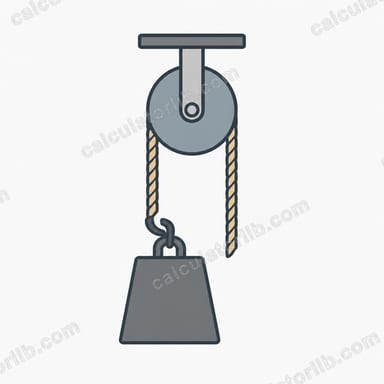
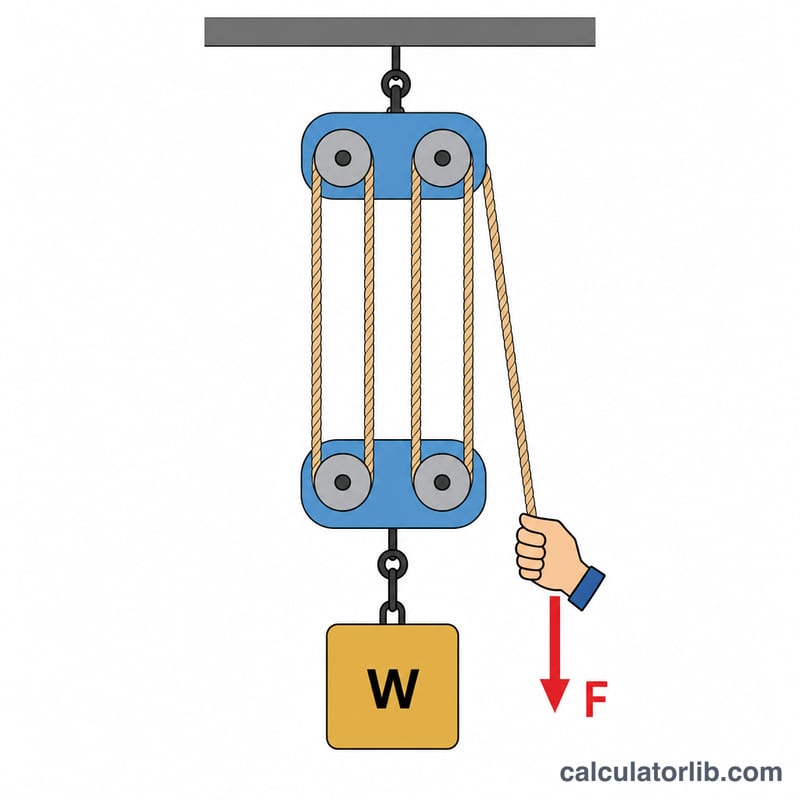
A pulley system makes lifting heavy loads easier by trading distance for force. The mechanical advantage (MA) tells you how many times the system multiplies your pulling force. For an ideal block-and-tackle, the MA equals the number of rope segments that directly support the movable block — the load.
How to Use This Calculator
Enter the number of supporting rope segments (count every length of rope pulling up on the movable pulley) and the load weight in newtons. The calculator returns the mechanical advantage and the effort force you must apply to hold or slowly raise the load. Multiply your mass in kilograms by 9.81 to convert to newtons if needed.
The Formula Explained
The two equations are simple: \(\text{MA} = N\), where N is the number of supporting segments, and \(\text{Effort} = \text{Load} \div \text{MA}\). Because energy is conserved, the rope you pull must travel N times farther than the load rises. This is the ideal, frictionless case — real systems need slightly more effort to overcome friction and rope stiffness.
$$\text{MA} = \text{Segments} \qquad \text{Effort} = \frac{\text{Load (N)}}{\text{Segments}}$$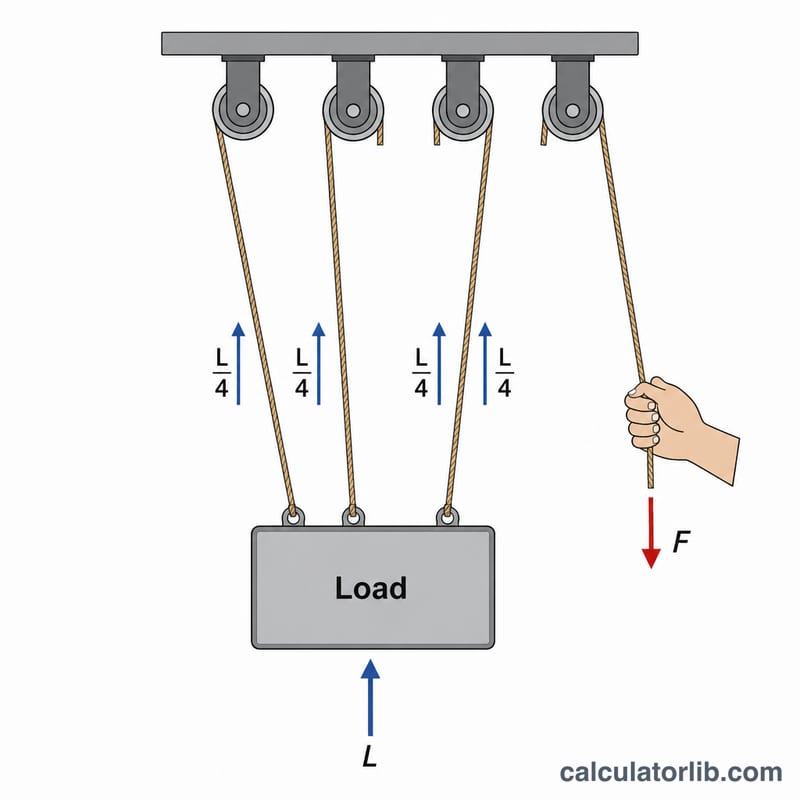
Worked Example
Suppose a system has 4 supporting rope segments and you want to lift a 1000 N load. The mechanical advantage is \(\text{MA} = 4\). The effort needed is
$$1000 \div 4 = 250 \text{ N}$$You'd pull 4 metres of rope for every 1 metre the load rises.
Interpreting Your Result: Ideal vs Real-World Effort
The calculator gives the ideal result: it assumes a frictionless system with massless rope and pulleys. The mechanical advantage equals the number of rope segments supporting the load, and the ideal effort is the load divided by that number. Real effort is always higher because of sheave (bearing) friction, rope stiffness and bending losses, and the overall efficiency of the pulleys.
To include losses, add an efficiency factor \(\eta\) (a value between 0 and 1):
$$\text{Effort} = \frac{L}{N \times \eta}$$
Here \(L\) is the load force in newtons and \(N\) is the number of supporting rope segments.
Example: a 600 N load on a system with 4 supporting segments gives an ideal mechanical advantage of 4 and an ideal effort of \(600 \div 4 = \)150 N. If the system is 85% efficient (an assumed value for illustration), the effort is \(600 \div (4 \times 0.85) \approx 176.5\) N.
The trade-off: a pulley system does not reduce the work done. It trades force for distance. To lift the load a height \(h\), you must pull \(N \times h\) of rope. Lifting the 600 N load 2 m with 4 segments means pulling \(4 \times 2 = 8\) m of rope. More segments mean less effort but more rope to pull.
Raising vs holding: friction opposes motion in both directions. When you raise the load, the effort must overcome friction in addition to the load, so it is higher than the ideal value (and higher again if the load is accelerating). When you hold the load still, or lower it slowly, the friction works in your favor and the force needed is lower than when raising. In a high-friction system the load may not slide back down when you let go.
This figure is a physics estimate only. It is not a safety rating or working-load limit. Rope, pulleys, anchors and hardware must be rated for the actual forces involved, which can be much higher than the load alone. Follow the manufacturer's ratings and qualified guidance for any real lifting.
Pulley Terms and Definitions
- Fixed pulley
- A pulley whose axle is attached to a fixed support. It changes the direction of the pull but gives a mechanical advantage of 1.
- Movable pulley
- A pulley that is attached to the load and moves with it. The rope supports the load on both sides of the wheel, so ideally it halves the effort.
- Block and tackle
- A system of fixed and movable pulleys (blocks) threaded with a single rope to give a larger mechanical advantage.
- Supporting rope segment
- A length of rope that directly holds up the load, that is, one that pulls on the movable block or the load. The count of these segments sets the ideal mechanical advantage. The rope you pull on counts only if it also attaches to the movable block.
- Mechanical advantage (MA)
- The ratio of load force to effort force. Ideally it equals the number of supporting rope segments.
- Effort force
- The force you apply to the free end of the rope to raise or hold the load.
- Load
- The weight or force being lifted, measured in newtons (N). A mass in kg is converted to a force by multiplying by about 9.81 m/s².
- Efficiency
- The ratio of useful work output to work input, usually written as a percentage or as a fraction \(\eta\). Friction and rope stiffness make it less than 100% in real systems.
FAQ
How do I count supporting segments? Count only the rope segments that pull upward on the movable block holding the load. Segments leading to a fixed pulley used only to change direction do not add to the MA.
Does adding pulleys always reduce effort? Yes ideally, but each pulley adds friction and weight, so beyond a point the real benefit shrinks.
Is the rope length affected? Yes — the higher the MA, the more rope you must pull through to move the load a given distance.