What Is a Square Number?
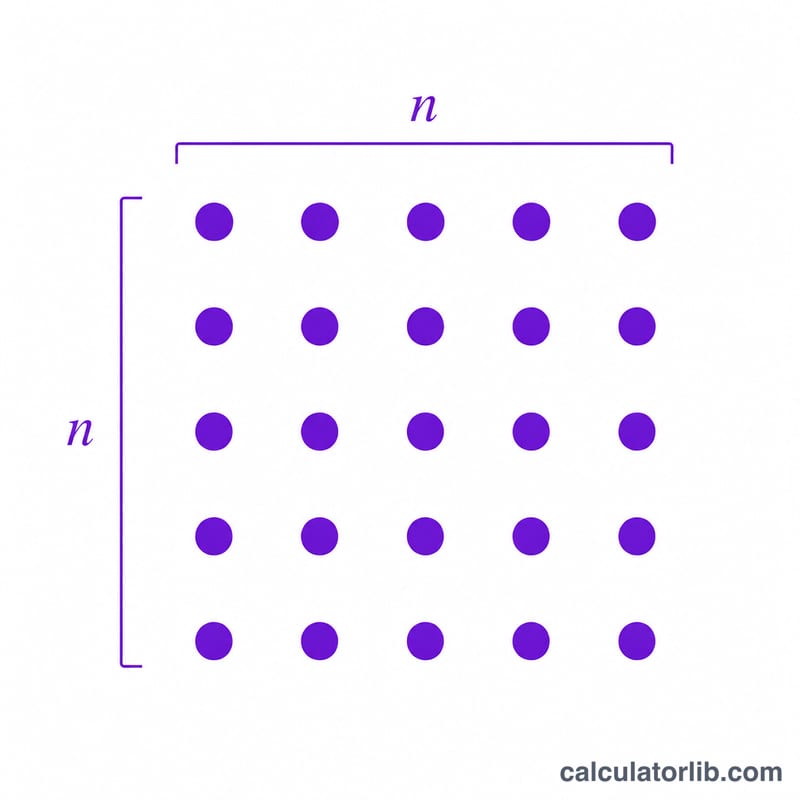
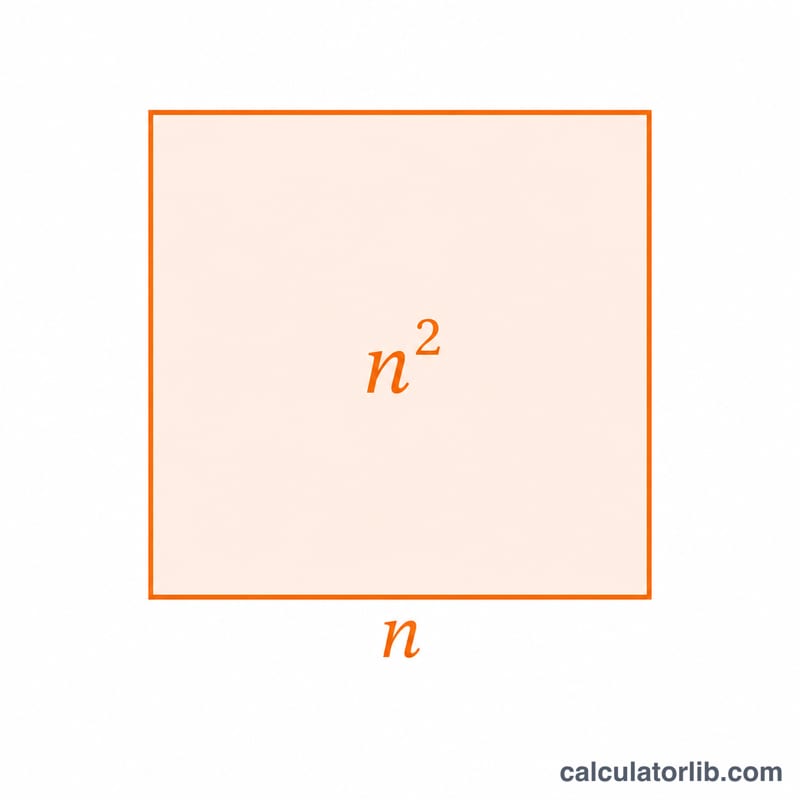
Squaring a number means multiplying it by itself. The result, written as n² (read "n squared"), is the area of a square whose side length equals n. This calculator computes n² for any value — whole numbers, decimals, and negatives. Because a negative times a negative is positive, the square of any real number is always zero or positive.
How to Use This Calculator
Type a number into the input box and the calculator returns its square instantly. For example, entering 12 gives 144, and entering 2.5 gives 6.25. There are no units — the tool works purely with numbers, so it fits maths homework, geometry (area of a square), statistics (variance and standard deviation), and physics formulas.
The Formula Explained
The square is defined by the simple equation:
$$\text{square} = n \times n = n^2$$
Multiplication is commutative and the same factor is used twice, so the order never matters. Squaring grows fast: doubling n quadruples the result, because \((2n)^2 = 4n^2\).
Worked Example
Suppose \(n = 9\). Then $$n^2 = 9 \times 9 = 81.$$ For a decimal, \(n = 1.5\) gives \(1.5 \times 1.5 = 2.25\). For a negative, \(n = -7\) gives \((-7) \times (-7) = 49\).
Perfect Squares Table (1² to 20²)
A perfect square is the square of a whole number. Memorizing the first twenty makes mental math, factoring and estimating square roots much faster.
| n | n² | n | n² |
|---|---|---|---|
| 1 | 1 | 11 | 121 |
| 2 | 4 | 12 | 144 |
| 3 | 9 | 13 | 169 |
| 4 | 16 | 14 | 196 |
| 5 | 25 | 15 | 225 |
| 6 | 36 | 16 | 256 |
| 7 | 49 | 17 | 289 |
| 8 | 64 | 18 | 324 |
| 9 | 81 | 19 | 361 |
| 10 | 100 | 20 | 400 |
A few larger benchmarks: 25² = 625, 30² = 900, 50² = 2,500, and 100² = 10000 (written 10,000).
Pattern to notice: the gap between consecutive squares grows by 2 each time (1→4 is +3, 4→9 is +5, 9→16 is +7), because \((n+1)^2 - n^2 = 2n + 1\).
How to Square a Number by Hand
Squaring means multiplying a number by itself: \(n^2 = n \times n\).
- Write n twice. For example, to square 23, write 23 × 23.
- Multiply as in normal long multiplication. 23 × 23 = 23 × 20 + 23 × 3 = 460 + 69 = 529. Ignore any sign and decimal point for now.
- Handle the sign. A negative times a negative is positive, so a square is never negative. \((-7)^2 = (-7) \times (-7) = 49\), the same as \(7^2\). Note that \(-7^2\) without brackets means \(-(7^2) = -49\).
- Place the decimal point. The square has twice as many decimal places as the original number. For 1.5 (one decimal place), compute 15 × 15 = 225, then put the decimal point two places from the right: 1.5² = 2.25. Likewise 0.12² : 12 × 12 = 144, with four decimal places gives 0.0144.
Shortcut for numbers ending in 5
Write the number as \(10a + 5\). Then multiply the leading digit(s) \(a\) by \(a+1\) and append 25. For 35: a = 3, so 3 × 4 = 12, append 25 → 1225. Another example: 85² → 8 × 9 = 72, append 25 → 7225.
Mental math with (a + b)²
Split the number into an easy round part and a small remainder, then use
$$(a+b)^2 = a^2 + 2ab + b^2$$
Example: 47 = 40 + 7, so
$$47^2 = 40^2 + 2 \times 40 \times 7 + 7^2 = 1600 + 560 + 49 = 2209$$
The result is 2209. You can also subtract: 49² = (50 − 1)² = 2500 − 100 + 1 = 2401.
FAQ
Can I square a negative number? Yes. The square of a negative number is always positive, e.g. \((-4)^2 = 16\).
What is the square of a decimal? The same rule applies: \(0.5^2 = 0.25\).
How is squaring different from doubling? Doubling adds the number to itself (\(n + n = 2n\)); squaring multiplies it by itself (\(n \times n = n^2\)). For \(n = 5\), doubling gives 10 but squaring gives 25.