What Is the Tank Volume Calculator?
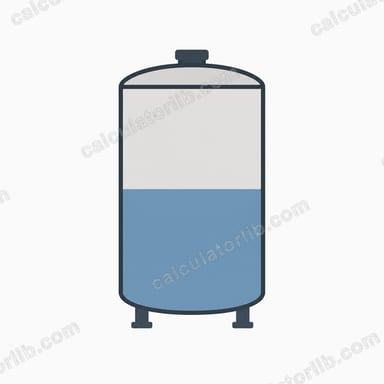
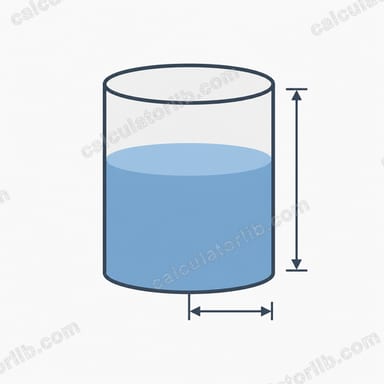
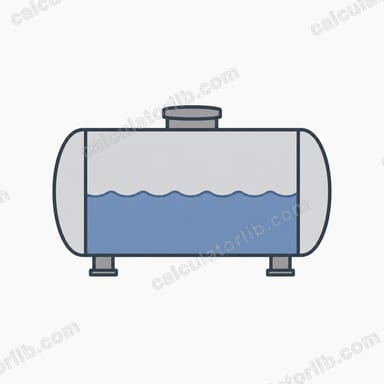
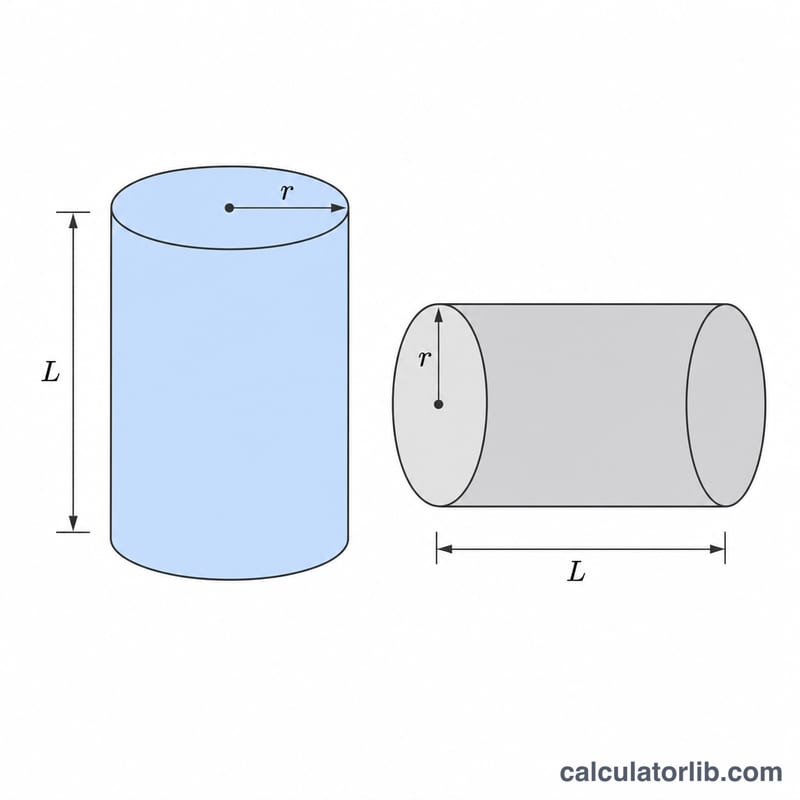
This calculator finds the total volume (capacity) of a cylindrical storage tank, whether it sits upright (vertical) or on its side (horizontal). For a full cylinder the orientation does not change the total volume — both use the same formula — but the labels help you describe your tank correctly. Enter the diameter and the length (or height) and you get the capacity in cubic meters, liters, and US gallons.
How to Use It
Select whether your tank is vertical or horizontal, then enter the diameter across the circular end and the length (for horizontal) or height (for vertical). All measurements should be in meters. The calculator instantly reports the full-tank volume in three common units so you can plan fluid storage, ordering, or transport.
The Formula Explained
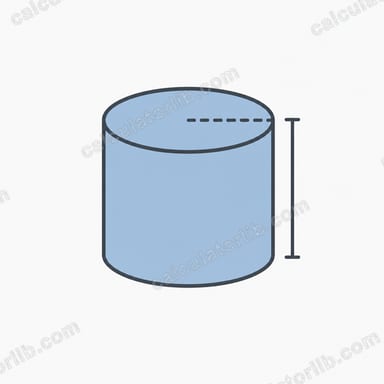
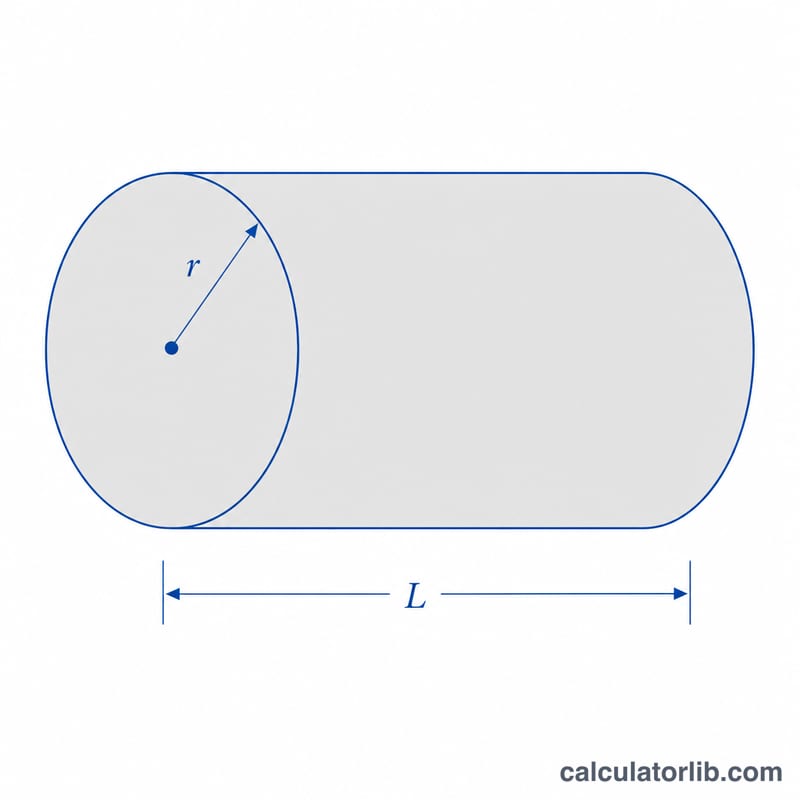
A cylinder's volume is the area of its circular cross-section multiplied by its length:
$$V = \pi r^2 L$$where \(r\) is the radius (half the diameter) and \(L\) is the length or height. To convert cubic meters to liters, multiply by 1,000. To get US gallons, multiply cubic meters by 264.172.
Worked Example
Suppose a vertical tank has a diameter of 2 m and a height of 5 m. The radius is 1 m, so
$$V = \pi \times 1^2 \times 5 = 15.708 \text{ m}^3$$That equals 15,708 liters or about 4,150 US gallons.
Tank Capacity for Common Sizes
The table uses \(V = \pi r^{2} L\) with \(r = d/2\), where the tank is a plain cylinder with flat ends. A horizontal tank uses its length and a vertical tank uses its height, and the full-tank volume is the same either way. Liters = m³ × 1,000 and US gallons = m³ × 264.172.
| Diameter (m) | Length / Height (m) | Volume (m³) | Liters | US gallons |
|---|---|---|---|---|
| 1 | 2 | 1.571 | 1,570.8 | 415.0 |
| 2 | 2 | 6.283 | 6,283.2 | 1,659.8 |
| 1.5 | 3 | 5.301 | 5,301.4 | 1,400.5 |
| 2 | 5 | 15.708 | 15,708.0 | 4,149.6 |
| 2.5 | 6 | 29.452 | 29,452.4 | 7,780.5 |
| 3 | 10 | 70.686 | 70,685.8 | 18,673.2 |
Example substitution for the 2 m × 5 m row: \(V = \pi (1)^{2} \times 5 = 15.708\ \text{m}^3\), which is 15,708 L.
Scaling: volume depends on the square of the diameter but only linearly on length. Doubling the diameter quadruples the volume (1 m × 2 m = 1.571 m³ becomes 2 m × 2 m = 6.283 m³). Doubling the length only doubles it (1 m × 2 m becomes 1 m × 4 m = 3.142 m³).
Volume Unit Conversion Reference
| Volume unit | Equivalent of 1 m³ |
|---|---|
| Liters (L) | 1,000 L |
| US gallons | 264.172 US gal |
| Imperial gallons | 219.969 imp gal |
| Cubic feet | 35.3147 ft³ |
| Oil barrels (42 US gal) | 6.2898 bbl |
These factors are rounded to the digits shown.
| Length unit | In meters |
|---|---|
| 1 foot (ft) | 0.3048 m (exact) |
| 1 inch (in) | 0.0254 m (exact) |
| 1 centimeter (cm) | 0.01 m |
Convert every measurement to meters before entering it. For example, a 48 in diameter is 48 × 0.0254 = 1.2192 m, and a 10 ft length is 10 × 0.3048 = 3.048 m.
Practical Tips for Sizing and Measuring a Tank
- Use the internal diameter. Wall thickness reduces capacity. An external measurement overstates the volume, and the error grows with the square of the diameter.
- Leave headspace. Tanks are usually not filled to the brim. A common allowance is about 5–10% ullage, so usable volume is lower than total volume. Check the figure that applies to your fluid, temperature and local rules.
- Account for dished or domed ends. The simple formula assumes flat ends. Elliptical, hemispherical or conical ends add (or change) volume, so use the manufacturer's stated capacity or add the end volumes separately.
- Round up when ordering liquid. Allow for spillage, residual liquid and measurement error, and confirm which gallon (US or imperial) your supplier uses.
- Partial fills in horizontal tanks are not linear with depth. A half-full depth is exactly half the volume, but a quarter-depth is not a quarter of the volume. Use a tank chart or a circular-segment calculation for dipstick readings. In a vertical tank, volume is proportional to liquid height.
This is general information for estimating. For safety-critical or regulated storage, rely on certified tank data and a qualified professional.
FAQ
Does orientation change the total volume? No. A completely full cylinder holds the same amount whether vertical or horizontal. Orientation matters only for partial-fill (dipstick) calculations.
What units should I use? Enter measurements in meters. The results give cubic meters, liters, and US gallons.
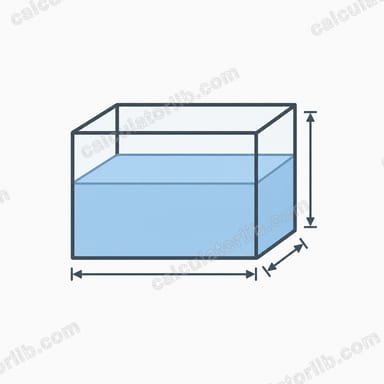
Can I use it for rectangular tanks? No — this tool assumes a circular cylinder. Rectangular tanks use length \(\times\) width \(\times\) height instead.