What Is Thermal Diffusivity?
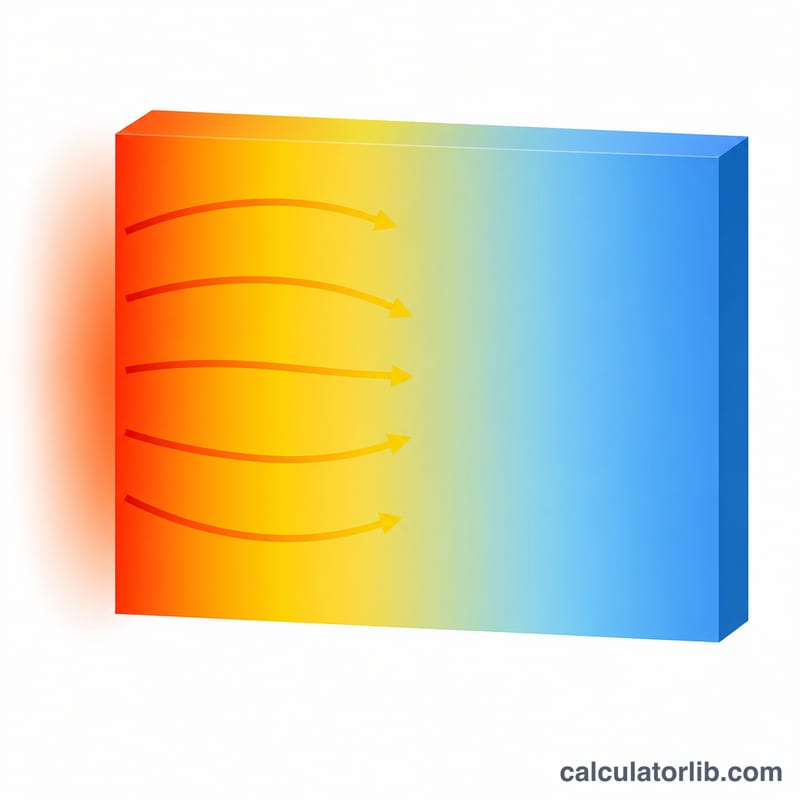
Thermal diffusivity (\(\alpha\)) measures how quickly heat spreads through a material relative to how much it stores. A high diffusivity means heat moves fast and the material reaches thermal equilibrium quickly; a low value means heat conducts slowly. It is a key property in transient heat-transfer analysis, casting, electronics cooling, and building physics. The SI unit is square metres per second (m²/s).
How to Use This Calculator
Enter three material properties: thermal conductivity k in W/m·K, density ρ in kg/m³, and specific heat capacity cp in J/kg·K. The calculator returns the thermal diffusivity in m²/s and, for convenience, in mm²/s (multiply m²/s by 1,000,000).
The Formula Explained
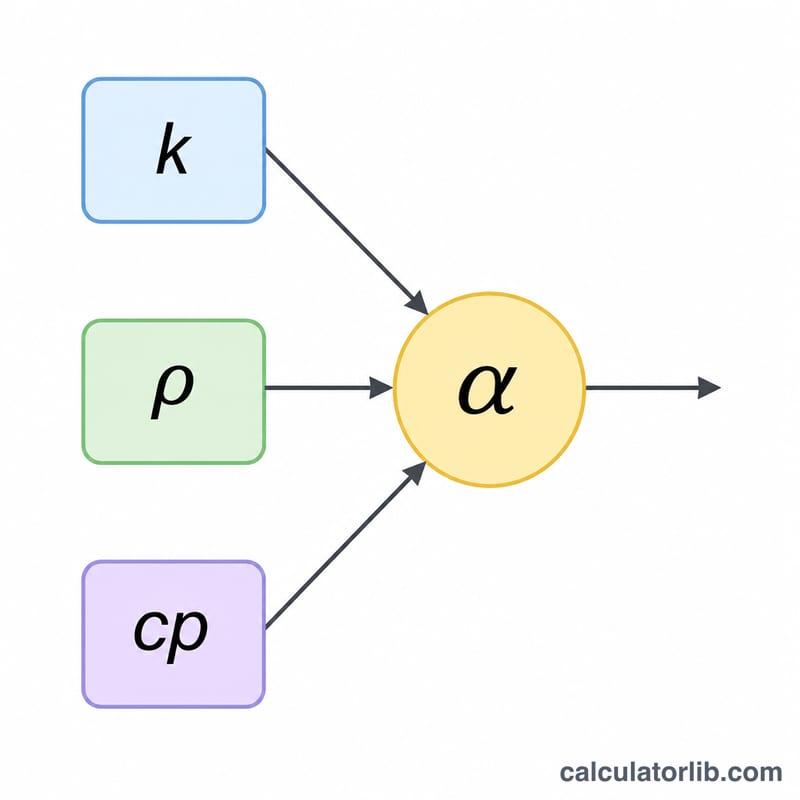
The defining equation is:
$$\alpha = \frac{\text{Thermal Conductivity } k}{\text{Density } \rho \cdot \text{Specific Heat } c_p}$$Here k tells you how readily a material conducts heat, while the product \(\rho \cdot c_p\) is the volumetric heat capacity — the amount of heat needed to raise a unit volume by one degree. Dividing conduction ability by heat-storage capacity gives the rate at which a temperature disturbance propagates.
Worked Example
For pure aluminium: k = 237 W/m·K, ρ = 2700 kg/m³, cp = 900 J/kg·K.
$$\alpha = \frac{237}{2700 \times 900} = \frac{237}{2{,}430{,}000} \approx 0.00009753 \ \text{m}^2/\text{s}$$or about 97.53 mm²/s. This high value explains why aluminium heats and cools so rapidly.
Interpreting Your Thermal Diffusivity Result
Thermal diffusivity \(\alpha = \dfrac{k}{\rho\, c_p}\) measures how quickly a temperature change spreads through a material. It compares the ability to conduct heat (\(k\)) with the ability to store it (\(\rho c_p\)). A high \(\alpha\) means the material reaches a uniform temperature quickly. A low \(\alpha\) means heat moves slowly and temperature differences persist.
Rough magnitude bands
- Metals: about 10 to over 100 mm²/s (steels roughly 5 to 15, aluminium roughly 90 to 100, copper roughly 115).
- Ceramics, concrete and stone: around 0.5 to 2 mm²/s, so about 1 mm²/s as a rule of thumb.
- Polymers and wood: about 0.1 to 0.2 mm²/s.
- Liquids such as water: about 0.14 mm²/s.
- Gases: often larger than you would expect (air near room temperature is roughly 20 mm²/s) because the very low density makes \(\rho c_p\) tiny, even though \(k\) is also tiny.
For reference, 1 mm²/s = \(10^{-6}\) m²/s.
Link to penetration time and the Fourier number
The characteristic time for heat to diffuse across a thickness \(L\) scales as
$$t \sim \frac{L^2}{\alpha}$$The dimensionless Fourier number \(\mathrm{Fo} = \dfrac{\alpha t}{L^2}\) expresses the same idea. Values of \(\mathrm{Fo}\) well below 1 mean the interior has barely responded, and values well above 1 mean it is close to equilibrium. For a 1 cm (0.01 m) thickness:
- Steel, \(\alpha \approx 13\) mm²/s: \(t \sim \dfrac{(0.01)^2}{1.3\times10^{-5}} \approx 8\) s.
- Wood, \(\alpha \approx 0.15\) mm²/s: \(t \sim \dfrac{(0.01)^2}{1.5\times10^{-7}} \approx 670\) s, or about 11 minutes.
Because time scales with \(L^2\), doubling the thickness makes equilibration about four times slower.
Caveats
Real values depend on temperature, and for metals also on purity, alloying and heat treatment. Moisture content, porosity and grain direction matter for wood, stone and composites. Use consistent SI units for the inputs (W/m·K, kg/m³, J/kg·K). This is general educational information, not design advice. Confirm material data against measured or authoritative sources for any engineering work.
Comparing Materials: How Inputs Change α
The table uses typical room-temperature values. Exact figures vary with temperature, composition and moisture, so treat them as approximate.
| Material | k (W/m·K) | ρ (kg/m³) | cp (J/kg·K) | ρcp (MJ/m³·K) | α (mm²/s) |
|---|---|---|---|---|---|
| Copper | 401 | 8960 | 385 | 3.45 | ≈ 116 |
| Carbon steel | 50 | 7850 | 490 | 3.85 | ≈ 13 |
| Water (about 20 °C) | 0.60 | 998 | 4182 | 4.17 | ≈ 0.14 |
| Softwood (e.g. pine) | 0.12 | 500 | 1600 | 0.80 | ≈ 0.15 |
Worked check for copper: \(\alpha = \dfrac{401}{8960 \times 385} = \dfrac{401}{3{,}449{,}600} \approx 1.16\times10^{-4}\) m²/s, which is 116 mm²/s.
Takeaway: a high \(k\) does not guarantee a high \(\alpha\). Water conducts about five times better than softwood, yet their diffusivities are almost the same, because water stores far more heat per unit volume (4.17 vs 0.80 MJ/m³·K). Copper and steel have similar \(\rho c_p\), so the roughly 9-fold difference in their \(\alpha\) comes almost entirely from \(k\). Always consider both conduction and heat storage when judging how fast a material responds to temperature change.
FAQ
What units must I use? Use consistent SI units (W/m·K, kg/m³, J/kg·K) to get \(\alpha\) in m²/s.
How does diffusivity differ from conductivity? Conductivity (\(k\)) describes steady-state heat flow; diffusivity (\(\alpha\)) describes how fast temperature changes propagate during transient conditions.
Why convert to mm²/s? Material tables often list \(\alpha\) in mm²/s because the m²/s values are very small; 1 m²/s = 1,000,000 mm²/s.