What This Calculator Does
The Square Feet of a Triangle Calculator finds the area of any triangle when you know its base and perpendicular height, both measured in feet. The result is returned in square feet (ft²) and automatically converted to square yards and square meters. It is ideal for estimating flooring, sod, paint, tile, or material for triangular sections of a room, yard, roof, or lot.
How to Use It
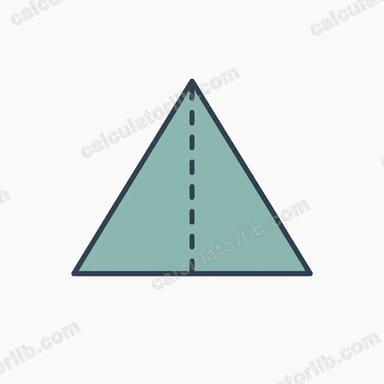
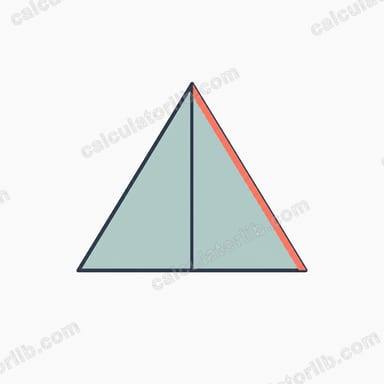
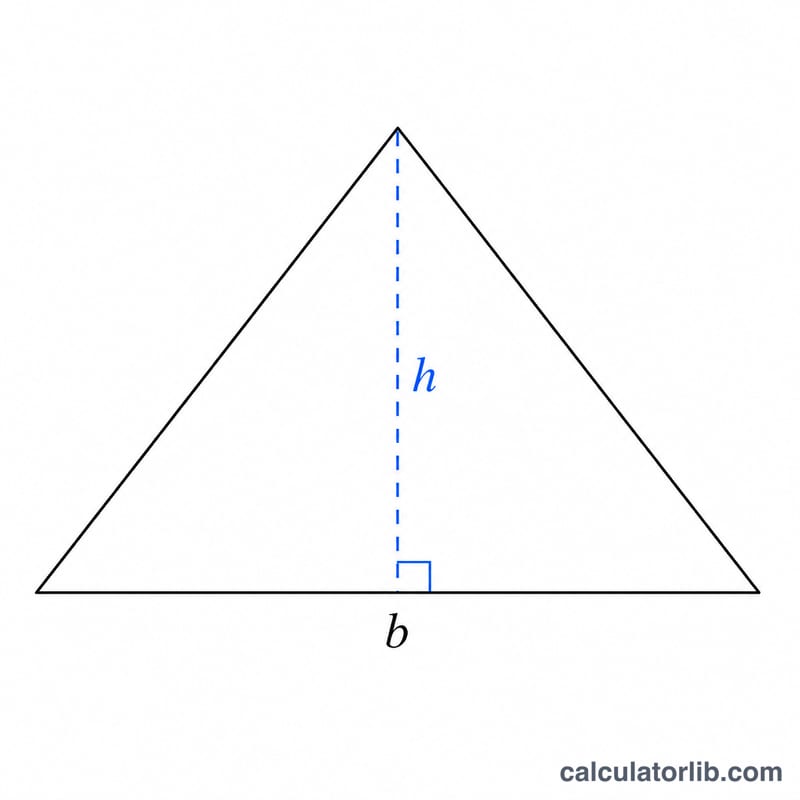
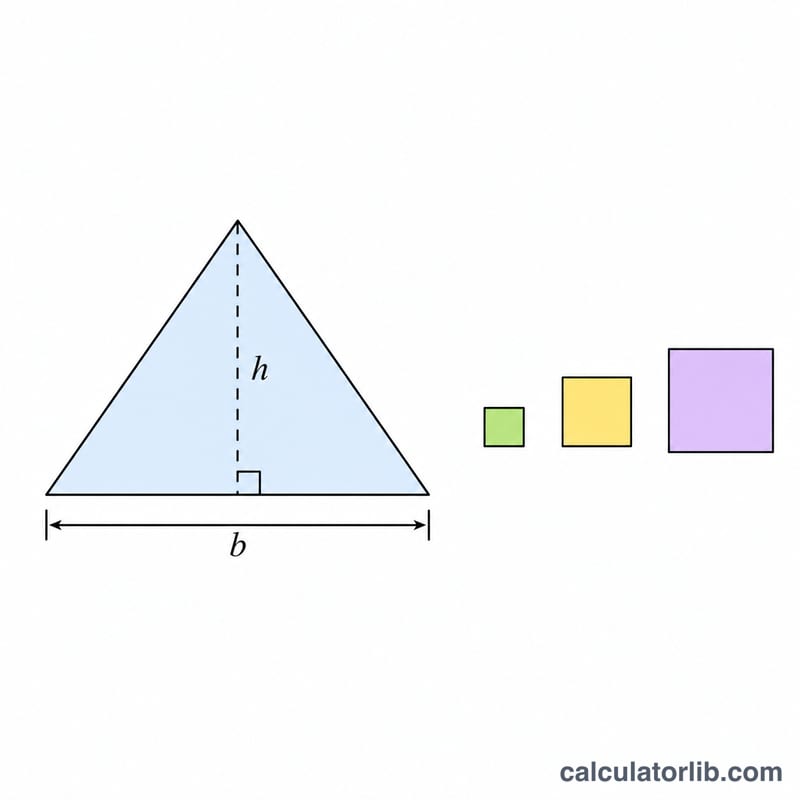
Enter the base length of the triangle in feet and its height in feet. The height must be measured straight from the base to the opposite vertex (a right-angle distance), not along a slanted side. Click calculate and the tool returns the area instantly.
The Formula Explained
A triangle's area is exactly half that of a rectangle with the same base and height, which is why the formula is $$A = \frac{\text{base} \times \text{height}}{2}$$ Because both measurements are in feet, multiplying them gives square feet, and halving accounts for the triangular shape.
Worked Example
Suppose a triangular garden bed has a base of 12 feet and a height of 8 feet. The area is $$(12 \times 8) \div 2 = 96 \div 2 = \textbf{48 square feet}.$$ That equals about 5.33 square yards or roughly 4.46 square meters.
Square Feet Conversion Reference
Use these exact factors to move between square feet and other common area and length units.
| Quantity | Equivalent |
|---|---|
| 1 ft² | 144 in² |
| 1 ft² | 1/9 yd² ≈ 0.111111 yd² |
| 1 ft² | 0.09290304 m² (exact) |
| 1 yd² | 9 ft² |
| 1 m² | ≈ 10.7639 ft² |
| 1 acre | 43,560 ft² |
Linear relationships: 1 ft = 12 in = 0.3048 m (exact), and 1 yd = 3 ft. Because area is a product of two lengths, area factors are the squares of the linear ones: \(3^2 = 9\) ft² per yd², and \(0.3048^2 = 0.09290304\) m² per ft².
To convert a triangle's area from ft² to yd², divide by 9. To convert to m², multiply by 0.09290304.
Practical Tips for Ordering Materials
- Add a waste allowance. Plan for about 10% extra for waste. For tile or flooring laid in triangular areas with many angled cuts, use 10–15%.
- Round up to full units. Materials are sold in boxes, rolls, bags or sheets, so round the final quantity up to the next whole unit rather than down.
- Measure the height correctly. The height must be perpendicular (at 90°) to the base, not the length of a slanted side.
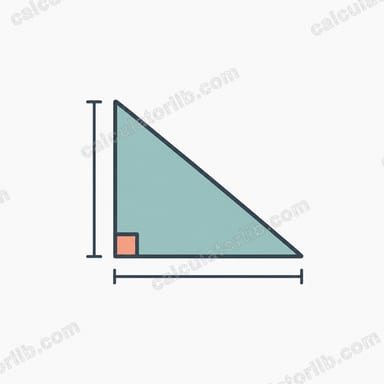
- Right triangles are simple. The two legs that meet at the right angle serve as the base and the height.
- Split irregular shapes. Divide an irregular area into triangles (and rectangles), calculate each area with \(A = \frac{b \times h}{2}\), and add the results.
- Keep units consistent. Convert inches or meters to feet before multiplying, or convert the final area using the factors above.
- Check product coverage. Coverage per box or bag is printed on the packaging, so divide your area (plus waste) by that number and round up.
Triangle Area Comparison for Common Sizes
Each area is computed with \(A = \frac{b \times h}{2}\) in square feet, then converted using 1 yd² = 9 ft² and 1 ft² = 0.09290304 m². Values are rounded to four decimal places.
| Base × Height (ft) | Calculation | Area (ft²) | Area (yd²) | Area (m²) |
|---|---|---|---|---|
| 4 × 3 | \(\frac{4 \times 3}{2}\) | 6 | 0.6667 | 0.5574 |
| 6 × 4 | \(\frac{6 \times 4}{2}\) | 12 | 1.3333 | 1.1148 |
| 10 × 5 | \(\frac{10 \times 5}{2}\) | 25 | 2.7778 | 2.3226 |
| 12 × 8 | \(\frac{12 \times 8}{2}\) | 48 | 5.3333 | 4.4593 |
| 20 × 15 | \(\frac{20 \times 15}{2}\) | 150 | 16.6667 | 13.9355 |
Example for the 12 × 8 ft triangle: \(A = \frac{12 \times 8}{2} = \frac{96}{2} = 48\) ft². In square yards, \(48 \div 9 = 5.3333\) yd². In square meters, \(48 \times 0.09290304 = 4.4593\) m².
Doubling both the base and height multiplies the area by 4, as the step from 6 × 4 (12 ft²) to 12 × 8 (48 ft²) shows.
FAQ
What if I only know the three side lengths? This calculator uses base and height. For three sides you would need Heron's formula instead.
Can I enter measurements in inches? Convert inches to feet first by dividing by 12, then enter the decimal foot values.
Does the height have to be the slanted side? No. Height is the perpendicular (straight-down) distance from the base to the top vertex, not the length of a sloped edge.