What is VO2 max?
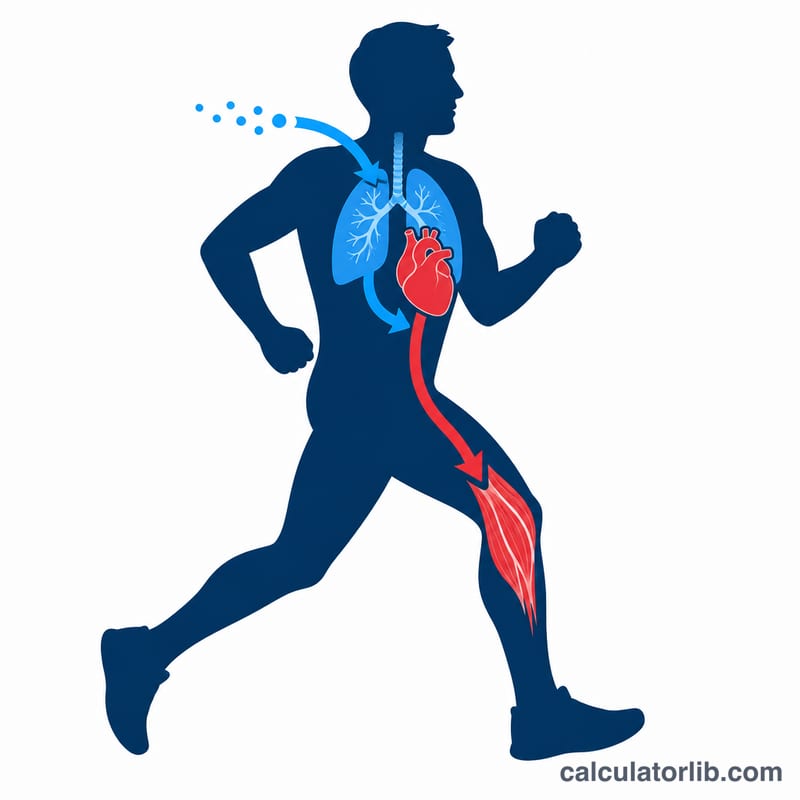
VO2 max is the maximum rate at which your body can take in and use oxygen during intense exercise, measured in milliliters of oxygen per kilogram of body weight per minute (mL/kg/min). It is one of the best single indicators of aerobic fitness and endurance potential. This calculator estimates VO2 max two ways: from the distance run in a 12-minute Cooper test, or from the ratio of your maximum to resting heart rate.
How to use this calculator
For the Cooper method, run as far as you can in exactly 12 minutes on a flat track, record the distance in meters, and enter it. For the heart rate ratio method, enter your maximum heart rate (from a maximal effort test) and your true resting heart rate, ideally measured first thing in the morning. Choose the method that matches the data you have and read your estimated VO2 max plus a fitness category.
The formulas explained
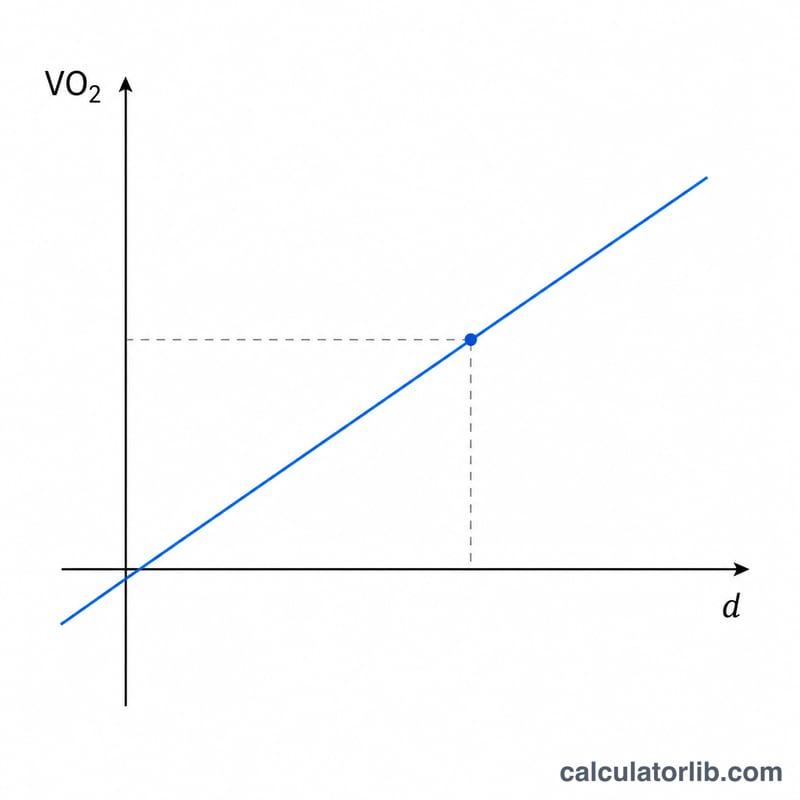
The Cooper formula is $$\text{VO}_2\text{max} = \frac{\text{Distance (m)} - 504.9}{44.73}$$ derived from Kenneth Cooper's field research correlating 12-minute run distance with laboratory VO2 max. The heart rate method uses $$\text{VO}_2\text{max} = 15.3 \times \frac{\text{Max HR (bpm)}}{\text{Resting HR (bpm)}}$$ a simple estimate that works because a wider gap between maximum and resting heart rate reflects a stronger, more efficient cardiovascular system.
Worked example
Suppose you cover 2,800 meters in 12 minutes. $$\text{VO}_2\text{max} = \frac{2800 - 504.9}{44.73} = \frac{2295.1}{44.73} \approx 51.3 \text{ mL/kg/min}$$ which falls in the "Good" range for most adults. Using the heart rate method with a max of 190 bpm and resting of 60 bpm: \(15.3 \times \frac{190}{60} \approx 48.5\) mL/kg/min.
VO2 Max Norms by Age and Sex
The tables below show approximate population norms for VO2 max in mL/kg/min, adapted from Cooper Institute / ACSM-style normative data. Published tables differ slightly between sources, so the values are rounded and approximate. Use them as a general guide rather than exact cut-offs. "Poor" here combines the "poor" and "very poor" bands found in some tables.
Men (mL/kg/min)
| Age | Poor | Fair | Good | Excellent | Superior |
|---|---|---|---|---|---|
| 20-29 | < 36 | 36-42 | 43-46 | 47-52 | > 52 |
| 30-39 | < 35 | 35-40 | 41-44 | 45-49 | > 49 |
| 40-49 | < 33 | 34-38 | 39-43 | 44-48 | > 48 |
| 50-59 | < 31 | 31-35 | 36-40 | 41-45 | > 45 |
| 60+ | < 26 | 26-32 | 33-36 | 37-44 | > 44 |
Women (mL/kg/min)
| Age | Poor | Fair | Good | Excellent | Superior |
|---|---|---|---|---|---|
| 20-29 | < 31 | 31-34 | 35-38 | 39-41 | > 41 |
| 30-39 | < 29 | 29-32 | 33-36 | 37-40 | > 40 |
| 40-49 | < 27 | 27-30 | 31-34 | 35-38 | > 38 |
| 50-59 | < 22 | 22-26 | 27-30 | 31-35 | > 35 |
| 60+ | < 18 | 18-23 | 24-27 | 28-31 | > 31 |
These are population norms, not targets. VO2 max normally declines with age, and individual genetics, training history and body composition all influence where a person falls.
Cooper Distance vs. Estimated VO2 Max
The Cooper 12-minute run estimate uses \(\text{VO}_2\text{max} = \frac{d - 504.9}{44.73}\), where \(d\) is the distance covered in 12 minutes in metres. The values below are rounded to two decimals.
| 12-min distance (m) | Substitution | VO2 max (mL/kg/min) |
|---|---|---|
| 1600 | \(\frac{1600 - 504.9}{44.73}\) | 24.48 |
| 2000 | \(\frac{2000 - 504.9}{44.73}\) | 33.42 |
| 2400 | \(\frac{2400 - 504.9}{44.73}\) | 42.37 |
| 2800 | \(\frac{2800 - 504.9}{44.73}\) | 51.31 |
| 3200 | \(\frac{3200 - 504.9}{44.73}\) | 60.25 |
The heart rate ratio method estimates \(\text{VO}_2\text{max} = 15.3 \times \frac{ {HR_{max}}}{ {HR_{rest}}}\).
| Max HR (bpm) | Resting HR (bpm) | Substitution | VO2 max (mL/kg/min) |
|---|---|---|---|
| 180 | 70 | \(15.3 \times 180 / 70\) | 39.34 |
| 190 | 60 | \(15.3 \times 190 / 60\) | 48.45 |
| 200 | 50 | \(15.3 \times 200 / 50\) | 61.20 |
A lower resting heart rate raises the ratio and therefore the estimate, even though resting heart rate is only an indirect indicator of fitness.
Interpreting Your VO2 Max Result
VO2 max is the maximum rate at which your body can use oxygen during hard exercise, expressed in millilitres of oxygen per kilogram of body weight per minute. It is a common indicator of aerobic capacity. Compare your result with the age- and sex-specific norms above. The same number can be "excellent" for a 55-year-old and only "fair" for a 25-year-old.
Typical ranges
- Untrained adults: often roughly 30-40 mL/kg/min, with women typically a few points lower than men.
- Regularly trained recreational athletes: often about 45-60 mL/kg/min.
- Elite endurance athletes: elite male endurance athletes (distance runners, cross-country skiers, cyclists) often record 70-85 or more. Elite women are commonly around 60-75.
Limitations of these estimates
- Cooper 12-minute run: the result depends heavily on pacing. Starting too fast or too slow lowers the distance. It also depends on motivation, a flat and accurately measured course, wind, heat and running experience. The formula is a regression estimate and can be off by several mL/kg/min for an individual.
- Heart rate ratio: the accuracy depends on a true maximum heart rate and a genuine resting heart rate. Age-predicted max HR formulas can be off by 10 bpm or more. Resting HR varies with sleep, stress, caffeine and medication. The method tends to be less reliable for very fit people and for those taking heart-rate-affecting medication.
- Neither method replaces a laboratory test with gas analysis, which measures VO2 max directly.
Track changes over time using the same method and conditions instead of focusing on one absolute number. This is general information, not medical advice or a clinical measurement. If you have a heart condition, symptoms such as chest pain or dizziness, or have been inactive for a long time, consult a healthcare professional before attempting maximal-effort tests.
FAQ
How accurate are these estimates? Field estimates typically fall within a few mL/kg/min of lab-measured values, depending on pacing, terrain, and motivation.
What is a good VO2 max? It varies by age and sex, but values above 50 are generally good for recreational athletes and above 60 are excellent.
How can I improve it? Interval training, long steady runs, and consistent aerobic exercise raise VO2 max over weeks to months.