What is the Volume to Weight Calculator?
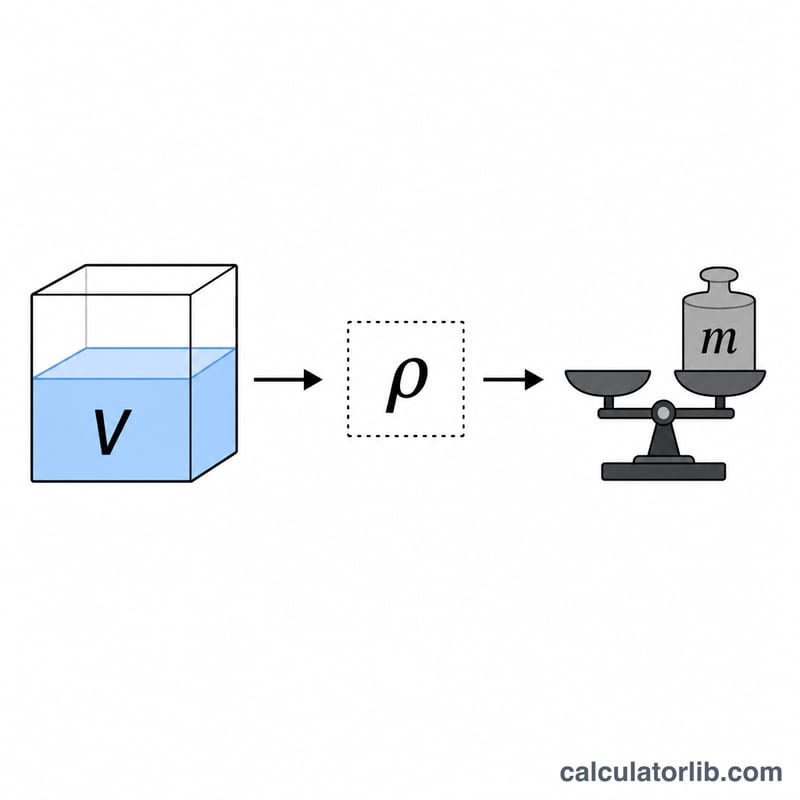
This tool converts a measured volume of any substance into its weight (mass) using the substance's density. It applies the universal relationship between mass, density and volume, so it works for water, oils, fuels, metals, chemicals and more — anywhere on Earth, with no country-specific rules.
How to use it
Enter the volume, choose the volume unit (milliliters, liters, cubic meters or US gallons), and type the density of your substance. Density can be given in g/cm³ or kg/L — they are numerically identical. The calculator returns the weight in kilograms, grams and pounds.
The formula explained
The core equation is $$m = \rho \cdot V$$ where \(m\) is mass, \(\rho\) (rho) is density and \(V\) is volume. To keep units consistent, the entered volume is first converted to liters, then multiplied by the density in kg/L to yield kilograms. Grams are kilograms \(\times 1000\) and pounds are kilograms \(\times 2.20462\).
Worked example
Take 5 liters of water, which has a density of 1.0 kg/L. $$\text{Mass} = 1.0 \times 5 = 5 \text{ kg}$$ which is 5,000 g or about 11.02 lb. Olive oil at 0.92 kg/L gives \(0.92 \times 5 = 4.6\) kg for the same 5 L.
Density of Common Substances
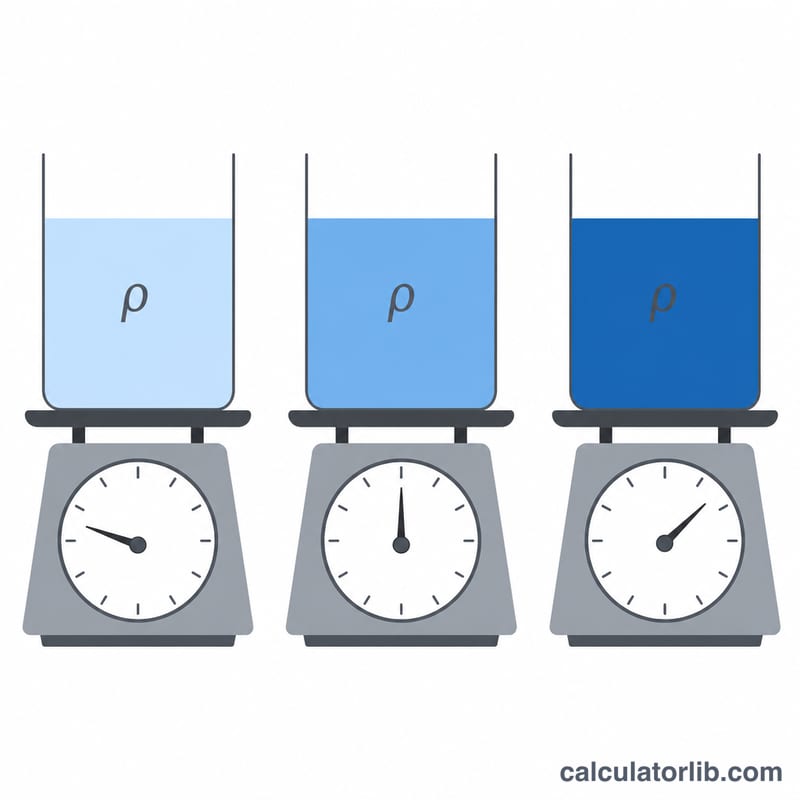
The calculator expects density in g/cm³, which is the same as kg/L. The values below are in that unit, so you can enter them directly. They are typical figures. Real densities change with temperature, composition, moisture and grade. Where a range is shown, use the middle of the range for a rough estimate. Use a measured or supplier-specified value when accuracy matters.
| Substance | Typical density (g/cm³ = kg/L) | Notes |
|---|---|---|
| Liquids | ||
| Water (pure) | 1.000 | At 4 °C (maximum density, 0.99997) |
| Water (pure) | 0.998 | At 20 °C |
| Seawater | ~1.020–1.030 (typ. 1.025) | Depends on salinity and temperature |
| Ethanol | 0.789 | At 20 °C |
| Diesel fuel | ~0.83–0.85 | At 15 °C; varies by grade and region |
| Gasoline (petrol) | ~0.71–0.77 | At 15 °C; varies by blend |
| Vegetable oil | ~0.91–0.93 (typ. 0.92) | At room temperature |
| Honey | ~1.38–1.45 (typ. 1.42) | Depends on water content |
| Mercury | 13.53 | At about 25 °C (13.55 at 20 °C) |
| Metals | ||
| Aluminum | 2.70 | Pure metal; alloys roughly 2.6–2.8 |
| Steel (carbon) | ~7.75–8.05 (typ. 7.85) | Stainless steels are usually ~7.9–8.0 |
| Iron | 7.87 | Pure iron |
| Copper | 8.96 | Pure copper |
| Lead | 11.34 | Pure lead |
| Gold | 19.32 | Pure (24-karat) gold |
| Construction and other materials | ||
| Concrete (normal-weight) | ~2.3–2.5 (typ. 2.4) | Reinforced concrete is at the higher end |
| Sand, dry | ~1.5–1.7 (typ. 1.6) | Bulk (loose-fill) density; wet sand is heavier |
| Ice | 0.917 | At 0 °C |
| Pine wood | ~0.35–0.6 (typ. 0.5) | Depends heavily on species and moisture content |
For granular materials such as sand, gravel or grain, use the bulk density. This counts the air gaps between particles. It is much lower than the density of the solid particles themselves.
Volume and Density Unit Conversions
The calculator works in liters and kg/L. Mass equals density × volume × the unit factor that converts your volume into liters. These factors are exact or standard values.
| Quantity | Conversion | Notes |
|---|---|---|
| Volume | ||
| Liter | 1 L = 1000 mL = 0.001 m³ | Calculator factor for mL: 0.001 |
| Cubic meter | 1 m³ = 1000 L | Calculator factor: 1000 |
| US liquid gallon | 1 US gal = 3.78541 L | Exact: 3.785411784 L; this is the factor the calculator uses |
| Imperial (UK) gallon | 1 imp gal = 4.54609 L | Not offered by the calculator. Convert to liters first. |
| Density | ||
| g/cm³ | 1 g/cm³ = 1 kg/L = 1 g/mL | The unit the calculator expects |
| kg/m³ | 1 g/cm³ = 1000 kg/m³ | Divide kg/m³ by 1000 to get kg/L |
| lb/ft³ | 1 g/cm³ = 62.428 lb/ft³ | Divide lb/ft³ by 62.428 to get kg/L |
| lb/US gal | 1 g/cm³ = 8.3454 lb/US gal | Divide lb/gal by 8.3454 to get kg/L |
| Mass | ||
| Kilogram | 1 kg = 1000 g = 2.20462 lb | 1 lb = 0.45359237 kg exactly |
Worked conversion
A fuel data sheet gives diesel as 850 kg/m³. You want the mass of 200 L of it. First, convert the density to kg/L:
$$\rho = \frac{850\ \text{kg/m}^3}{1000} = 0.85\ \text{kg/L}$$Then multiply by the volume. The volume is already in liters, so the unit factor is 1:
$$m = 0.85\ \text{kg/L} \times 200\ \text{L} \times 1 = 170\ \text{kg}$$So 200 L of this diesel has a mass of 170 kg. In pounds, that is \(170 \times 2.20462 \approx 374.79\) lb.
If your density is in lb/ft³, convert it the same way. For example, \(53.06 \div 62.428 \approx 0.85\) kg/L.
FAQ
Where do I find the density? Common densities: water 1.0, milk 1.03, olive oil 0.92, gasoline 0.74, honey 1.42, mercury 13.6 (all in g/cm³ = kg/L).
Why are g/cm³ and kg/L the same number? Because 1 cm³ = 1 mL and there are 1000 mL in a liter and 1000 g in a kg, the conversion factors cancel exactly.
Does temperature matter? Yes — density varies slightly with temperature, especially for gases and liquids. Use a density value measured at your working temperature for best accuracy.