What yarn count measures
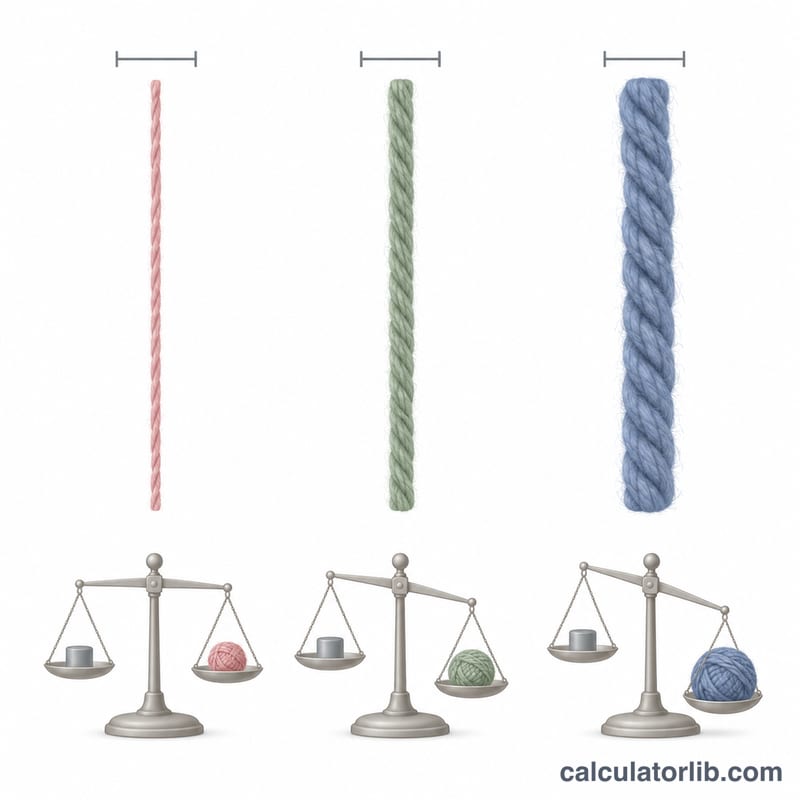
Yarn count expresses how fine or coarse a yarn is by relating its length to its weight. Two families exist. Direct systems - Tex, decitex and denier - state the mass of a fixed length, so a higher number means a thicker yarn. Indirect systems - the English cotton count \(\text{Ne}\) and the metric count \(\text{Nm}\) - state how much length you get per unit of mass, so a higher number means a finer yarn. Spinners, weavers, knitters and handspinners all need to move between these systems, which is exactly what this calculator does.
How to use it
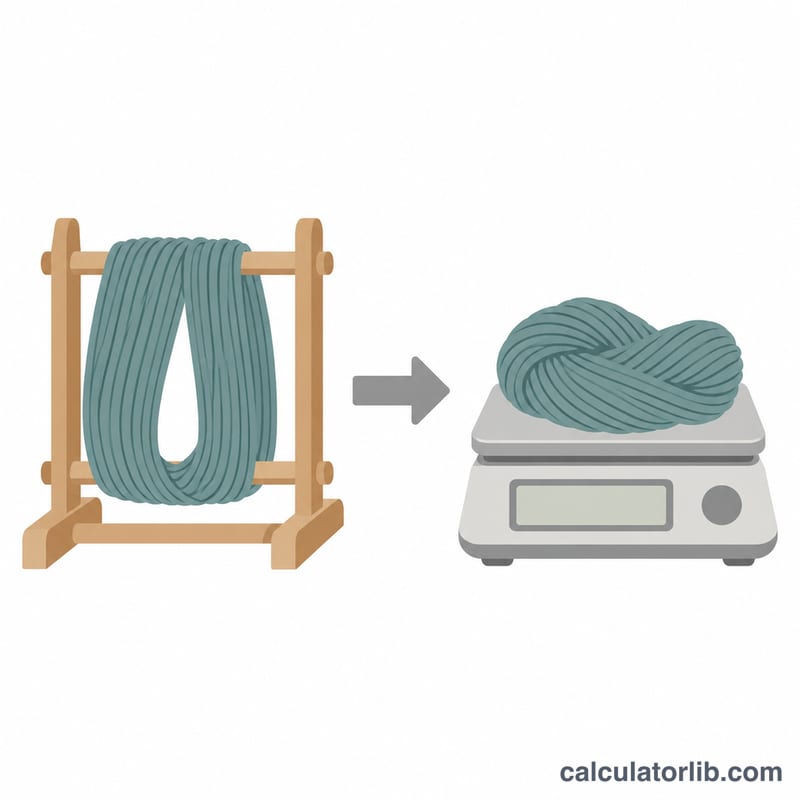
Choose Length and weight of a sample if you have wound off a skein and weighed it: enter the length and weight with their units and the tool normalises them to metres and grams. Choose Convert a known yarn count if the cone label already says 30 Ne or 150 denier, and pick the matching system. Either way you get the yarn expressed in all five counts plus yards per pound.
The formula explained
Everything is anchored on Tex, the mass in grams of 1000 metres:
$$\text{Tex} = \frac{W_g}{L_m} \times 1000$$with \(W_g\) = sample weight in grams and \(L_m\) = sample length in metres. The other counts follow directly: \(\text{Nm} = 1000/\text{Tex}\), \(\text{Den} = 9 \times \text{Tex}\) and \(\text{dtex} = 10 \times \text{Tex}\). The cotton count constant comes from its definition of one hank as 840 yards per pound:
$$\text{Ne} = \frac{453.59237}{768.096} \times \text{Nm} = \frac{590.54}{\text{Tex}}$$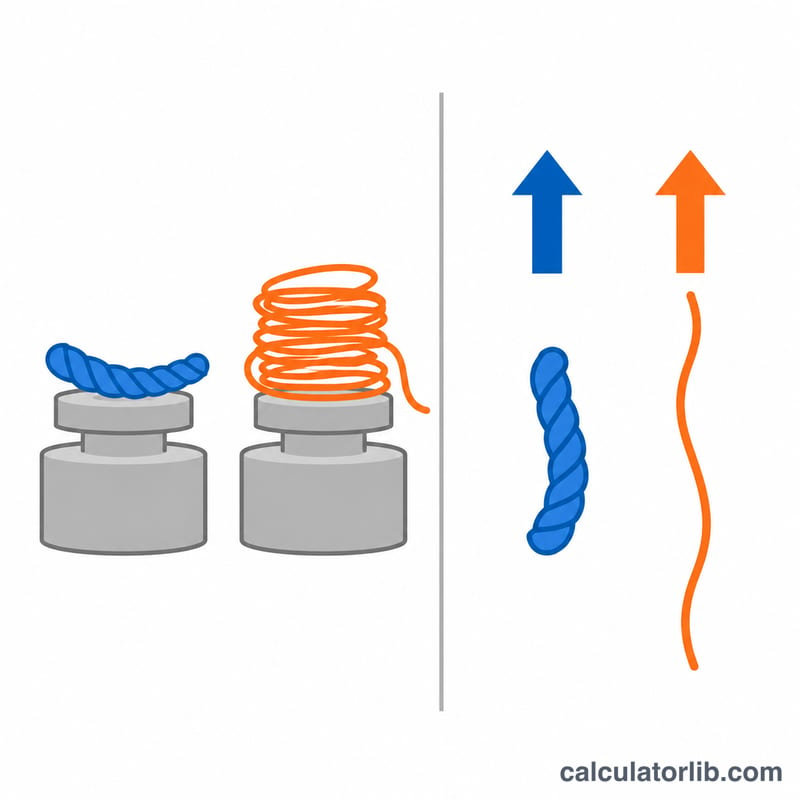
Worked example
You wind a 1000 m skein and it weighs 20 g:
$$\text{Tex} = \frac{20}{1000} \times 1000 = 20$$ $$\text{Nm} = \frac{1000}{20} = 50, \qquad \text{Ne} = \frac{590.54}{20} = 29.53$$ $$\text{Den} = 9 \times 20 = 180, \qquad \text{dtex} = 200$$So a 20 Tex yarn is roughly a 30s cotton count yarn - a typical fine shirting weft.
Yarn Count Conversion Table
Yarn fineness is quoted in two opposite families of units. Direct systems state mass per unit length, so a bigger number means a thicker yarn: tex (grams per 1 000 m, the SI-based system defined in ISO 1144), decitex (grams per 10 000 m) and denier (grams per 9 000 m). Indirect systems state length per unit mass, so a bigger number means a finer yarn: the metric count \(\text{Nm}\) (metres per gram, equivalently km per kg) and the English cotton count \(\text{Ne}\), which is the number of 840-yard hanks contained in one pound. Because Ne is built on the imperial pound and yard, its conversion constant is
$$\text{Ne} = \frac{453.59237\ \text{g/lb}}{840\ \text{yd} \times 0.9144\ \text{m/yd}} \times \frac{1000}{\text{Tex}} = \frac{590.5412474}{\text{Tex}}$$Conversion formula matrix
Read a row as the known system and a column as the system wanted. "yd/lb" is yards per pound, the raw length-per-pound figure behind Ne.
| From ↓ To → | Tex | dtex | Denier | Nm | Ne | yd/lb |
|---|---|---|---|---|---|---|
| Tex | — | \(10\,\text{Tex}\) | \(9\,\text{Tex}\) | \(\dfrac{1000}{\text{Tex}}\) | \(\dfrac{590.5412}{\text{Tex}}\) | \(\dfrac{496055}{\text{Tex}}\) |
| dtex | \(\dfrac{\text{dtex}}{10}\) | — | \(0.9\,\text{dtex}\) | \(\dfrac{10000}{\text{dtex}}\) | \(\dfrac{5905.412}{\text{dtex}}\) | \(\dfrac{4960550}{\text{dtex}}\) |
| Denier | \(\dfrac{\text{Den}}{9}\) | \(1.1111\,\text{Den}\) | — | \(\dfrac{9000}{\text{Den}}\) | \(\dfrac{5314.871}{\text{Den}}\) | \(\dfrac{4464495}{\text{Den}}\) |
| Nm | \(\dfrac{1000}{\text{Nm}}\) | \(\dfrac{10000}{\text{Nm}}\) | \(\dfrac{9000}{\text{Nm}}\) | — | \(0.590541\,\text{Nm}\) | \(496.055\,\text{Nm}\) |
| Ne | \(\dfrac{590.5412}{\text{Ne}}\) | \(\dfrac{5905.412}{\text{Ne}}\) | \(\dfrac{5314.871}{\text{Ne}}\) | \(1.69337\,\text{Ne}\) | — | \(840\,\text{Ne}\) |
| yd/lb | \(\dfrac{496055}{\text{yd/lb}}\) | \(\dfrac{4960550}{\text{yd/lb}}\) | \(\dfrac{4464495}{\text{yd/lb}}\) | \(\dfrac{\text{yd/lb}}{496.055}\) | \(\dfrac{\text{yd/lb}}{840}\) | — |
Two shortcuts worth memorising: between the direct systems the ratios are fixed (\(\text{dtex} = 10\,\text{Tex}\), \(\text{Den} = 9\,\text{Tex}\)), and between the two indirect systems \(\text{Ne} \approx 0.59\,\text{Nm}\), i.e. a metric count is roughly 1.69 times the cotton count of the same yarn.
Equivalence table for common counts
All values below are computed from the exact constants above and rounded to 2 decimals (yards per pound to the nearest yard). For example, a 1 000 m sample weighing 20 g gives Tex 20, which is 200 dtex, 180 denier, Nm 50 and Ne 29.53.
| Tex (g/km) | dtex | Denier | Nm | Ne | yd/lb |
|---|---|---|---|---|---|
| 10 | 100 | 90 | 100.00 | 59.05 | 49,606 |
| 15 | 150 | 135 | 66.67 | 39.37 | 33,070 |
| 20 | 200 | 180 | 50.00 | 29.53 | 24,803 |
| 30 | 300 | 270 | 33.33 | 19.68 | 16,535 |
| 50 | 500 | 450 | 20.00 | 11.81 | 9,921 |
| 75 | 750 | 675 | 13.33 | 7.87 | 6,614 |
| 100 | 1,000 | 900 | 10.00 | 5.91 | 4,961 |
| 200 | 2,000 | 1,800 | 5.00 | 2.95 | 2,480 |
| 500 | 5,000 | 4,500 | 2.00 | 1.18 | 992 |
Notes on reading counts in practice: a count written as Ne 30/2 or Nm 48/2 normally means two singles of that count twisted together, so the resultant yarn is about twice as heavy (Ne 30/2 ≈ Ne 15 resultant ≈ Tex 39.4 plus a few percent for twist contraction). Direct counts are additive instead: two 20 tex singles plied give roughly 40 tex. Conversions are purely arithmetic and assume the same yarn — they do not account for twist take-up, sizing, finish or moisture regain, all of which change a measured weight and therefore the measured count.
FAQ
Is a higher yarn count thicker or thinner?
In Ne and Nm a higher number is thinner. In Tex, dtex and denier a higher number is thicker.
How accurate does my sample need to be?
Weigh at least a few grams on a scale reading to 0.01 g and measure the length on a wrap reel. Short, light samples magnify weighing error.
What about plied yarns?
This tool returns the resultant count of whatever you measured. For a 2-ply made of two 30 Ne singles, the resultant is about 15 Ne, which is what you get if you weigh the finished plied yarn.