What this calculator does
The Next Number in Sequence Calculator looks at a list of numbers you enter and figures out the pattern, then predicts the upcoming terms. It automatically tests whether your sequence is arithmetic (each term changes by a fixed amount) or geometric (each term is multiplied by a fixed factor), and uses the right rule to continue the pattern.
How to use it
Type your sequence into the box separated by commas, for example 3, 6, 9, 12. Choose how many future terms you want predicted, then submit. The calculator reports the detected sequence type, the common difference (d) or common ratio (r), and the list of next terms.
The formula explained
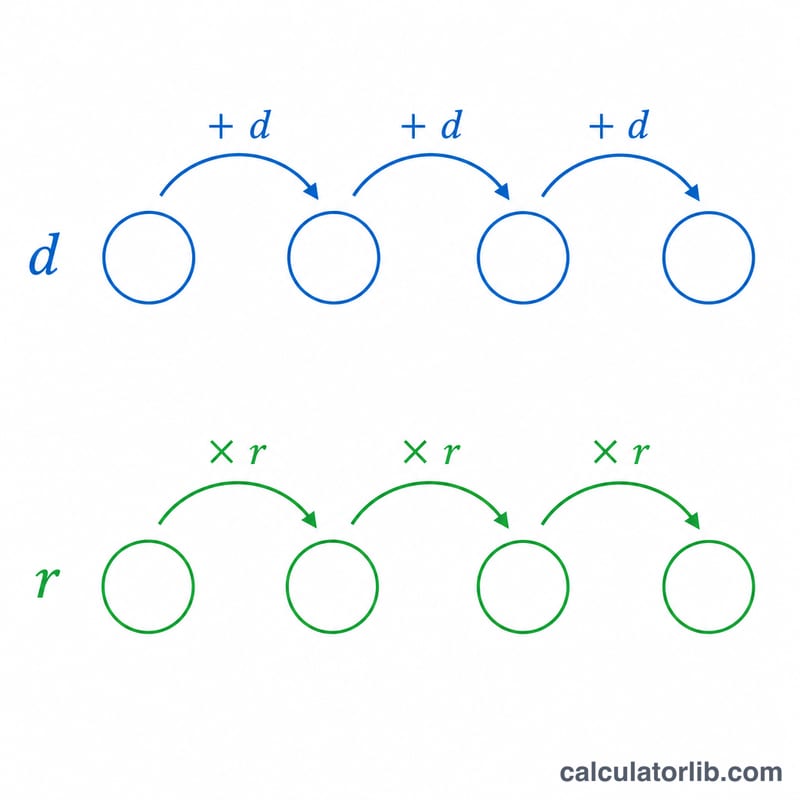
For an arithmetic sequence the difference between consecutive terms is constant: \(d = a_2 - a_1\). Each new term is the previous term plus \(d\), so $$a_{n+1} = a_n + d.$$ For a geometric sequence the ratio between consecutive terms is constant: \(r = a_2 \div a_1\). Each new term is the previous term times \(r\), so $$a_{n+1} = a_n \cdot r.$$ The tool checks every consecutive pair, so it only reports a pattern when it holds across the whole list.
Worked example
Given 2, 4, 8, 16: the differences (2, 4, 8) are not constant, so it is not arithmetic. The ratios (\(4 \div 2 = 2\), \(8 \div 4 = 2\), \(16 \div 8 = 2\)) are all 2, so it is geometric with \(r = 2\). The next three terms are $$16 \cdot 2 = 32, \quad 32 \cdot 2 = 64, \quad 64 \cdot 2 = 128.$$
More Worked Examples
Example 1: Arithmetic sequence with a positive difference
Sequence: 5, 8, 11, 14. Subtract each term from the next: \(8-5=3\), \(11-8=3\), \(14-11=3\). The difference is constant, so \(d=3\). Apply \(a_{n+1}=a_n+d\):
- \(14+3=\)17
- \(17+3=20\)
- \(20+3=23\)
The next three terms are 17, 20, 23.
Example 2: Decreasing arithmetic sequence with negatives
Sequence: 10, 7, 4. Differences: \(7-10=-3\) and \(4-7=-3\), so \(d=-3\). Continue:
- \(4+(-3)=1\)
- \(1+(-3)=-2\)
- \(-2+(-3)=-5\)
The next terms are 1, -2, -5. A negative difference means the sequence decreases and can pass through zero into negative numbers.
Example 3: A sequence that is neither arithmetic nor geometric
Sequence: 1, 4, 9, 16. Differences: \(4-1=3\), \(9-4=5\), \(16-9=7\). These are 3, 5, 7, so there is no common difference. Ratios: \(4/1=4\), \(9/4=2.25\), \(16/9\approx 1.78\). These are not equal either, so there is no common ratio.
This is the sequence of perfect squares, \(a_n=n^2\). The differences 3, 5, 7 grow by a constant amount. The second differences are \(5-3=2\) and \(7-5=2\), and a constant second difference signals a quadratic rule. The next terms are \(5^2=25\) and \(6^2=36\). A calculator that only tests for a constant difference or ratio cannot predict these, so a different rule is needed.
Sequence Terms and Definitions
- Sequence: an ordered list of numbers that follows a rule or pattern.
- Term: a single number in the sequence, identified by its position.
- nth term notation \(a_n\): the term in position \(n\). \(a_1\) is the first term, \(a_2\) the second, and \(a_{n+1}\) the term right after \(a_n\).
- Arithmetic sequence: a sequence in which each term is found by adding the same fixed number to the previous term.
- Common difference (d): that fixed number, \(d=a_{n+1}-a_n\). It can be positive, negative, or zero.
- Geometric sequence: a sequence in which each term is found by multiplying the previous term by the same fixed number.
- Common ratio (r): that fixed multiplier, \(r=a_{n+1}/a_n\) (with \(a_n\neq 0\)).
- Constant vs. non-constant patterns: arithmetic and geometric sequences have a constant difference or ratio. Many sequences do not. Quadratic sequences such as 1, 4, 9, 16 have constant second differences. The Fibonacci sequence (1, 1, 2, 3, 5, 8, …) adds the two previous terms, so neither its differences nor its ratios are constant. These need other rules.
Arithmetic vs Geometric Sequences at a Glance
| Feature | Arithmetic | Geometric |
|---|---|---|
| Pattern rule | Add a constant each step | Multiply by a constant each step |
| How to test | Differences \(a_{n+1}-a_n\) are all equal | Ratios \(a_{n+1}/a_n\) are all equal |
| Recurrence | \(a_{n+1}=a_n+d\) | \(a_{n+1}=a_n\cdot r\) |
| Closed form | \(a_n=a_1+(n-1)d\) | \(a_n=a_1\cdot r^{n-1}\) |
| Example | 5, 8, 11, 14, … (\(d=3\)) | 2, 6, 18, 54, … (\(r=3\)) |
| Behavior | Linear growth (\(d>0\)) or decline (\(d<0\)); constant if \(d=0\) | Exponential growth if \(|r|>1\), decay toward 0 if \(0<|r|<1\); if \(r<0\) the signs alternate |
FAQ
What if my sequence is neither type? If the differences and ratios are both inconsistent, the calculator reports that it is not a simple arithmetic or geometric sequence.
Can it handle decimals and negatives? Yes. Negative steps (like 10, 7, 4) and fractional ratios (like 8, 4, 2) are fully supported.
How many terms do I need? At least two numbers are required to detect a pattern; more terms give a more reliable result.