


What the converter does now
Pick the ingredient and the measure you used (US cup, 250 mL metric cup, 200 mL cup, tablespoon, teaspoon, mL or US fluid ounce), type the amount, and the weight in grams appears as you type. Switch to Grams to cups to go the other way, for example to measure 300 g of sugar with a cup. Weights come from the USDA FoodData Central household measures; for an ingredient that is not listed, choose Other and type its density.
Example: All-purpose flour: 1 US cup = 125 g. Flour and other powders vary with how the cup is filled, by about 10%, so spoon them in and level them. The numbers you type stay in your browser.
What this calculator does
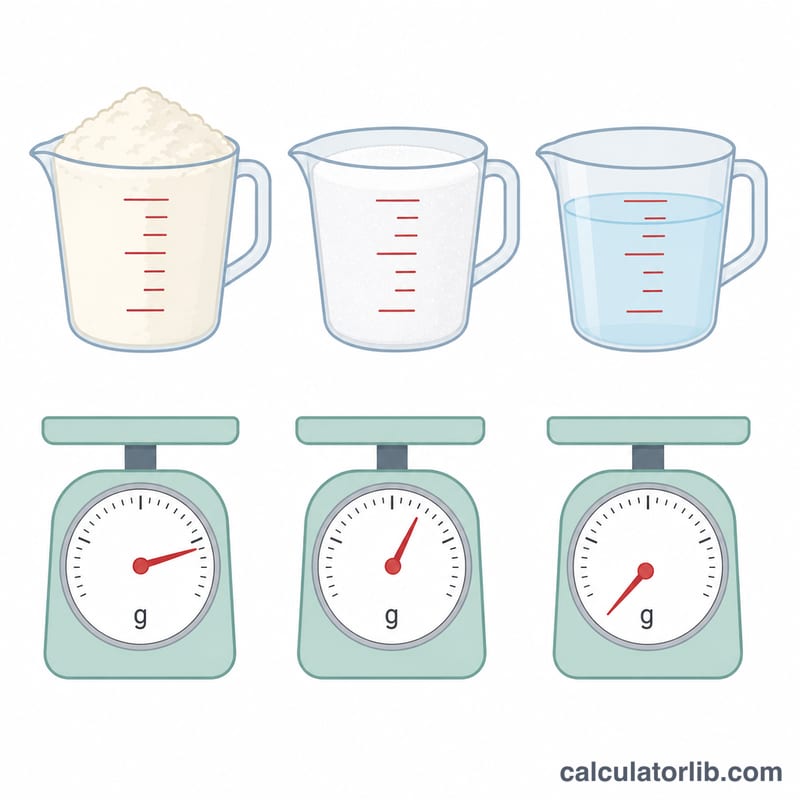
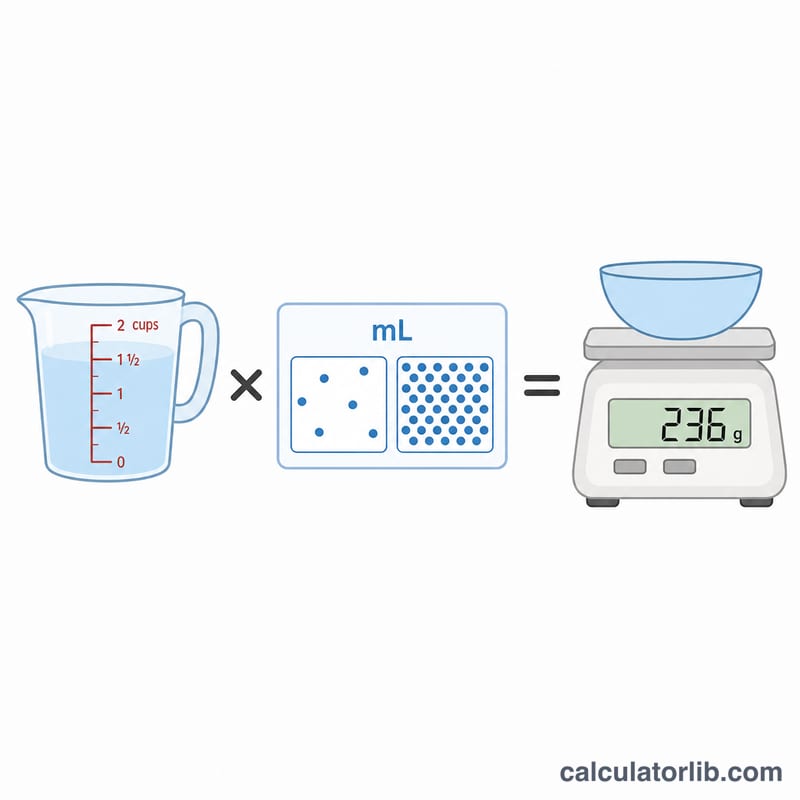
The Cups to Grams Calculator converts a volume measured in US cups into a weight in grams. Because a cup is a measure of volume and grams measure mass, the conversion depends entirely on the ingredient's density. A cup of flour weighs far less than a cup of honey, so this tool lets you select common baking ingredients or enter your own density in grams per milliliter.
The formula explained
The calculation is $$\text{Grams} = \text{Cups} \times 236.588 \times \text{Density}$$ The constant \(236.588\) is the number of milliliters in one US customary cup. Multiplying cups by this constant gives the volume in mL, and multiplying that by the density (g/mL) converts volume to mass in grams.
Worked example
Suppose you need 2 cups of all-purpose flour. Flour has a density of about \(0.529\) g/mL. Volume $$= 2 \times 236.588 = 473.176 \text{ mL}.$$ Weight $$= 473.176 \times 0.529 \approx 250.3 \text{ grams}.$$ So 2 cups of flour is roughly 250 g.
Ingredient Density and Grams-per-Cup Table
Grams per cup are found by multiplying the volume of one US customary cup (236.588 mL) by the ingredient's density in g/mL:
$$\text{Grams per cup} = 236.588 \times \text{Density (g/mL)}$$
| Ingredient | Typical density (g/mL) | Grams per 1 US cup |
|---|---|---|
| Water | ~1.00 | 237 g |
| All-purpose flour | ~0.529 | 125 g |
| Granulated sugar | ~0.845 | 200 g |
| Brown sugar (packed) | ~0.93 | 220 g |
| Powdered sugar | ~0.51 | 120 g |
| Butter | ~0.911 | 216 g |
| Honey | ~1.42 | 336 g |
| Milk | ~1.03 | 244 g |
| Vegetable oil | ~0.92 | 218 g |
| Rolled oats | ~0.34 | 80 g |
| Cocoa powder | ~0.45 | 107 g |
These are typical averages and vary by source. Powdered sugar and cocoa powder are usually quoted as 120 g and 107 g per cup, which correspond to densities of about 0.507 and 0.452 g/mL; the rounded densities shown give 121 g and 106 g. Dry ingredients vary most because of how they are scooped, sifted or packed, so a kitchen scale is more reliable than any cup conversion. For an ingredient not listed, use the custom density option.
Quick Cup Fractions to Grams Conversion
Values use 236.588 mL per US cup and the densities flour 0.529, sugar 0.845, butter 0.911 and water 1.00 g/mL, rounded to the nearest gram. For example, 1 cup of granulated sugar: \(1 \times 236.588 \times 0.845 = \) 200 g.
| US cups | Flour (g) | Sugar (g) | Butter (g) | Water (g) |
|---|---|---|---|---|
| 1/4 | 31 | 50 | 54 | 59 |
| 1/3 | 42 | 67 | 72 | 79 |
| 1/2 | 63 | 100 | 108 | 118 |
| 2/3 | 83 | 133 | 144 | 158 |
| 3/4 | 94 | 150 | 162 | 177 |
| 1 | 125 | 200 | 216 | 237 |
Recipes often round these figures (for example 30 g for 1/4 cup of flour), so small differences from published recipes are normal.
Constants and Cup Size Standards
"Cup" is not one universal unit. Check which cup your recipe uses, since the difference can change the result noticeably.
| Quantity | Value |
|---|---|
| US customary cup | 236.588 mL |
| US legal / nutrition-label cup (US labeling) | 240 mL |
| Metric cup (e.g. Australia, Canada, New Zealand recipes) | 250 mL |
| UK imperial cup (older recipes) | ~284.131 mL |
| 1 US tablespoon | 14.787 mL |
| Tablespoons per US cup | 16 |
| 1 ounce (avoirdupois) | 28.3495 g |
| Water density | 1 g/mL at about 4 °C (slightly less at room temperature) |
This calculator uses the US customary cup (236.588 mL). If your recipe uses a 250 mL metric cup, multiply the density by 250 instead of 236.588; for example, 1 metric cup of water is about 250 g.
FAQ
Why isn't 1 cup always the same grams? Different ingredients pack differently. A cup of water is 236.6 g, but a cup of flour is only about 125 g because flour is much less dense.
Is this US or metric cups? This tool uses the US customary cup of 236.588 mL. A metric cup is 250 mL and a UK imperial cup is about 284 mL.
How accurate is it for baking? Density values are typical averages; sifted vs. packed flour and humidity can vary results by 5–10%. For precision baking, a kitchen scale is best.