What Is an Ellipsoid Volume Calculator?
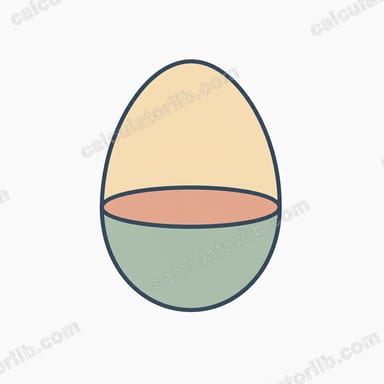
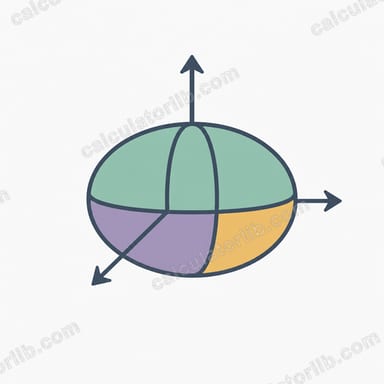
An ellipsoid is a smooth, three-dimensional surface that looks like a stretched or squashed sphere. It is defined by three semi-axes — half-lengths measured from the center along each perpendicular direction — usually labeled a, b and c. This calculator computes the enclosed volume of any ellipsoid given those three values, instantly and to full precision.

How to Use It
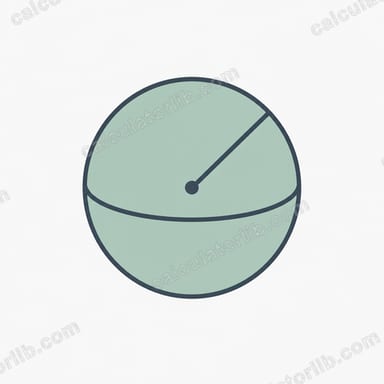
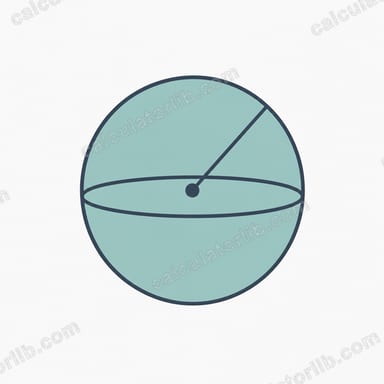
Enter the three semi-axes a, b and c in any consistent unit (centimeters, inches, meters, etc.). The calculator multiplies them together with the constant \(\frac{4\pi}{3}\) and returns the volume in the cube of that unit. For a perfect sphere, simply set \(a = b = c\) equal to the radius.
The Formula Explained
The volume of an ellipsoid is given by:
$$V = \frac{4}{3}\,\pi\,\text{a}\,\text{b}\,\text{c}$$This generalizes the familiar sphere formula \(V = \frac{4}{3}\pi r^3\). When all three semi-axes equal the radius \(r\), the product \(a\cdot b\cdot c\) becomes \(r^3\) and the equation reduces exactly to the sphere case. The factor \(\frac{4\pi}{3} \approx 4.18879\) is the same constant that appears for spheres.

Worked Example
Suppose an ellipsoid has semi-axes \(a = 3\), \(b = 4\) and \(c = 5\). Then $$V = \frac{4}{3} \times \pi \times 3 \times 4 \times 5 = \frac{4}{3} \times \pi \times 60 = 80\pi \approx 251.33$$ cubic units.
More Ellipsoid Volume Examples
The volume of an ellipsoid with semi-axes \(a\), \(b\) and \(c\) is \(V = \frac{4}{3}\pi abc\). A semi-axis is the distance from the center to the surface along one axis, which is half the full diameter. The units multiply as well, so centimeters become cubic centimeters.
Example 1: Prolate spheroid (a = b = 2 cm, c = 6 cm)
- Write the formula: \(V = \frac{4}{3}\pi abc\).
- Substitute the values: \(V = \frac{4}{3}\pi \cdot (2\ \text{cm})(2\ \text{cm})(6\ \text{cm})\).
- Multiply the lengths. The unit is cubed: \(2 \times 2 \times 6 = 24\), and \(\text{cm} \times \text{cm} \times \text{cm} = \text{cm}^3\), so the product is 24 cm³.
- Apply the factor: \(\frac{4}{3} \times 24 = 32\), so \(V = 32\pi\ \text{cm}^3\).
- Evaluate: \(V \approx\) 100.53 cm³.
Example 2: Starting from full diameters (6, 4 and 4 cm)
An egg-like ellipsoid is measured by its full diameters, so halve each one to get the semi-axes.
- Halve the diameters: \(a = 6/2 = 3\ \text{cm}\), \(b = 4/2 = 2\ \text{cm}\), \(c = 4/2 = 2\ \text{cm}\).
- Substitute: \(V = \frac{4}{3}\pi \cdot (3\ \text{cm})(2\ \text{cm})(2\ \text{cm})\).
- Multiply the lengths. The unit is cubed: \(3 \times 2 \times 2 = 12\), so the product is 12 cm³.
- Apply the factor: \(\frac{4}{3} \times 12 = 16\), so \(V = 16\pi\ \text{cm}^3\).
- Evaluate: \(V \approx\) 50.27 cm³.
A common mistake is entering full diameters as if they were semi-axes. That makes the volume 8 times too large, because each of the three factors is doubled.
Volume Comparison: Sphere, Oblate and Prolate Shapes
The table compares several shapes using the same formula \(V = \frac{4}{3}\pi abc\). Lengths are in any single unit, so volumes are in that unit cubed.
| Shape | Semi-axes (a, b, c) | Product a·b·c | Volume (exact) | Volume (approx.) |
|---|---|---|---|---|
| Sphere | (3, 3, 3) | 27 | \(36\pi\) | 113.10 |
| Oblate spheroid (flattened) | (4, 4, 2.25) | 36 | \(48\pi\) | 150.80 |
| Prolate spheroid (elongated) | (2, 2, 9) | 36 | \(48\pi\) | 150.80 |
| Sphere, all axes doubled | (6, 6, 6) | 216 | \(288\pi\) | 904.78 |
What the comparison shows
- Only the product matters. The oblate (4, 4, 2.25) and prolate (2, 2, 9) shapes look very different, but both have \(abc = 36\), so they have the same volume.
- Scaling is cubic. Doubling every semi-axis gives \(\frac{4}{3}\pi(2a)(2b)(2c) = 8 \cdot \frac{4}{3}\pi abc\). The sphere's volume goes from \(36\pi\) to \(288\pi\), which is 8 times larger.
- Equal semi-axes give a sphere. If \(a = b = c = r\), the formula reduces to \(\frac{4}{3}\pi r^3\).
FAQ
Do I use the full axis lengths or half-lengths? Use the semi-axes (half-lengths from center). If you measured full diameters, divide each by two first.
What units does the result use? Whatever unit you entered, cubed. Enter centimeters and you get cubic centimeters.
Can I use it for a sphere or a spheroid? Yes. A sphere uses \(a = b = c = r\); a spheroid (ellipsoid of revolution) uses two equal semi-axes.