What is the espresso brew ratio?
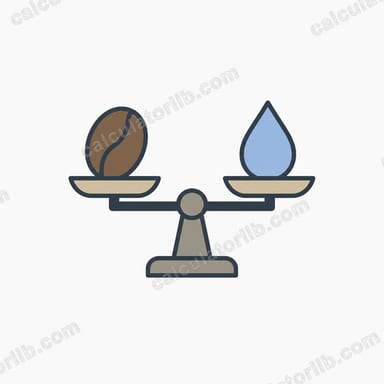
The brew ratio is the relationship between the amount of dry ground coffee you put in the portafilter (the dose) and the amount of liquid espresso you pull into the cup (the yield). It is written as 1 : N, where N is how many grams of espresso you get for every gram of coffee. A ratio of 1:2 means 18 g of coffee produces 36 g of espresso. Ratio is the single most useful number for dialing in repeatable shots across any machine or grinder.
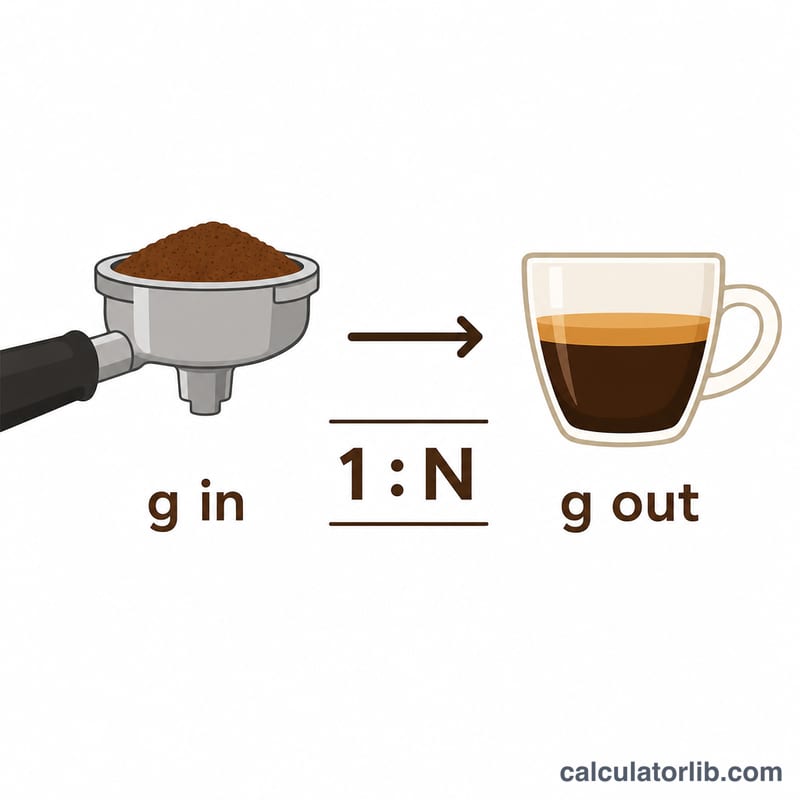
How to use this calculator
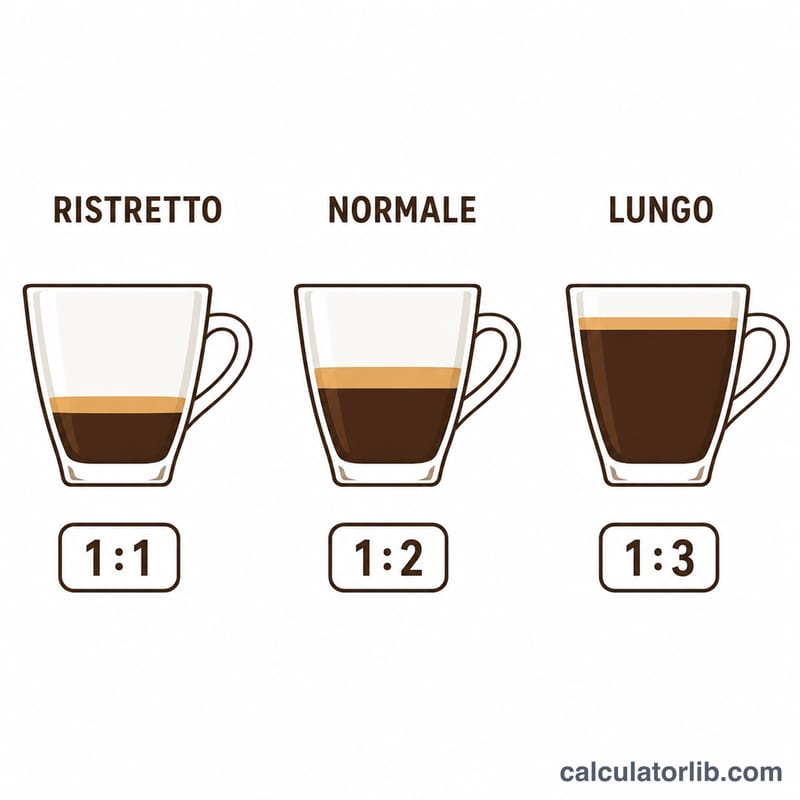
Enter your dose in grams (most baskets are made for 14–22 g) and your target brew ratio. The calculator returns the yield you should weigh on your scale. Lower ratios (1:1 to 1:1.5) give concentrated, syrupy ristretto shots; 1:2 is the classic balanced "normale"; higher ratios (1:3+) make a longer, lighter lungo. Weigh the output rather than timing alone — time is a result, not a target.
The formula explained
The math is simple multiplication: $$\text{Yield} = \text{Dose} \times \text{Ratio}$$ To work backwards from a shot you already pulled, divide: $$\text{Ratio} = \text{Yield} \div \text{Dose}$$ Because espresso is measured by mass on a scale (grams), there is no need to convert to volume or account for crema.
Worked example
You load 18 g of coffee and want a standard 1:2 shot. $$\text{Yield} = 18 \times 2 = 36 \text{ g}$$ of espresso. Pull until your scale reads 36 g, then stop the shot.
Espresso Ratio Reference: Ristretto, Normale and Lungo
Espresso brew ratio compares the dry coffee dose (grams in) with the liquid espresso yield (grams out), written 1:N. Yield = dose × N. The names and ranges below are community conventions used by baristas, not formal standards, and cafés draw the lines in slightly different places.
| Style | Typical ratio | 15 g dose | 18 g dose | 20 g dose | Typical shot time | Usual flavor profile |
|---|---|---|---|---|---|---|
| Ristretto | about 1:1 to 1:1.5 | 15–22.5 g | 18–27 g | 20–30 g | about 25–35 s (often the shorter end) | Syrupy, intense, heavy body, sweet-leaning but can taste sharp or sour |
| Normale | about 1:1.5 to 1:2.5 | 22.5–37.5 g | 27–45 g | 30–50 g | about 25–35 s | Balanced sweetness, acidity and bitterness with moderate body |
| Lungo | about 1:3 and up | 45 g+ | 54 g+ | 60 g+ | about 25–35 s, or longer with a coarser grind or higher flow | Lighter body, more dilute, more bitter or drying notes, more extracted flavors |
Shot time is a result of grind size, dose, pressure and basket, not a target in itself. Two shots with the same ratio can taste different if their times differ widely. Use the ranges as starting points and adjust to taste.
Yield Comparison by Dose and Ratio
Each cell is dose × ratio number, in grams of liquid espresso. For example, an 18 g dose at 1:2 gives \(18 \times 2 = \)36 g.
| Dose (g) | 1:1.5 | 1:2 | 1:2.5 | 1:3 |
|---|---|---|---|---|
| 14 | 21 g | 28 g | 35 g | 42 g |
| 16 | 24 g | 32 g | 40 g | 48 g |
| 18 | 27 g | 36 g | 45 g | 54 g |
| 20 | 30 g | 40 g | 50 g | 60 g |
| 22 | 33 g | 44 g | 55 g | 66 g |
Weigh the liquid in the cup, not the volume. Espresso with crema is less dense than water, so volume in milliliters will look larger than the gram yield.
Interpreting Your Ratio
The ratio sets how much water-soluble material from the coffee is spread across the liquid in your cup. A lower ratio (such as 1:1 to 1:1.5) gives a more concentrated, heavier-bodied drink. If the shot is cut short, it may also taste sour or underdeveloped, because less of the coffee has dissolved. A higher ratio (such as 1:2.5 to 1:3 or more) gives a lighter, more dilute drink. It can taste more bitter or astringent if the extra water also pulls out late-extracting compounds.
Worked example: a 20 g dose aimed at 1:2.5 gives \(20 \times 2.5 = \)50 g of espresso in the cup.
Roast level
- Darker roasts are soluble and can turn bitter quickly, so many baristas pull them at shorter ratios, often around 1:1.5 to 1:2.
- Lighter roasts are denser and harder to extract, so many baristas pull them longer, often around 1:2 to 1:3, to reach sweetness and balance.
- These are tendencies, not rules. Origin, freshness, basket and machine all matter.
Ratio, extraction yield and TDS
TDS (total dissolved solids) describes the strength of the drink, while extraction yield describes the share of the dry coffee that dissolved. In general, a longer ratio with the same dose raises extraction yield and lowers TDS, since more water carries away more solubles but dilutes them. A shorter ratio does the opposite. Grind size, water temperature and shot time also change these numbers, so a ratio alone does not guarantee a given strength or extraction. Change one variable at a time, taste the result, and adjust.
FAQ
What ratio should I start with? 1:2 is the safest starting point for most modern espresso. Adjust toward 1:1.5 for more intensity or 1:2.5 for more clarity.
Should I include crema in the yield? Weigh the total mass in the cup including crema; it settles into the liquid anyway.
Why is my shot bitter or sour at the right ratio? Ratio controls strength, not extraction balance. Adjust grind size and time: sour means under-extracted (grind finer), bitter means over-extracted (grind coarser).