What Is Free Space Path Loss?
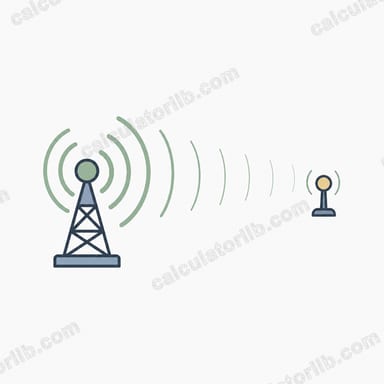
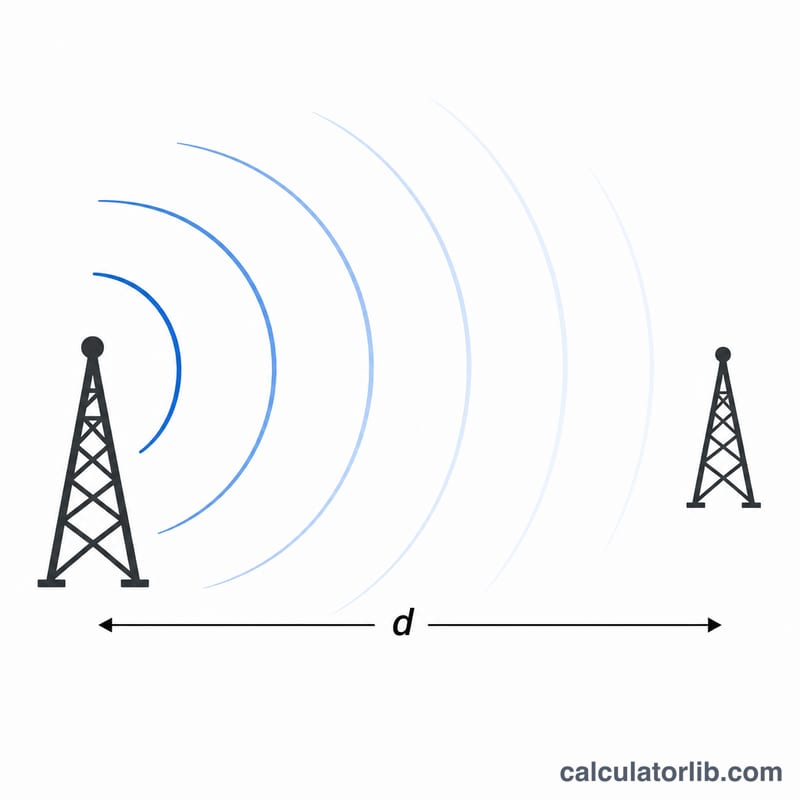
Free Space Path Loss (FSPL) is the attenuation a radio signal experiences traveling through free space (a clear line-of-sight path with no obstacles, reflections, or atmospheric absorption). It increases with both distance and frequency, and it is a foundational term in any RF link budget for Wi-Fi, satellite, microwave, cellular, and radar systems.
How to Use This Calculator
Enter the path distance in kilometers and the operating frequency in megahertz, then read the path loss in decibels (dB). Higher dB values mean more signal is lost between transmitter and receiver. To estimate received power, subtract FSPL (and other losses) from your transmit power plus antenna gains.
The Formula Explained
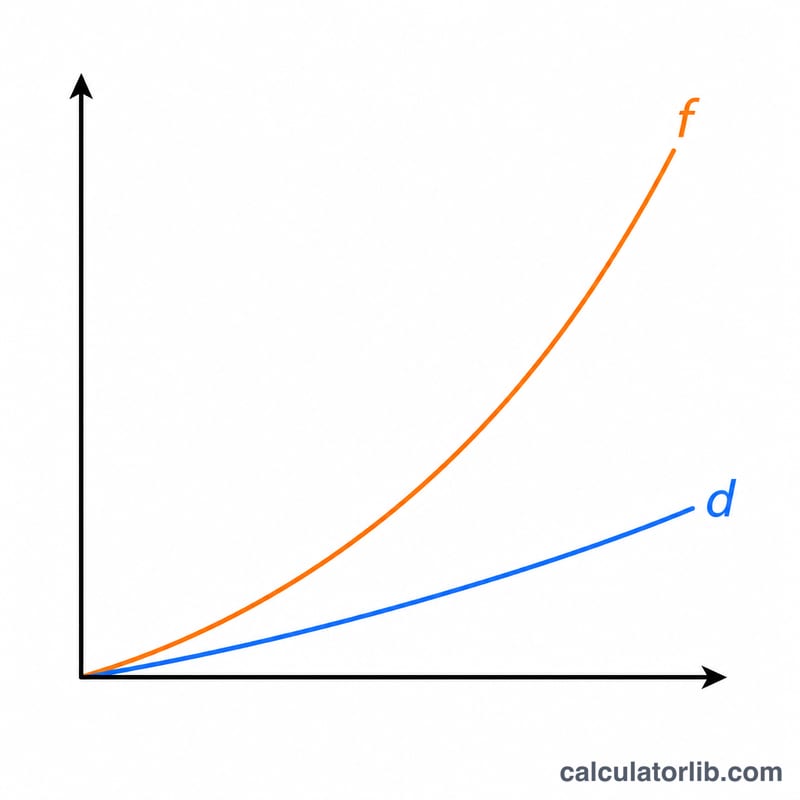
This tool uses the convenient engineering form: $$\text{FSPL}_{\text{dB}} = 20\log_{10}\!\left(\text{Distance (km)}\right) + 20\log_{10}\!\left(\text{Frequency (MHz)}\right) + 32.44$$, where \(d\) is in kilometers and \(f\) is in megahertz. The 32.44 constant bundles the speed of light and unit conversions so you can work directly in km and MHz. Doubling either distance or frequency adds about 6 dB of loss.
Worked Example
For a 2.4 GHz (2400 MHz) Wi-Fi link over 1 km: \(20\cdot\log_{10}(1) = 0\), \(20\cdot\log_{10}(2400) \approx 67.60\), plus 32.44 gives roughly 100.04 dB of free space path loss.
$$\text{FSPL}_{\text{dB}} = 20\log_{10}(1) + 20\log_{10}(2400) + 32.44 \approx 100.04\ \text{dB}$$FSPL for Common Frequencies and Distances
The values below use \(\text{FSPL} = 20\log_{10}(d_{\text{km}}) + 20\log_{10}(f_{\text{MHz}}) + 32.44\), rounded to two decimals. They are free-space values only and ignore antennas, obstructions, rain and ground reflections.
| Scenario | Frequency (MHz) | Distance (km) | FSPL (dB) |
|---|---|---|---|
| 433 MHz ISM, 1 km | 433 | 1 | 85.17 |
| 900 MHz, 5 km | 900 | 5 | 105.50 |
| 2.4 GHz Wi-Fi, 0.1 km | 2400 | 0.1 | 80.04 |
| 2.4 GHz Wi-Fi, 1 km | 2400 | 1 | 100.04 |
| 5.8 GHz, 1 km | 5800 | 1 | 107.71 |
| 5.8 GHz, 10 km | 5800 | 10 | 127.71 |
| 11 GHz microwave, 30 km | 11000 | 30 | 142.81 |
| 1.5 GHz GEO satellite, 35,786 km | 1500 | 35786 | 187.04 |
The 6 dB rule: doubling the distance (or the frequency) adds \(20\log_{10}(2) \approx 6.02\) dB of loss. Multiplying the distance by 10 adds exactly 20 dB, as in the 5.8 GHz rows (107.71 dB to 127.71 dB).
Constants and Unit Conversions Behind the 32.44 Term
The speed of light in vacuum is \(c = 299{,}792{,}458\) m/s. The general free-space path loss formula, in consistent SI units (distance \(d\) in metres, frequency \(f\) in hertz), is:
$$\text{FSPL} = 20\log_{10}\left(\frac{4\pi d f}{c}\right)$$
Deriving 32.44 for km and MHz: substitute \(d = d_{\text{km}}\times 10^{3}\) m and \(f = f_{\text{MHz}}\times 10^{6}\) Hz. Then
$$\text{FSPL} = 20\log_{10}(d_{\text{km}}) + 20\log_{10}(f_{\text{MHz}}) + 20\log_{10}\left(\frac{4\pi\times 10^{9}}{c}\right)$$
The last term is \(20\log_{10}(41.917) \approx 32.448\) dB. It is conventionally written as 32.44 (sometimes 32.45); the difference is about 0.01 dB and is negligible in practice.
| Distance unit | Frequency unit | Constant (dB) |
|---|---|---|
| km | MHz | 32.44 (more precisely 32.45) |
| km | GHz | 92.45 |
| m | MHz | -27.55 |
| m | Hz | -147.55 |
Each constant follows from the same base value: \(20\log_{10}(4\pi/c) \approx -147.55\) dB for metres and hertz. Each factor of 1000 in a unit changes the constant by 60 dB (for example, from MHz to GHz adds 60 dB, and from m to km adds 60 dB).
Interpreting Your FSPL Result in a Link Budget
FSPL is one term in the link budget, which estimates the received power:
$$P_{rx} = P_{tx} + G_{tx} + G_{rx} - \text{FSPL} - L_{\text{other}}$$
Here \(P_{tx}\) is the transmit power (dBm or dBW), \(G_{tx}\) and \(G_{rx}\) are the antenna gains (dBi), and \(L_{\text{other}}\) covers cable, connector and other losses, all in dB.
Typical magnitudes:
- About 60-80 dB: short indoor or LAN-scale links (tens of metres at 2.4 or 5 GHz).
- About 100-130 dB: kilometre-scale terrestrial links, from sub-GHz radios to 5.8 GHz point-to-point links.
- About 180-210 dB: satellite links, such as GEO at roughly 36,000 km.
What FSPL does not include: it assumes an unobstructed path in vacuum. Real links also suffer multipath fading, rain and atmospheric absorption (important at higher frequencies), foliage or building obstruction, and Fresnel-zone blockage. These losses add to FSPL. A fade margin is then applied on top of the calculated budget to allow for this variability.
Treat the result as a theoretical baseline for comparing frequencies and distances. It is not a design recommendation for any specific installation.
FAQ
Does FSPL include obstacles or weather? No. It assumes an ideal unobstructed path. Real-world links add fading, rain, foliage, and diffraction losses on top.
Why does higher frequency mean more loss? The formula models loss relative to an isotropic antenna whose effective aperture shrinks with wavelength, so higher frequencies capture less energy at the same distance.
Can I use meters and Hz? This version expects km and MHz. Convert your values first (1000 m = 1 km, 1,000,000 Hz = 1 MHz).