What Is the Gold Weight Calculator?
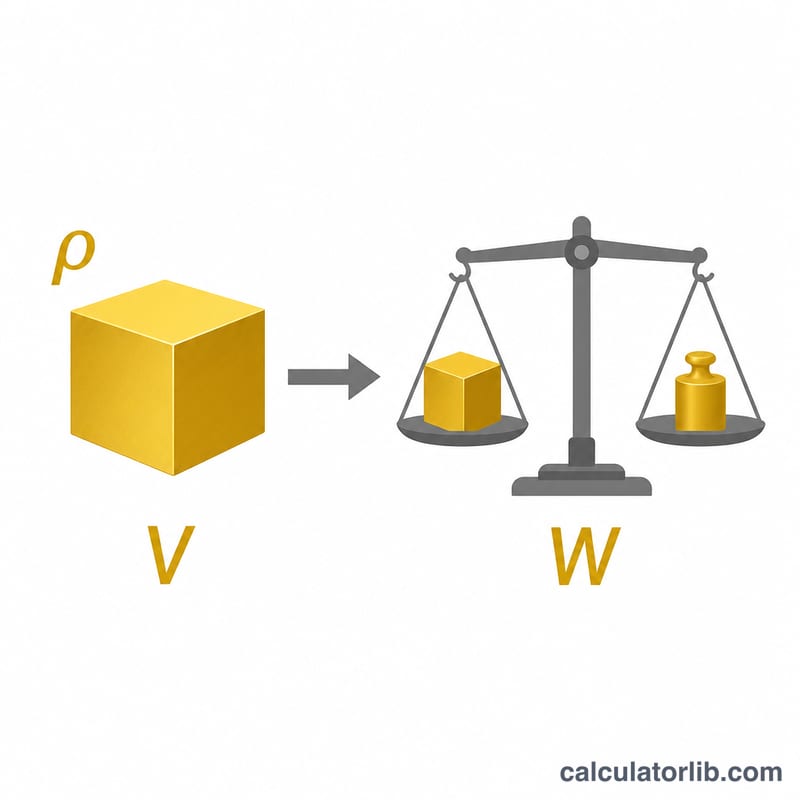
This calculator estimates how much a piece of gold weighs based on its volume. It uses the fundamental relationship between mass, density, and volume: weight equals density multiplied by volume. Pure (24-karat) gold has a density of 19,320 kg/m³, or equivalently 19.32 grams per cubic centimetre — one of the highest of any common metal, which is why even small gold objects feel surprisingly heavy.
How to Use It
Enter the volume of your gold object in cubic centimetres (cm³). If you know the dimensions, multiply length × width × height, or use water displacement to measure an irregular object. Then choose the karat purity. The calculator returns the total weight in grams, ounces, and troy ounces, plus the estimated mass of pure gold contained in the item.
The Formula Explained
The core equation is \(W = \rho \times V\). With \(\rho = 19.32 \text{ g/cm}^3\), a volume of 1 cm³ of pure gold weighs 19.32 grams. To estimate the pure gold content of an alloyed piece, the total weight is multiplied by the karat fraction (karat ÷ 24). The full relationship used by the calculator is:
$$\text{Gold Weight (g)} = 19.320 \times \text{Volume (cm}^3\text{)} \times \frac{\text{Purity (K)}}{24}$$
Note that real alloys have slightly lower density than pure gold, so this is a practical approximation for the gold portion.
Worked Example
Suppose you have a small pure-gold bar measuring 10 cm³. Weight $$= 19.32 \times 10 = \textbf{193.2 grams}$$ Converting: \(193.2 \div 28.3495 \approx 6.82\) ounces, or \(193.2 \div 31.1035 \approx 6.21\) troy ounces (the unit used for precious metals).
Gold Karat Purity and Alloy Density Table
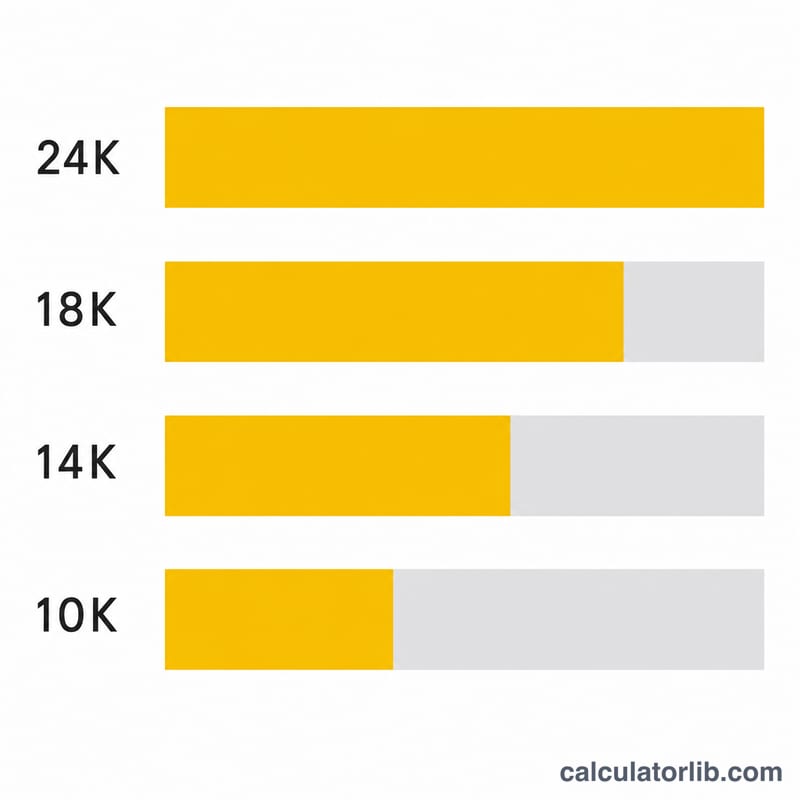
Karat (K) expresses how much of an alloy is pure gold, as a fraction of 24 parts. The fineness (millesimal) number stamped on jewellery is the same figure written in parts per thousand. Because the remaining parts are lighter metals — copper, silver, nickel, zinc, palladium — the density of a karat alloy is always lower than that of pure gold, and this is what lets a volume-based estimate be converted into a realistic weight.
| Karat | Gold fraction (K÷24) | Fineness mark | Gold by weight | Typical alloy density (g/cm³) |
|---|---|---|---|---|
| 24K | 24/24 = 1.000 | 999 | ≈ 99.9% | 19.32 (pure gold) |
| 22K | 22/24 ≈ 0.9167 | 916 | ≈ 91.7% | ≈ 17.7–17.8 |
| 18K | 18/24 = 0.750 | 750 | 75.0% | ≈ 15.6 (yellow); ≈ 14.7–16.3 (white, depending on nickel vs. palladium) |
| 14K | 14/24 ≈ 0.5833 | 585 | ≈ 58.5% | ≈ 13.1 (yellow) |
| 10K | 10/24 ≈ 0.4167 | 417 | ≈ 41.7% | ≈ 11.6 |
| 9K | 9/24 = 0.375 | 375 | 37.5% | ≈ 11.2 |
Notes on using this table:
- The density column is indicative. Two 18K pieces of the same karat can differ by more than 1 g/cm³ because the alloy recipe differs: copper-rich rose gold sits at the higher end, nickel white gold lower, and palladium white gold higher again. Rose and white variants of the same karat are never identical to the yellow figure.
- Fineness marks are rounded conventions. A 22K alloy is 916.7 parts per thousand but is stamped 916; 14K is 583.3 and is stamped 585 in most markets. Hallmarking rules and the karats legally allowed for sale differ by country — 9K (375) is common in the UK and Australia, while 10K (417) is the usual low-karat grade in the United States and Canada.
- This calculator uses the simpler proportional model \(m = 19.320 \times V \times \dfrac{K}{24}\), i.e. it scales the pure-gold density 19.320 g/cm³ by the karat fraction. That gives the mass of gold content implied by a volume of pure gold, and is a clean way to compare karats on a common basis. For the total mass of a finished alloy object, multiply the measured volume by the measured alloy density from the last column instead.
A worked check with the proportional model: an 18K item of volume 5 cm³ gives
$$m = 19.320 \times 5 \times \frac{18}{24} = 19.320 \times 5 \times 0.75 = 72.45\ \text{g}$$
so the result is 72.45 g. For comparison, the same 5 cm³ at 24K would be 96.60 g, and at 10K about 40.25 g — the volume is unchanged, only the karat fraction moves.
To convert any gram figure onward: 1 troy ounce = 31.1034768 g (the unit used for precious-metal pricing), while 1 avoirdupois ounce = 28.349523125 g. So 72.45 g ≈ 2.330 troy ounces.
FAQ
What is a troy ounce? Precious metals are weighed in troy ounces, which equal about 31.1 grams — heavier than the standard avoirdupois ounce of 28.35 grams.
Why does purity matter? Lower-karat gold contains other metals (copper, silver). The "pure gold content" figure estimates how much actual gold is present.
How do I measure volume? For regular shapes use geometry; for jewellery, submerge it in water and measure the volume of water displaced.