1 inch is exactly 2.54 cm and 1 foot is 12 inches, so inches = cm ÷ 2.54. 170 cm = 66.93 in = 5 ft 6.93 in, and 180 cm = 70.87 in = 5 ft 10.87 in.
What this converter does
This tool converts a height given in centimeters into US customary units: decimal inches, decimal feet, and the everyday feet-and-inches form (like 5 ft 6 7/8 in). Because the conversion uses the exact international inch (1 inch = 2.54 cm exactly), it is pure unit conversion and gives identical results everywhere in the world.
How to use it
Enter your height in centimeters. Then choose the fraction precision for the feet-and-inches answer by typing a denominator after "1/" — for example 8 rounds the leftover inches to the nearest 1/8 inch, 16 to the nearest 1/16, and so on. Press calculate to see all four results. The displayed fraction is automatically reduced (so 4/8 shows as 1/2).
The formula explained
Decimal inches = cm / 2.54. Decimal feet = inches / 12 (equivalently cm / 30.48, since one foot is 30.48 cm). For the combined form, whole feet is the floor of inches / 12. The leftover inches (a value between 0 and 12) are split into a whole-inch part and a fractional part. The fraction is found by rounding (frac \(\times\) D) to the nearest whole numerator over your chosen denominator D, then reducing by the greatest common divisor. If rounding pushes the inches to 12, it rolls over into an extra foot.
$$\text{inches} = \frac{\text{cm}}{2.54}, \quad \text{feet} = \frac{\text{cm}}{30.48}$$$$\text{ft} = \left\lfloor \frac{\text{in}}{12} \right\rfloor, \quad \text{frac} = \frac{\text{round}((\text{in} \bmod 12 - \lfloor \rfloor)\cdot D)}{D}$$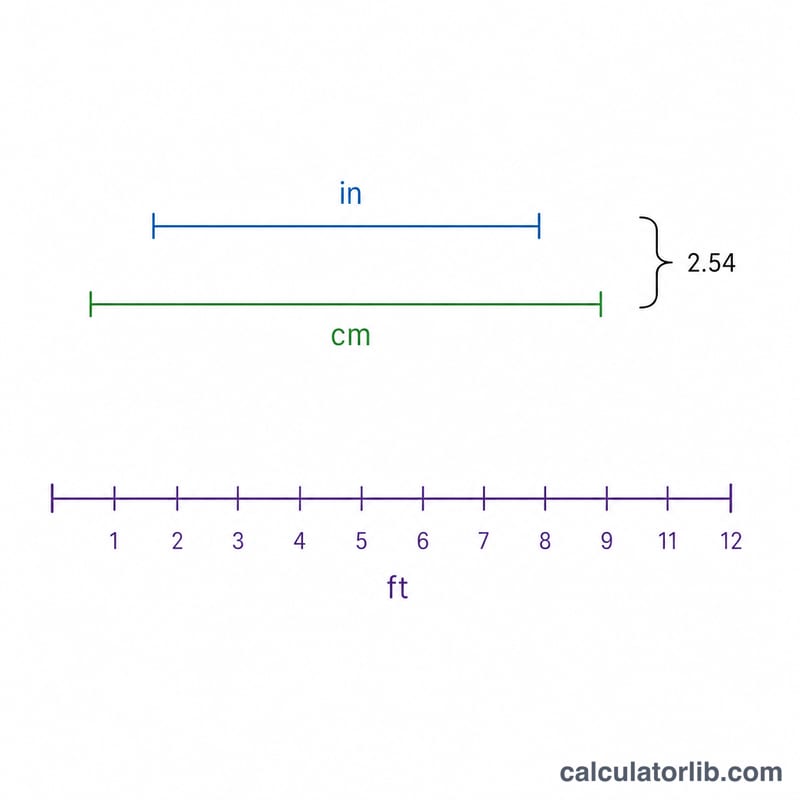
Worked example
For 170 cm with denominator 8: decimal inches = 170 / 2.54 = 66.93 in; decimal feet = 66.93 / 12 = 5.58 ft. Whole feet = floor(5.5774) = 5, leftover = 6.929 in. Whole inch part = 6, frac = 0.929, numerator = round(0.929 \(\times\) 8) = 7, giving 7/8. Result: 5 ft 6 7/8 in.
$$\text{inches} = \frac{170}{2.54} = 66.93 \text{ in}$$$$\text{feet} = \frac{66.93}{12} = 5.58 \text{ ft}$$$$\text{round}(0.929 \times 8) = 7$$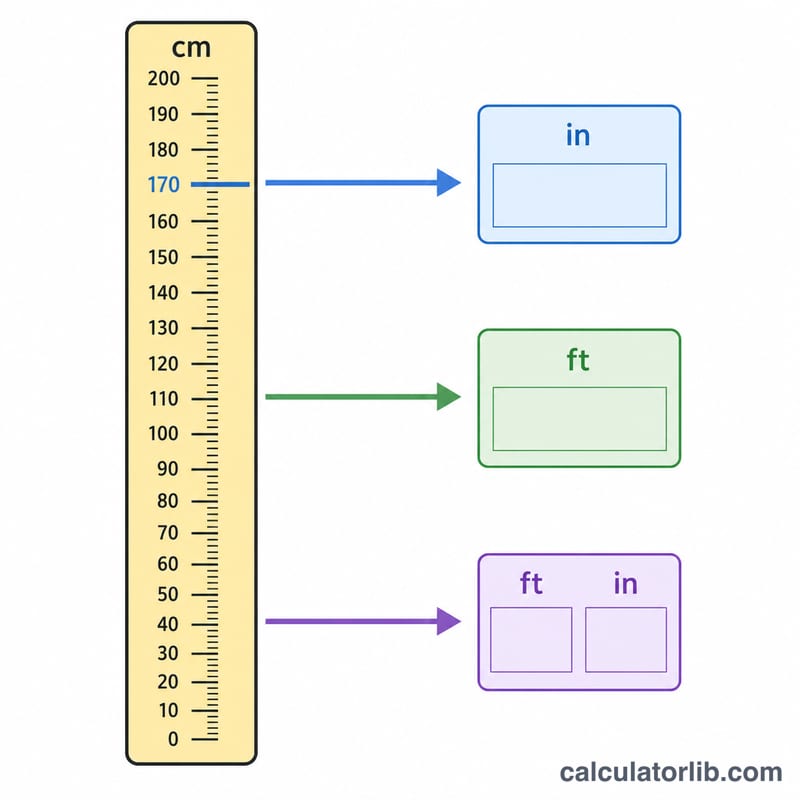
cm to Feet and Inches Conversion Table
Every value below is derived from the exact definition \(1\ \text{in} = 2.54\ \text{cm}\): inches are \(\text{cm} \div 2.54\), decimal feet are \(\text{inches} \div 12\), and the feet-and-inches column is rounded to the nearest \(1/8\) in (denominator \(D = 8\)). Decimal columns are shown to 4 decimal places; the underlying quotients are non-terminating in decimal form, so they are rounded, not exact.
| Centimeters | Inches (decimal) | Feet (decimal) | Feet & inches (nearest 1/8 in) |
|---|---|---|---|
| 140 | 55.1181 | 4.5932 | 4 ft 7 1/8 in |
| 142 | 55.9055 | 4.6588 | 4 ft 7 7/8 in |
| 144 | 56.6929 | 4.7244 | 4 ft 8 3/4 in |
| 146 | 57.4803 | 4.7900 | 4 ft 9 1/2 in |
| 148 | 58.2677 | 4.8556 | 4 ft 10 1/4 in |
| 150 | 59.0551 | 4.9213 | 4 ft 11 in |
| 152 | 59.8425 | 4.9869 | 4 ft 11 7/8 in |
| 154 | 60.6299 | 5.0525 | 5 ft 0 5/8 in |
| 156 | 61.4173 | 5.1181 | 5 ft 1 3/8 in |
| 158 | 62.2047 | 5.1837 | 5 ft 2 1/4 in |
| 160 | 62.9921 | 5.2493 | 5 ft 3 in |
| 162 | 63.7795 | 5.3150 | 5 ft 3 3/4 in |
| 164 | 64.5669 | 5.3806 | 5 ft 4 5/8 in |
| 166 | 65.3543 | 5.4462 | 5 ft 5 3/8 in |
| 168 | 66.1417 | 5.5118 | 5 ft 6 1/8 in |
| 170 | 66.9291 | 5.5774 | 5 ft 6 7/8 in |
| 172 | 67.7165 | 5.6430 | 5 ft 7 3/4 in |
| 174 | 68.5039 | 5.7087 | 5 ft 8 1/2 in |
| 176 | 69.2913 | 5.7743 | 5 ft 9 1/4 in |
| 178 | 70.0787 | 5.8399 | 5 ft 10 1/8 in |
| 180 | 70.8661 | 5.9055 | 5 ft 10 7/8 in |
| 182 | 71.6535 | 5.9711 | 5 ft 11 5/8 in |
| 184 | 72.4409 | 6.0367 | 6 ft 0 1/2 in |
| 186 | 73.2283 | 6.1024 | 6 ft 1 1/4 in |
| 188 | 74.0157 | 6.1680 | 6 ft 2 in |
| 190 | 74.8031 | 6.2336 | 6 ft 2 3/4 in |
| 192 | 75.5906 | 6.2992 | 6 ft 3 5/8 in |
| 194 | 76.3780 | 6.3648 | 6 ft 4 3/8 in |
| 196 | 77.1654 | 6.4304 | 6 ft 5 1/8 in |
| 198 | 77.9528 | 6.4961 | 6 ft 6 in |
| 200 | 78.7402 | 6.5617 | 6 ft 6 3/4 in |
Two rows above show the rounding rollover: at 160 cm the leftover after 5 ft is 2.9921 in, and \(0.9921 \times 8 = 7.94\) rounds to 8 eighths, i.e. a whole inch, so the display becomes 5 ft 3 in rather than 5 ft 2 8/8 in. The same happens at 198 cm (6 ft 6 in).
| Feet & inches | Total inches | Centimeters (exact) |
|---|---|---|
| 5 ft 0 in | 60 | 152.4 |
| 5 ft 4 in | 64 | 162.56 |
| 5 ft 6 in | 66 | 167.64 |
| 5 ft 10 in | 70 | 177.8 |
| 6 ft 0 in | 72 | 182.88 |
| 6 ft 2 in | 74 | 187.96 |
The reverse values are exact because multiplying whole inches by 2.54 terminates: \(72 \times 2.54 = 182.88\) cm. Going the other way rarely lands on a clean fraction, which is why a denominator has to be chosen. Rounding to the nearest \(1/8\) in can shift the displayed height by up to \(1/16\) in \(\approx 0.159\) cm; choosing \(D = 16\) halves that to about 0.079 cm.
Exact Conversion Constants
Since the 1959 international yard and pound agreement — signed by the national standards bodies of the United States, the United Kingdom, Canada, Australia, New Zealand and South Africa — the international yard is defined as exactly 0.9144 m. Every inch and foot relationship below follows from that single definition, so the metric-to-imperial link is a matter of definition, not measurement.
| Relationship | Value | Exact or rounded? |
|---|---|---|
| 1 inch | 2.54 cm | Exact by definition (1959 agreement) |
| 1 foot = 12 in | 30.48 cm = 0.3048 m | Exact by definition |
| 1 yard = 36 in = 3 ft | 91.44 cm = 0.9144 m | Exact by definition |
| 1 meter | 100 cm | Exact by definition (SI prefix centi- = 10⁻²) |
| 1 cm | 0.393700787401… in | Rounded decimal (exact value is 1/2.54) |
| 1 m | 39.370078740157… in | Rounded decimal (exact value is 100/2.54) |
| 1 m | 3.280839895013… ft | Rounded decimal (exact value is 1/0.3048) |
The distinction matters for how you round. The forward constants are exact fractions:
$$1\ \text{cm} = \frac{1}{2.54}\ \text{in} = \frac{50}{127}\ \text{in}, \qquad 1\ \text{m} = \frac{5000}{127}\ \text{in} = \frac{1250}{381}\ \text{ft}$$Because 127 is prime and does not divide any power of 10, those quotients never terminate in decimal form — 0.3937007874… and 39.3700787401… are truncations, so a converter that divides by 2.54 is more accurate than one that multiplies by a stored 0.3937 factor. The calculator above divides.
One country-specific caveat: the United States also had a legacy US survey foot, defined as exactly 1200/3937 m, which is about 2 parts per million longer than the international foot (a difference of roughly 3.2 mm over 1600 m). It was used only in land surveying and geodetic work, was never used for body height, and was officially retired for new US applications at the end of 2022. For heights, always use the international inch of exactly 2.54 cm.
More Worked Examples
Each example follows the same four steps: divide by 2.54 to get total inches, take the floor of inches ÷ 12 for whole feet, take the floor of the leftover for whole inches, then turn the remaining decimal into a fraction with numerator \(N = \operatorname{round}(\text{frac} \times D)\) and reduce \(N/D\) by their greatest common divisor.
Example 1 — 155 cm to the nearest 1/16 in (a fraction that rounds away)
- Total inches: \(155 \div 2.54 = 61.023622\) in.
- Whole feet: \(\left\lfloor 61.023622 \div 12 \right\rfloor = \left\lfloor 5.085302 \right\rfloor = 5\) ft.
- Leftover inches: \(61.023622 - 12 \times 5 = 1.023622\), so \(I = \left\lfloor 1.023622 \right\rfloor = 1\) in.
- Fractional part: \(0.023622 \times 16 = 0.378\), which rounds to \(N = 0\).
The remainder is smaller than half of one sixteenth (0.03125 in), so it disappears and the result is 5 ft 1 in (61.0236 in, 5.0853 ft). This is a useful reminder that a finer denominator does not force a fraction to appear — 155 cm really is within 0.024 in (0.06 cm) of a whole 61 in.
Example 2 — 182.8 cm to the nearest 1/8 in (rollover case)
- Total inches: \(182.8 \div 2.54 = 71.968504\) in.
- Whole feet: \(\left\lfloor 71.968504 \div 12 \right\rfloor = \left\lfloor 5.997375 \right\rfloor = 5\) ft.
- Leftover inches: \(71.968504 - 60 = 11.968504\), so \(I = 11\) in.
- Fractional part: \(0.968504 \times 8 = 7.748\), which rounds to \(N = 8\).
Here \(N = D\), so the fraction is a whole inch: \(11 + 1 = 12\) in, which is itself a whole foot. The carry propagates twice and the answer is 6 ft 0 in, even though the decimal feet value is 5.9974 ft. A converter that skips this carry would wrongly print "5 ft 12 in".
Example 3 — 200 cm to the nearest 1/4 in
- Total inches: \(200 \div 2.54 = 78.740157\) in.
- Whole feet: \(\left\lfloor 78.740157 \div 12 \right\rfloor = \left\lfloor 6.561680 \right\rfloor = 6\) ft.
- Leftover inches: \(78.740157 - 72 = 6.740157\), so \(I = 6\) in.
- Fractional part: \(0.740157 \times 4 = 2.961\), which rounds to \(N = 3\); \(\gcd(3,4) = 1\), so \(3/4\) is already reduced.
Result: 6 ft 6 3/4 in (78.7402 in, 6.5617 ft).
Example 4 — where reduction matters: 146 cm at D = 16
Total inches \(146 \div 2.54 = 57.480315\); \(F = 4\), leftover \(9.480315\) so \(I = 9\); \(0.480315 \times 16 = 7.685\) rounds to \(N = 8\). Since \(\gcd(8,16) = 8\), the fraction reduces:
$$\frac{8}{16} = \frac{8 \div 8}{16 \div 8} = \frac{1}{2}$$so the height prints as 4 ft 9 1/2 in, not 4 ft 9 8/16 in. Reduction is cosmetic only — it never changes the numeric value, just the way it reads on a tape measure or a height chart.
FAQ
Is the conversion exact? Yes. The international inch is defined as exactly 2.54 cm, so the math is exact and locale-independent.
Why choose a denominator? Tape measures and rulers come in fractional gradations (halves, quarters, eighths, sixteenths). Picking the matching denominator gives a number you can read straight off a real ruler.
What about 0 or negative input? Zero centimeters returns 0 in / 0 ft / 0 ft 0 in. Negative heights are treated as 0 because a height cannot be negative.