What This Calculator Does
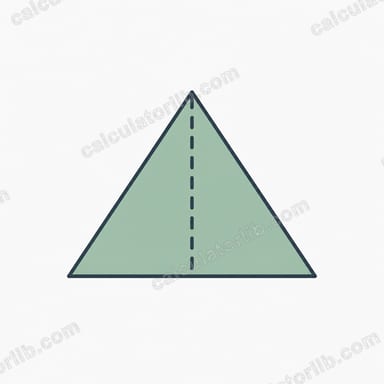
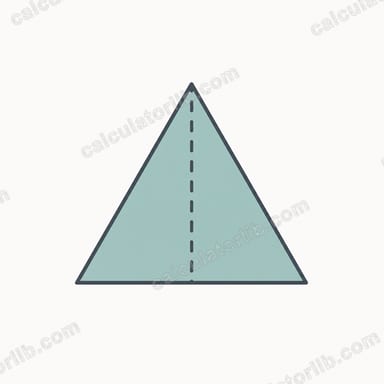
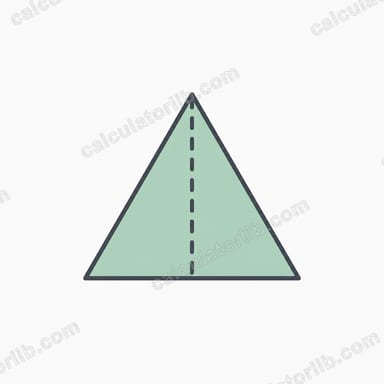
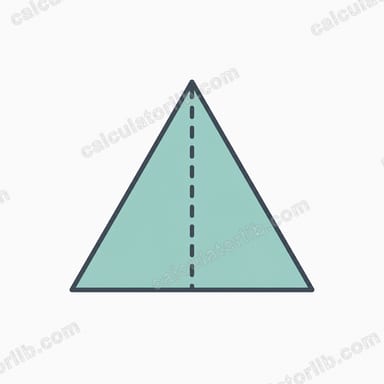
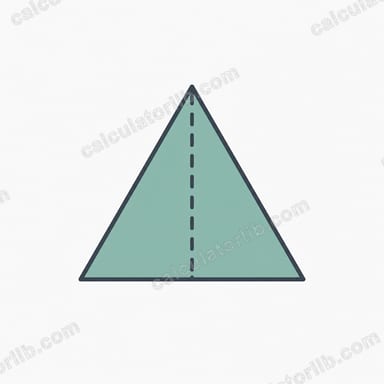
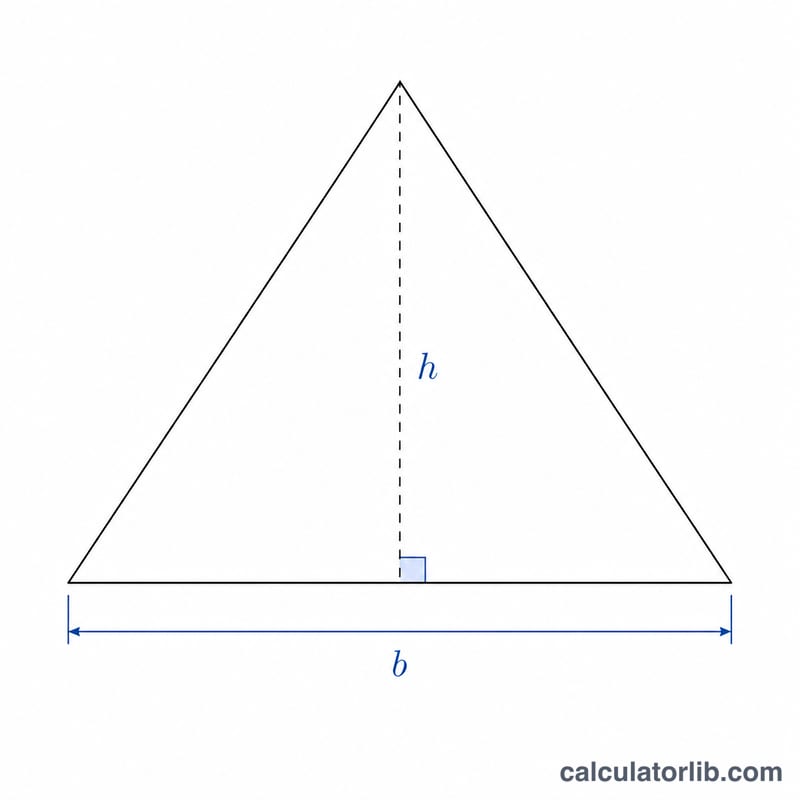
The Isosceles Triangle Area Calculator finds the area of an isosceles triangle from just two measurements: the base and the height. An isosceles triangle has two equal sides, so the perpendicular height drawn from the apex meets the base at its exact midpoint. This calculator uses that geometry to compute both the area and, as a bonus, the full perimeter — so you get a complete picture from two simple inputs.
The Inputs You Provide
- Base: the length of the bottom (unequal) side of the triangle.
- Height: the perpendicular distance from the base up to the apex (the top vertex).
Use the same unit for both — centimetres, metres, inches, etc. The area will be in those units squared.
The Formula
The area uses the standard triangle formula:
$$A = \frac{1}{2} \times b \times h$$
Behind the scenes the tool also calculates the perimeter. Because the height splits the base into two equal halves of \(b/2\), each of the two equal sides is found with the Pythagorean theorem:
$$P = b + 2 \times \sqrt{h^2 + \left(\frac{b}{2}\right)^2}$$
Worked Example
Suppose your isosceles triangle has a base of 10 and a height of 12.
- Area $$= \frac{1}{2} \times 10 \times 12 = \textbf{60 square units}$$
- Each equal side $$= \sqrt{12^2 + 5^2} = \sqrt{144 + 25} = \sqrt{169} = 13$$
- Perimeter $$= 10 + 2 \times 13 = \textbf{36 units}$$
So with two quick measurements you instantly know both the area (60) and the perimeter (36).
More Worked Examples
Each example uses the area formula \(A = \tfrac{1}{2} \times b \times h\). To get the perimeter, find the length of each equal side \(s\) first. The height splits an isosceles triangle into two congruent right triangles. Each one has legs \(\tfrac{b}{2}\) and \(h\), and its hypotenuse is the side \(s\):
$$s = \sqrt{\left(\tfrac{b}{2}\right)^2 + h^2}, \qquad P = b + 2s$$Area is given in square units and perimeter in ordinary length units.
Example 1: Decimal metric inputs (base 6.4 m, height 3.5 m)
- Area: \(A = \tfrac{1}{2} \times 6.4 \times 3.5 = 3.2 \times 3.5 = 11.2\). The area is 11.2 m².
- Half the base: \(\tfrac{6.4}{2} = 3.2\) m.
- Equal side: \(s = \sqrt{3.2^2 + 3.5^2} = \sqrt{10.24 + 12.25} = \sqrt{22.49} \approx 4.742\) m, or about 4.74 m.
- Perimeter: \(P = 6.4 + 2 \times 4.742 = 6.4 + 9.485 \approx 15.88\) m.
Use the unrounded side length when you add up the perimeter, then round the final answer. Rounding the sides first can shift the last digit.
Example 2: Only the base and the equal sides are known (base 16, sides 17)
- Find the height: half the base is \(\tfrac{16}{2} = 8\). The Pythagorean theorem gives \(h = \sqrt{17^2 - 8^2} = \sqrt{289 - 64} = \sqrt{225} = 15\).
- Area: \(A = \tfrac{1}{2} \times 16 \times 15 = 8 \times 15 = 120\). The area is 120 square units.
- Perimeter: \(P = 16 + 2 \times 17 = 16 + 34 = 50\) units.
The 8–15–17 right triangle is a Pythagorean triple, so every value here is a whole number. Once you have found the height, enter base 16 and height 15 into the calculator.
Example 3: A practical case in inches (gable end, base 24 in, height 9 in)
- Area: \(A = \tfrac{1}{2} \times 24 \times 9 = 12 \times 9 = 108\). The gable face covers 108 in².
- Half the base: \(\tfrac{24}{2} = 12\) in.
- Equal (sloped) side: \(s = \sqrt{12^2 + 9^2} = \sqrt{144 + 81} = \sqrt{225} = 15\) in.
- Perimeter: \(P = 24 + 2 \times 15 = 24 + 30 = 54\) in.
Use the area to work out how much siding, paint or sheathing the triangle needs. Use the perimeter for trim or edging. Add an allowance for waste and overlaps, because the calculation covers only the exact geometric shape.
Frequently Asked Questions
Does this work for any triangle, or only isosceles? The area formula \(A = \frac{1}{2}bh\) works for any triangle. However, the perimeter result is only correct for an isosceles triangle, since it assumes the height bisects the base into two equal halves.
What is "height" exactly? It is the perpendicular distance from the base to the opposite vertex — not the length of a slanted side. If you only know the slant side, use the Pythagorean theorem to find the height first.
What units does the answer use? Whatever unit you enter for base and height. If both are in centimetres, the area is in square centimetres and the perimeter is in centimetres.