What Is the Math Power Calculator?
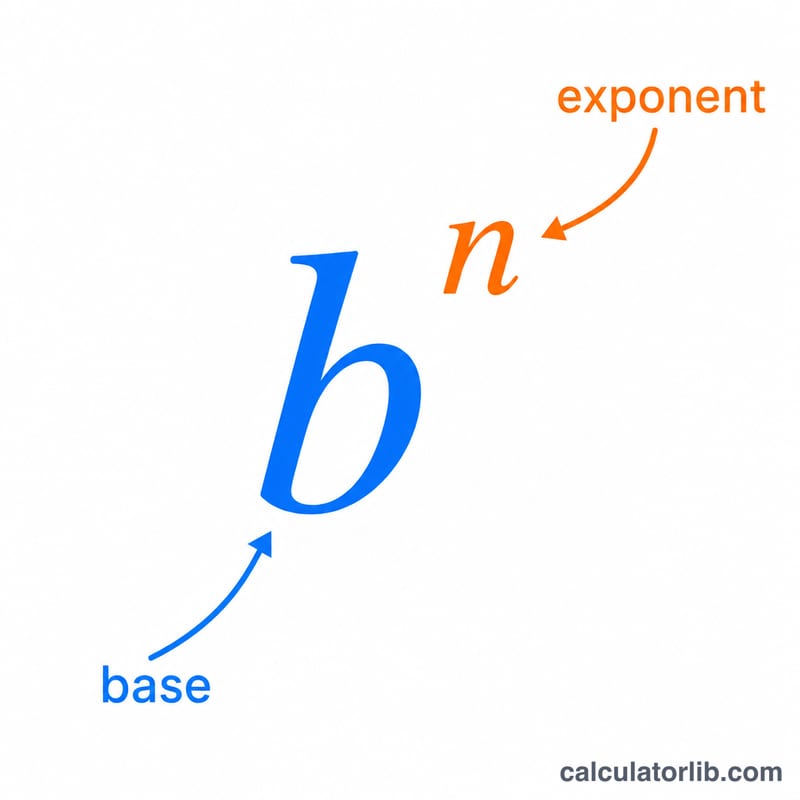
The Math Power Calculator computes exponentiation — raising a base number to an exponent (also called the power or index). It evaluates the expression \(\text{base}^{\text{exponent}}\), supporting whole numbers, decimals, negative bases, and even fractional exponents (which produce roots).
How to Use It
Enter the base value and the exponent value, then read the result instantly. For example, a base of 2 with an exponent of 10 gives 1,024. A fractional exponent like 0.5 produces a square root, and a negative exponent gives the reciprocal of the positive power.
The Formula Explained
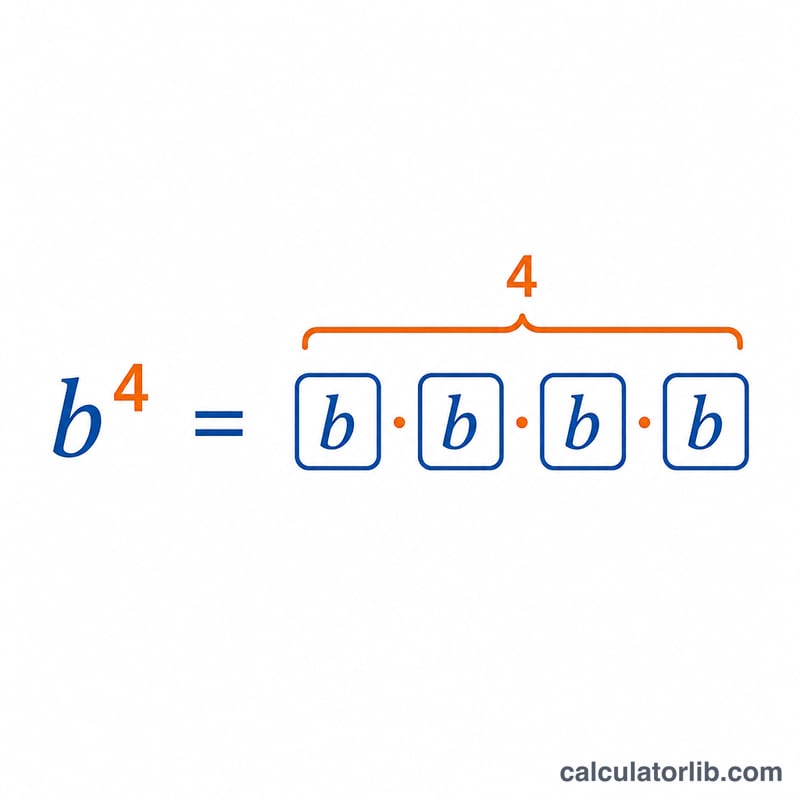
Exponentiation is defined as $$\text{result} = \text{base}^{\text{exponent}}$$ For a positive whole-number exponent \(n\), this means multiplying the base by itself \(n\) times: \(b^3 = b \times b \times b\). A negative exponent inverts the result: \(b^{-n} = 1 / b^n\). A fractional exponent is a root: \(b^{1/2} = \sqrt{b}\). Any non-zero number raised to the power 0 equals 1.
Worked Example
Suppose base = 3 and exponent = 4. Then $$\text{result} = 3^4 = 3 \times 3 \times 3 \times 3 = 81.$$ If instead exponent = -2, \(\text{result} = 3^{-2} = 1 / 9 \approx 0.111111\).
Common Powers Reference Table
These exact values are useful for checking results from the calculator. For example, 1,024 is \(2^{10}\).
Squares and cubes, 1 to 12
| n | n² | n³ |
|---|---|---|
| 1 | 1 | 1 |
| 2 | 4 | 8 |
| 3 | 9 | 27 |
| 4 | 16 | 64 |
| 5 | 25 | 125 |
| 6 | 36 | 216 |
| 7 | 49 | 343 |
| 8 | 64 | 512 |
| 9 | 81 | 729 |
| 10 | 100 | 1,000 |
| 11 | 121 | 1,331 |
| 12 | 144 | 1,728 |
Powers of 2
| Power | Value | Power | Value |
|---|---|---|---|
| 2⁰ | 1 | 2⁹ | 512 |
| 2¹ | 2 | 2¹⁰ | 1,024 |
| 2² | 4 | 2¹¹ | 2,048 |
| 2³ | 8 | 2¹² | 4,096 |
| 2⁴ | 16 | 2¹³ | 8,192 |
| 2⁵ | 32 | 2¹⁴ | 16,384 |
| 2⁶ | 64 | 2¹⁵ | 32,768 |
| 2⁷ | 128 | 2¹⁶ | 65,536 |
| 2⁸ | 256 |
Powers of 10
| Power | Value |
|---|---|
| 10⁻³ | 0.001 |
| 10⁻² | 0.01 |
| 10⁻¹ | 0.1 |
| 10⁰ | 1 |
| 10¹ | 10 |
| 10² | 100 |
| 10³ | 1,000 |
| 10⁴ | 10,000 |
| 10⁵ | 100,000 |
| 10⁶ | 1,000,000 |
| 10⁷ | 10,000,000 |
| 10⁸ | 100,000,000 |
| 10⁹ | 1,000,000,000 |
Special Cases and Domain Limits
- 0⁰: The value is conventionally defined as 1 in many contexts, such as combinatorics, power series and the binomial theorem. Many programming languages also return 1 (for example, the IEEE 754
powfunction). In calculus, \(0^0\) is an indeterminate form when it arises as a limit, so some textbooks leave it undefined. Check which convention your context uses. - Zero to a negative exponent: \(0^{-n} = \frac{1}{0^n} = \frac{1}{0}\), which is division by zero and therefore undefined. For example, \(0^{-2}\) has no value.
- Negative base with a fractional exponent: \((-4)^{0.5}\) means the square root of \(-4\). It has no real value (the principal complex value is \(2i\)), so many calculators return an error or NaN. \((-8)^{1/3}\) is trickier. The real cube root is \(-2\), but since \(1/3\) is not stored exactly as a decimal, software working in real numbers often returns NaN. Under the principal complex definition the result is \(1 + i\sqrt{3}\). Results for these inputs depend on the tool.
- Even vs odd integer exponents: A negative base raised to an even integer gives a positive result: \((-3)^4 = 81\). A negative base raised to an odd integer gives a negative result: \((-3)^3 = -27\). Take care with notation, because \(-3^4\) means \(-(3^4) = -81\).
- Bases between 0 and 1: Larger positive exponents make the result smaller, for example \(0.5^1 = 0.5\), \(0.5^2 = 0.25\), \(0.5^3 = 0.125\). Negative exponents make it larger: \(0.5^{-3} = 8\). Bases above 1 do the opposite.
- Special bases: \(1^n = 1\) for any \(n\). Any nonzero base raised to the power 0 equals 1. Any base raised to the power 1 is itself.
- Floating-point and overflow limits: Most software uses 64-bit doubles. These represent integers exactly only up to \(2^{53} = 9{,}007{,}199{,}254{,}740{,}992\), so larger results are rounded to about 15 to 17 significant digits. The largest finite double is about \(1.8 \times 10^{308}\). For example, \(10^{308}\) is representable, but \(10^{309}\) overflows to Infinity. Likewise \(2^{1023}\) is finite and \(2^{1024}\) overflows. Very small results below about \(5 \times 10^{-324}\) underflow to 0.
Exponent Rules and Scenario Comparison
The table shows how the exponent changes the result for bases 4 and 2. A positive integer exponent means repeated multiplication, a zero exponent gives 1, a negative exponent gives a reciprocal, and an exponent of 0.5 gives a square root.
| Exponent | Meaning | 4^exponent | 2^exponent |
|---|---|---|---|
| 3 | multiply the base 3 times | 64 | 8 |
| 0 | always 1 (nonzero base) | 1 | 1 |
| -1 | reciprocal | 0.25 | 0.5 |
| 0.5 | square root | 2 | ≈ 1.41421356 (irrational, \(\sqrt{2}\)) |
| -0.5 | reciprocal of the square root | 0.5 | ≈ 0.70710678 (\(1/\sqrt{2}\)) |
Worked check for base 4: \(4^{-0.5} = \frac{1}{4^{0.5}} = \frac{1}{\sqrt{4}} = \frac{1}{2} = 0.5\).
Key exponent laws (for \(a \neq 0\))
- Product rule: \(a^m \cdot a^n = a^{m+n}\). Example: \(2^3 \cdot 2^4 = 2^7 = 128\).
- Quotient rule: \(\frac{a^m}{a^n} = a^{m-n}\). Example: \(\frac{10^5}{10^2} = 10^3 = 1{,}000\).
- Power of a power: \((a^m)^n = a^{mn}\). Example: \((2^3)^2 = 2^6 = 64\).
- Negative exponent: \(a^{-n} = \frac{1}{a^n}\).
- Fractional exponent: \(a^{1/n} = \sqrt[n]{a}\), and \(a^{m/n} = \left(\sqrt[n]{a}\right)^m\) for \(a > 0\).
FAQ
What does an exponent of 0 give? Any non-zero base raised to 0 equals 1.
Can I use a negative exponent? Yes — it returns the reciprocal of the base raised to the positive exponent.
Can the exponent be a decimal? Yes. Fractional exponents return roots; for example base 8 with exponent 1/3 gives 2, the cube root of 8.