What Is the Mega Millions Odds Calculator?
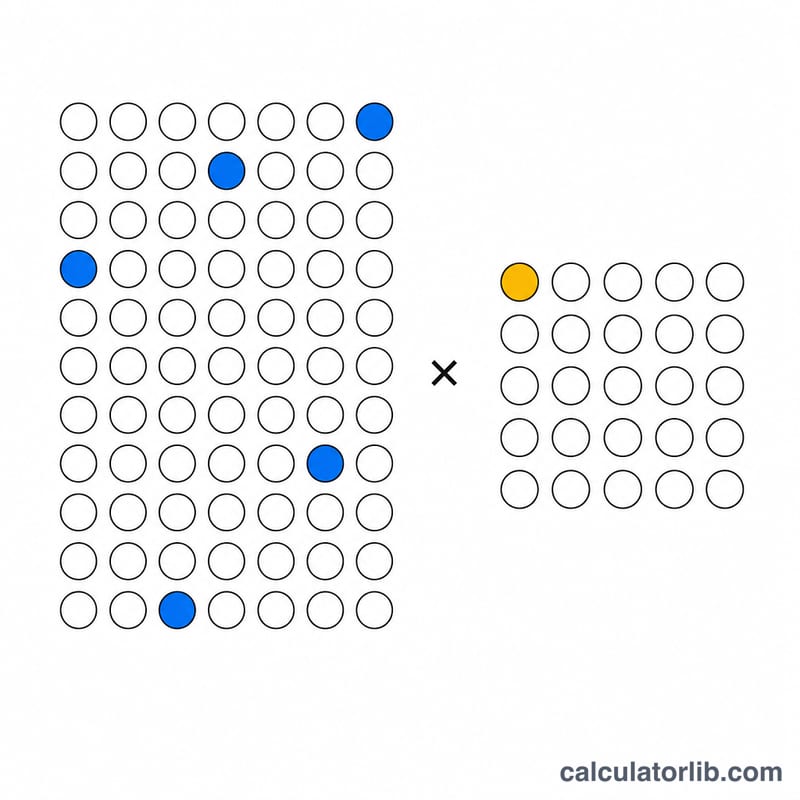
Mega Millions is a US multi-state lottery in which you pick 5 white-ball numbers from a pool (traditionally 1-70) plus one gold "Mega Ball" from a separate pool (traditionally 1-25). This calculator computes the probability of matching all numbers and winning the jackpot, expressed as a "1 in N" figure. It is configurable, so you can model rule changes or other lotteries simply by adjusting the pool sizes.
How to Use It
Enter the total number of white balls in the pool, how many white balls you must pick, and the number of Mega Balls. The defaults reflect the standard US Mega Millions matrix. Press calculate to see the exact number of possible combinations and your odds of hitting the jackpot with a single ticket.
The Formula Explained
The white-ball combinations follow the "n choose k" formula, since order does not matter: \(C(n,k) = \frac{n!}{k!\cdot(n-k)!}\). The single Mega Ball is a straightforward 1-in-m chance. Total jackpot combinations are the product of the two, and the odds are the reciprocal.
$$\text{Jackpot odds} = \frac{1}{\dbinom{\text{white total}}{\text{white pick}} \times \text{mega total}}$$
Worked Example
With 70 white balls choosing 5:
$$C(70,5) = \frac{70\cdot69\cdot68\cdot67\cdot66}{5\cdot4\cdot3\cdot2\cdot1} = \frac{1{,}452{,}361{,}680}{120} = 12{,}103{,}014$$Multiply by 25 Mega Balls:
$$12{,}103{,}014 \times 25 = 302{,}575{,}350$$So your jackpot odds are 1 in 302,575,350.
Odds Under Different Ball Matrices
The jackpot odds come from multiplying the number of ways to pick the white balls by the number of Mega Ball choices: \(\text{Combinations} = \binom{n}{5} \times m\), where \(n\) is the white-ball pool and \(m\) is the Mega Ball pool. Odds are 1 in that number. The table compares several US lottery matrices. The Powerball row is included only for context.
| Game / matrix | Period (US) | White combinations \(\binom{n}{5}\) | Bonus ball choices | Total combinations | Jackpot odds |
|---|---|---|---|---|---|
| Mega Millions 5/70 + 1/25 | October 2017 onward (this calculator's default) | 12,103,014 | 25 | 302,575,350 | 1 in 302,575,350 |
| Mega Millions 5/75 + 1/15 | October 2013 to October 2017 | 17,259,390 | 15 | 258,890,850 | 1 in 258,890,850 |
| Mega Millions 5/56 + 1/46 | Used until October 2013 | 3,819,816 | 46 | 175,711,536 | 1 in 175,711,536 |
| Powerball 5/69 + 1/26 (for context) | October 2015 onward | 11,238,513 | 26 | 292,201,338 | 1 in 292,201,338 |
Example of the arithmetic for the first row:
$$\binom{70}{5} = \frac{70 \times 69 \times 68 \times 67 \times 66}{5 \times 4 \times 3 \times 2 \times 1} = 12{,}103{,}014, \qquad 12{,}103{,}014 \times 25 = 302{,}575{,}350$$
The same method gives the other rows: \(17{,}259{,}390 \times 15 = 258{,}890{,}850\), \(3{,}819{,}816 \times 46 = 175{,}711{,}536\) and \(11{,}238{,}513 \times 26 = 292{,}201{,}338\). Moving from the 5/75 + 1/15 matrix to 5/70 + 1/25 enlarged the Mega Ball pool more than it shrank the white-ball pool, so the jackpot odds became longer. Lottery operators can change game rules, so check the official game rules for the matrix currently in use. The calculator lets you enter any pool sizes.
Interpreting Your Odds
Odds of 1 in 302,575,350 correspond to a probability of about \(3.3 \times 10^{-9}\), or roughly 0.00000033%, for a single ticket and a single drawing.
- Every combination is equally likely. Each possible set of five white balls plus a Mega Ball has exactly the same chance, whether it looks "random" (such as 3-17-42-58-66) or patterned (such as 1-2-3-4-5).
- Draws are independent. Past results do not influence future ones. A number that has not appeared recently is not "due," and a number that appeared often is not more or less likely next time.
- The figure applies to one ticket. It is the chance that a single entry matches all six numbers. It says nothing about expected payout, prize size, or how a jackpot might be shared if several tickets win.
For a sense of scale, consider flipping a fair coin and getting heads every time. Twenty-eight heads in a row has probability \(1/2^{28}\), and \(2^{28} = 268{,}435{,}456\). Twenty-nine in a row has \(2^{29} = 536{,}870{,}912\). Since 302,575,350 lies between these two values, the jackpot odds are comparable to getting about 28 heads in a row (log base 2 of 302,575,350 is roughly 28.2).
These figures cover only the jackpot (matching all five white balls and the Mega Ball) under the matrix you enter. Odds for lower prize tiers are different and depend on the official prize structure.
FAQ
Are these the official odds? Yes — 1 in 302,575,350 matches the published US Mega Millions jackpot odds for the 70/25 matrix.
Does buying more tickets help? Each distinct ticket adds one chance, so 10 tickets give roughly 10 in 302,575,350. The improvement is real but tiny.
Why is order ignored? Lottery draws are evaluated as a set of numbers, not a sequence, which is why combinations (not permutations) are used.