What this calculator does
This tool converts a mass concentration in milligrams per liter (mg/L) into parts per million (ppm), and also reports the equivalent in parts per billion (ppb). It is intended for dilute aqueous (water-based) solutions, which is the most common context in water quality, environmental testing, and laboratory work.
Why mg/L often equals ppm
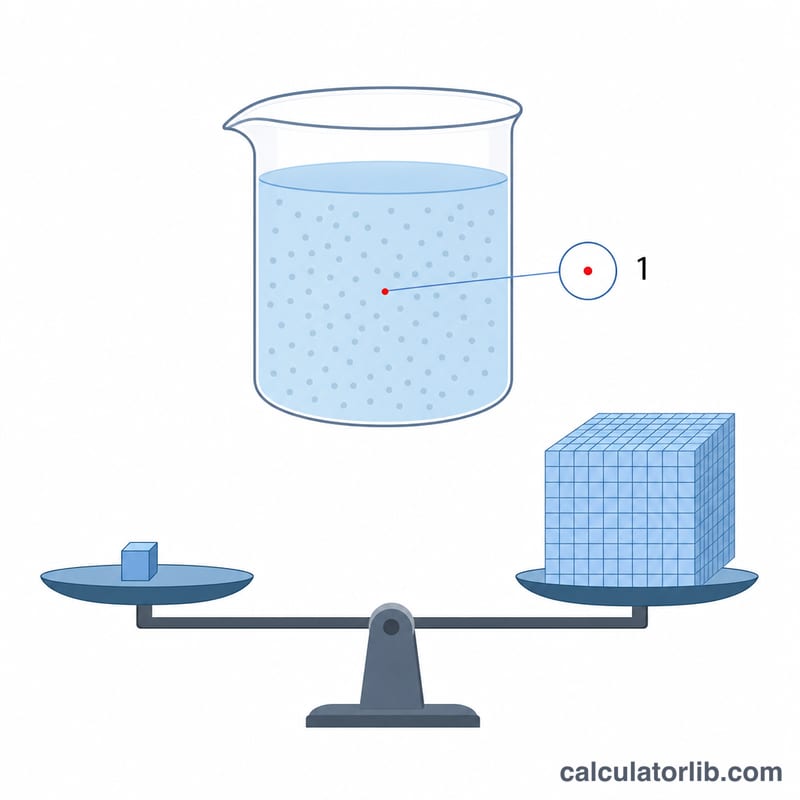
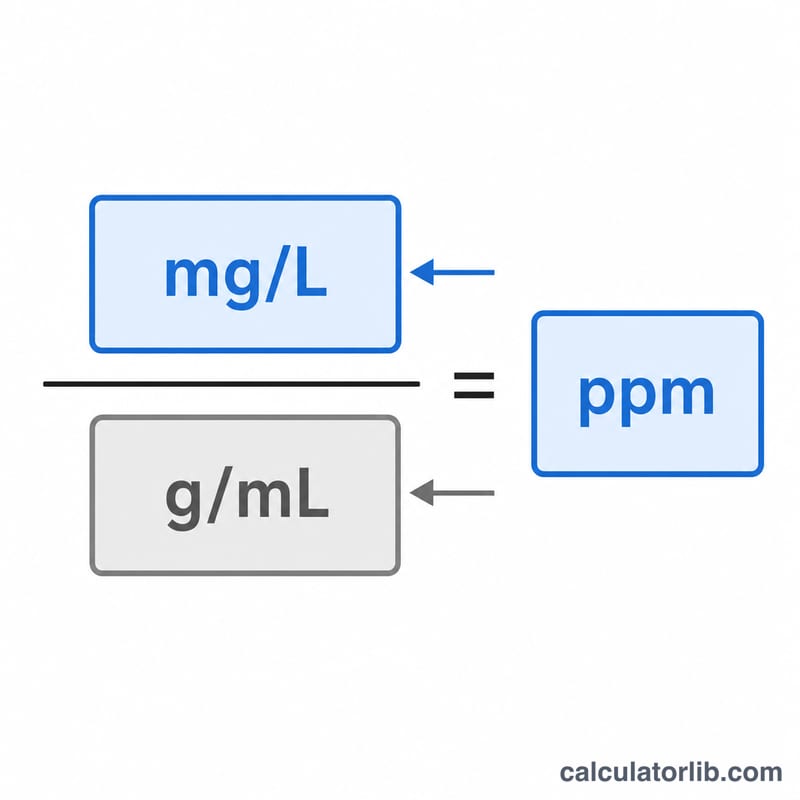
ppm is a mass ratio: milligrams of solute per kilogram of solution (mg/kg). mg/L is milligrams of solute per liter of solution. To convert between them you divide by the solution density in g/mL (which equals kg/L). For dilute water solutions the density is very close to 1 g/mL, so 1 mg/L is essentially 1 ppm. For concentrated brines, syrups, or solvents where density differs from 1, the density correction matters.
How to use it
Enter your concentration in mg/L and the solution density in g/mL (leave it at 1 for typical fresh water). The calculator returns the concentration in ppm and ppb.
The formula
$$\text{ppm} = \frac{\text{Concentration (mg/L)}}{\text{Density (g/mL)}}$$ and \(\text{ppb} = \text{ppm} \times 1000\).
Worked example
A water sample contains 25 mg/L of nitrate with density 1 g/mL. $$\text{ppm} = \frac{25}{1} = 25 \text{ ppm}$$ In ppb that is \(25 \times 1000 = 25{,}000\) ppb. If the same 25 mg/L were in a brine with density 1.2 g/mL, \(\text{ppm} = \frac{25}{1.2} \approx 20.83\) ppm.
Typical Densities of Aqueous Solutions and Resulting ppm
In the mass-based sense, 1 ppm equals 1 mg of solute per kg of solution. A concentration in mg/L is per liter of solution, so it must be divided by the solution density (in g/mL, which equals kg/L):
$$\text{ppm} = \frac{\text{mg/L}}{\rho\ (\text{g/mL})}$$
The table lists approximate densities at about 20 °C and the ppm value that corresponds to 100 mg/L in each solution.
| Solution | Approx. density (g/mL) | ppm for 100 mg/L (100 ÷ density) |
|---|---|---|
| Pure water | 0.9982 | 100.18 |
| Seawater | about 1.025 | 97.56 |
| 3.5% NaCl | about 1.025 | 97.56 |
| 10% NaCl | about 1.07 | 93.46 |
| 26% NaCl (near saturated) | about 1.20 | 83.33 |
| 10% sucrose | about 1.04 | 96.15 |
Densities are approximate. They change with temperature and with the exact composition of the solution, so use a measured density for your sample when accuracy matters.
Comparison: Same mg/L at Different Densities
Fixed input: 50 mg/L. Here ppm = 50 ÷ density, ppb = ppm × 1000, and the percent difference is measured against the original 50 mg/L value.
| Density (g/mL) | ppm | ppb | Difference from mg/L value |
|---|---|---|---|
| 0.98 | 51.02 | 51,020 | +2.04% |
| 1.00 | 50.00 | 50,000 | 0% |
| 1.025 | 48.78 | 48,780 | −2.44% |
| 1.10 | 45.45 | 45,450 | −9.09% |
| 1.20 | 41.67 | 41,670 | −16.67% |
Example substitution for seawater: \(50 \div 1.025 = 48.78\) ppm. For fresh water and seawater (densities of roughly 0.98 to 1.025 g/mL) the difference between mg/L and ppm is under about 3%, so treating them as equal is usually acceptable. For dense brines (about 1.10 g/mL and above) the difference becomes significant, and the density correction should be applied.
Interpreting ppm and ppb Values in Water
In dilute water, 1 mg/L is approximately 1 ppm, and 1 µg/L is approximately 1 ppb. The following examples come from US EPA drinking water rules (specific to the United States; other countries and the WHO may set different limits):
- Nitrate: maximum contaminant level (MCL) of 10 mg/L measured as nitrogen (nitrate-N), about 10 ppm.
- Arsenic: MCL of 10 µg/L, about 10 ppb.
- Lead: action level of 15 µg/L, about 15 ppb (an action level triggers treatment steps rather than being a strict MCL).
Standards often specify the chemical form. Nitrate expressed as N is not the same number as nitrate expressed as NO3: 10 mg/L nitrate-N corresponds to roughly 44 mg/L as NO3 (10 × 62.0 ÷ 14.0). Always check which form a result or limit refers to.
Typical total dissolved solids (TDS) ranges: fresh water is generally under about 1000 ppm, while seawater is about 35,000 ppm. At seawater levels the solution density (about 1.025 g/mL) makes the gap between mg/L and ppm noticeable, at around 2.4%.
This is general information, not professional or regulatory advice. For compliance, health or treatment decisions, consult current standards and a qualified professional or accredited laboratory.
FAQ
Is mg/L always the same as ppm? Only when the solution density is 1 g/mL. For dilute water this is an excellent approximation.
What density should I use? Use 1 g/mL for dilute fresh water at room temperature. Use the measured density for concentrated or non-aqueous solutions.
What is the relationship to ppb? 1 ppm equals 1000 ppb, so multiply ppm by 1000 to get ppb.