What Is the Michaelis-Menten Equation?
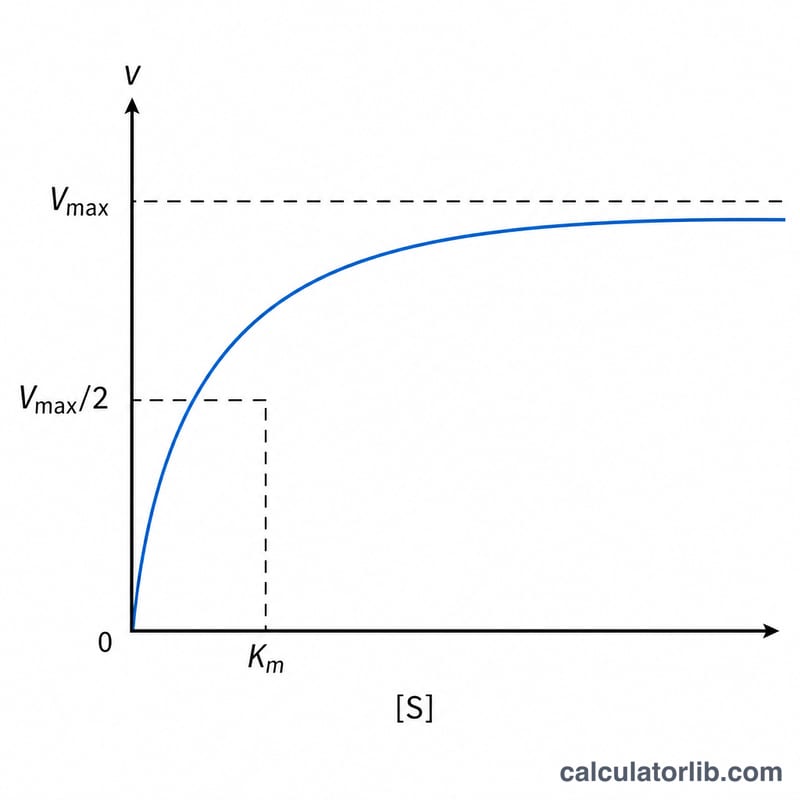
The Michaelis-Menten equation is the cornerstone of enzyme kinetics. It describes how the rate (velocity) of an enzyme-catalyzed reaction depends on the concentration of substrate. As substrate concentration rises, the reaction speeds up until the enzyme becomes saturated and the rate approaches a maximum, called Vmax. This calculator computes the reaction velocity v for any combination of Vmax, the Michaelis constant Km, and substrate concentration [S].
How to Use This Calculator
Enter three values: Vmax (the maximum reaction rate when the enzyme is fully saturated), Km (the substrate concentration at which the reaction runs at half of Vmax), and [S] (the current substrate concentration). The calculator returns the velocity v, the percent of Vmax achieved, and the denominator \(K_m + [S]\). Use consistent units — for example, Vmax in µmol/min and Km and [S] in mM.
The Formula Explained
The equation is $$v = \frac{V_{max} \cdot [S]}{K_m + [S]}$$ When [S] equals Km, the term simplifies to \(V_{max}/2\), which is exactly why Km is defined as the half-saturation constant. A small Km means the enzyme reaches high velocity at low substrate concentrations (high affinity), while a large Km indicates lower affinity. At very high [S], the [S] terms dominate and v approaches Vmax.
Worked Example
Suppose Vmax = 100 µmol/min, Km = 5 mM, and [S] = 10 mM. Then $$v = \frac{100 \times 10}{5 + 10} = \frac{1000}{15} \approx 66.67 \text{ µmol/min}$$ which is about 66.67% of Vmax. Notice the reaction has not yet reached its maximum because the enzyme is not fully saturated.
Velocity at Different Substrate Concentrations
The table uses a fixed \(V_{max} = 100\) µmol/min and \(K_m = 5\) mM, and applies \(v = \frac{V_{max}[S]}{K_m + [S]}\) at several multiples of \(K_m\).
| [S] (multiple of Km) | [S] (mM) | v (µmol/min) | % of Vmax |
|---|---|---|---|
| 0.1 Km | 0.5 | 9.09 | 9.09% |
| 0.5 Km | 2.5 | 33.33 | 33.3% |
| 1 Km | 5 | 50.00 | 50% |
| 2 Km | 10 | 66.67 | 66.7% |
| 5 Km | 25 | 83.33 | 83.3% |
| 10 Km | 50 | 90.91 | 90.9% |
| 20 Km | 100 | 95.24 | 95.2% |
Worked check for [S] = 10 mM: \(v = \frac{100 \times 10}{5 + 10} = \frac{1000}{15} = 66.67\) µmol/min. Velocity rises steeply at first and then flattens, approaching but never reaching Vmax.
Interpreting Your Velocity Result
- [S] << Km (below ~0.1 Km): the denominator is approximately Km, so \(v \approx \frac{V_{max}}{K_m}[S]\). Velocity is roughly proportional to substrate concentration, so the reaction is approximately first-order in substrate.
- [S] ≈ Km: \(v = \frac{V_{max}}{2}\), so the velocity is about 50% of Vmax. This is the definition of Km.
- [S] >> Km (above ~10 Km): v approaches Vmax and barely changes with more substrate. The reaction is approximately zero-order in substrate because the enzyme is nearly saturated.
The Michaelis-Menten equation assumes steady-state conditions (the enzyme-substrate complex stays at a roughly constant level), initial rates (measured before substrate is much depleted or product accumulates), and a single substrate with a simple one-site mechanism. Real systems can deviate from it. Substrate inhibition makes velocity fall at very high [S]. Allosteric or cooperative enzymes give sigmoidal curves, which are better described by the Hill equation. Reversible reactions, product inhibition and multi-substrate mechanisms also break the simple hyperbolic form.
FAQ
What does Km represent? Km is the substrate concentration at which the reaction velocity is half of Vmax. It is a measure of the enzyme's affinity for its substrate.
Can v ever exceed Vmax? No. The equation asymptotically approaches Vmax as [S] increases, but never exceeds it.
What units should I use? Any units are fine as long as Km and [S] share the same units; v will then carry the same units as Vmax.