What is the MME Calculator?
This tool applies to the United States and uses the conversion factors published in the CDC opioid prescribing guidance. Morphine Milligram Equivalents (MME) express the potency of any opioid relative to oral morphine, allowing clinicians to compare doses across different drugs on a single scale. A higher total daily MME is associated with greater risk of overdose, so the metric is widely used for risk stratification.
How to use it
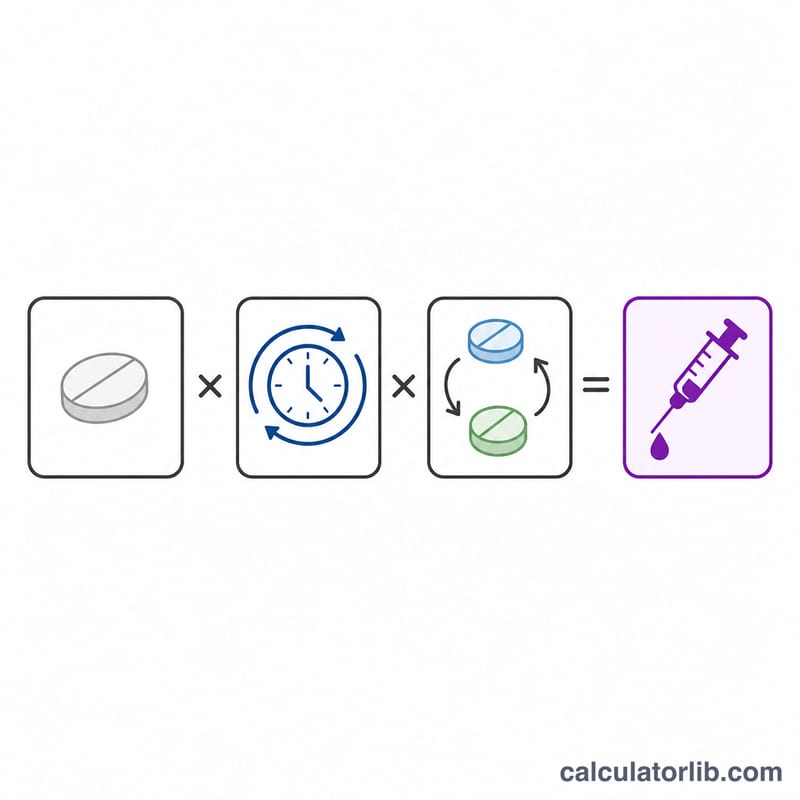
Select the opioid, enter the dose given each time (in mg, or mcg/hour for a fentanyl transdermal patch), and enter how many doses are taken per day. The calculator multiplies the dose by the frequency to get the total daily dose, then multiplies by the drug's conversion factor to produce MME/day. For a patient on multiple opioids, calculate each one separately and add the results.
The formula explained
$$\text{MME/day} = (\text{Dose} \times \text{Doses per day}) \times \text{Conversion Factor}$$ The conversion factor is a fixed per-drug multiplier: codeine \(0.15\), hydrocodone \(1\), morphine \(1\), oxycodone \(1.5\), oxymorphone \(3\), hydromorphone \(5\), tramadol \(0.2\), and transdermal fentanyl \(2.4\) (applied to mcg/hr).
Worked example
A patient takes 30 mg of oxycodone twice a day. Total dose per day = \(30 \times 2 = 60\) mg. Oxycodone's conversion factor is \(1.5\), so $$\text{MME/day} = 60 \times 1.5 = 90 \text{ MME}$$ The CDC flags reassessment of therapy at 50 MME/day and extra caution at 90 MME/day.
CDC Opioid Conversion Factors
Morphine milligram equivalents (MME) express different opioids on one common potency scale. The factors below are the ones this calculator applies. They come from the U.S. Centers for Disease Control and Prevention (CDC) opioid prescribing guidance, so they reflect U.S. clinical reference practice and are not a universal standard.
| Opioid | Input unit | MME conversion factor |
|---|---|---|
| Codeine | mg/day | 0.15 |
| Hydrocodone | mg/day | 1 |
| Hydromorphone | mg/day | 5 |
| Morphine | mg/day | 1 |
| Oxycodone | mg/day | 1.5 |
| Oxymorphone | mg/day | 3 |
| Tapentadol | mg/day | 0.4 |
| Tramadol | mg/day | 0.2 |
| Fentanyl, transdermal patch | mcg/hour | 2.4 |
Notes:
- The factors above follow the CDC Clinical Practice Guideline for Prescribing Opioids for Pain, 2022 (MMWR Recomm Rep 2022;71(3)). Compared with the 2016 guideline, hydromorphone rose from 4 to 5 and tramadol from 0.1 to 0.2, and tapentadol is listed at 0.4. Tools that still use the 2016 factors will give different results.
- Methadone is excluded because its conversion to morphine is not linear. The equivalence changes with the daily dose, so a single fixed factor would be misleading.
- For transdermal fentanyl, the input is the patch strength in mcg/hour, not mg/day.
Source: CDC Clinical Practice Guideline for Prescribing Opioids for Pain, with its MME conversion factor tables. This is educational reference information only.
Interpreting MME/day Results
Total daily MME is the sum, across all opioids taken, of each daily dose multiplied by its conversion factor. It turns different drugs and strengths into one standardized potency scale so that total opioid exposure can be compared.
Example: oxycodone 20 mg taken 2 times per day gives \(20 \times 2 \times 1.5 = \) 60 MME/day.
CDC reference points
- Below 50 MME/day: lower on the scale. Risk is still present, but the dose is below the level at which the CDC guidance advises added reassessment.
- 50 or more MME/day: the CDC guidance advises that clinicians reassess the balance of benefits and risks.
- 90 or more MME/day: the guidance advises extra caution and careful justification for any further dose increase.
Important limits
- Overdose risk rises as dose rises. The thresholds are reference points, not sharp cutoffs between safe and unsafe.
- MME is a population-level risk metric. It is not a prescribing target or a dose to aim for.
- Conversion factors are approximations. They do not account for incomplete cross-tolerance between opioids, differences in individual metabolism, age, kidney or liver function, or other medications.
- Factors vary between CDC versions, so results from different sources may not match exactly.
This is general educational information only. It is not medical advice and not dosing instructions. Decisions about any opioid therapy should be made with a qualified healthcare professional.
FAQ
Does fentanyl use the same units? No. For transdermal fentanyl patches, enter the patch strength in mcg/hour; the factor \(2.4\) converts that directly to MME/day, so set doses per day to 1.
How do I handle several opioids? Run the calculator once per drug and add the MME/day values for the patient's total.
Is this a clinical decision tool? No. It is an educational reference; always confirm conversions and use clinical judgment.