What This Calculator Does
The Multiplying Exponents Calculator multiplies two powers that share the same base. Using the product of powers rule, it keeps the common base and adds the exponents together, then evaluates the final numeric value. This is one of the core laws of exponents and shows up constantly in algebra, scientific notation, and simplifying expressions.
How to Use It
Enter the shared base (a), the first exponent (m), and the second exponent (n). The calculator returns the combined exponent (m + n) and the final value of \(a^{m+n}\). Exponents may be positive, negative, or decimal.
The Formula Explained
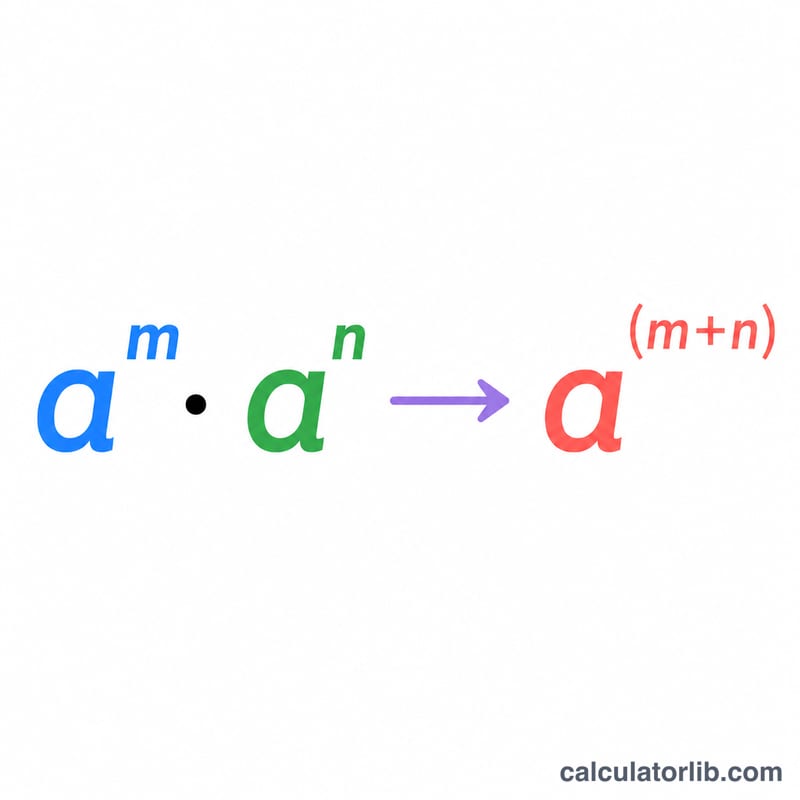
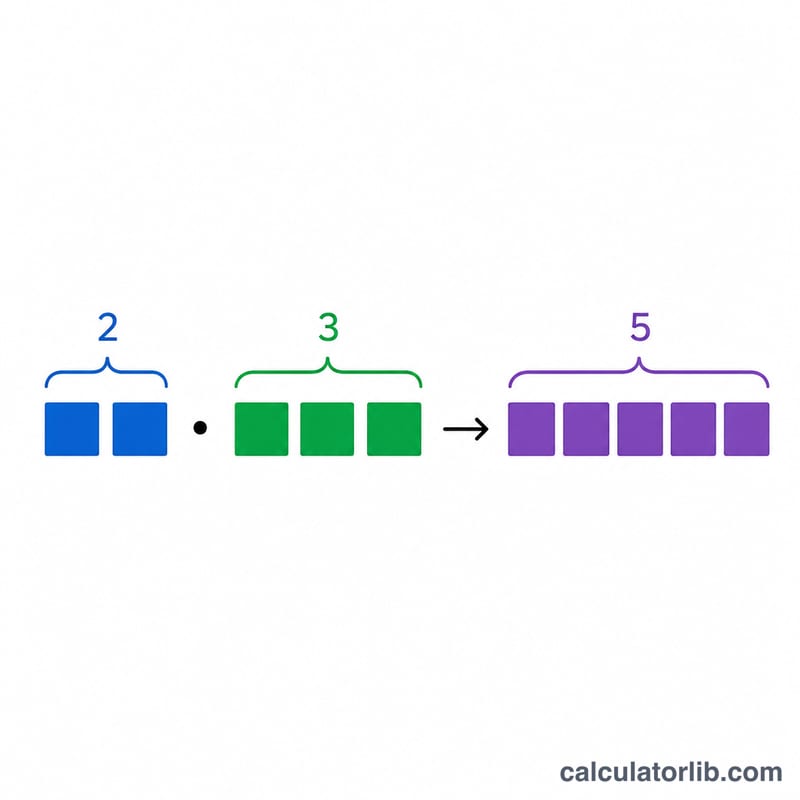
The rule is $$\text{a}^{\text{m}} \times \text{a}^{\text{n}} = \text{a}^{\left(\text{m} + \text{n}\right)}$$ It works because \(a^m\) means a multiplied by itself m times and \(a^n\) means a multiplied n times — putting them together gives a multiplied (m + n) times. The base must be identical for the rule to apply; you cannot combine \(2^3 \times 3^4\) this way.
Worked Example
Take \(2^3 \times 2^4\). Add the exponents: \(3 + 4 = 7\). So the answer is $$2^7 = 128$$ The calculator shows the combined exponent (7) and the final value (128).
More Worked Examples
The product of powers rule applies whenever the bases are identical: add the exponents, then evaluate. The examples below cover negative, fractional and variable cases.
Example 1: Negative exponent
Evaluate \(10^{5} \times 10^{-2}\).
- Same base (10), so add the exponents: \(5 + (-2) = 3\).
- Write the combined power: \(10^{5} \times 10^{-2} = 10^{3}\).
- Evaluate: \(10^{3} = 10 \times 10 \times 10 = \)1000.
Check: \(10^{-2} = \tfrac{1}{100}\), and \(100000 \times \tfrac{1}{100} = 1000\).
Example 2: Fractional (decimal) exponent
Evaluate \(4^{0.5} \times 4^{1.5}\).
- Add the exponents: \(0.5 + 1.5 = 2\).
- Combined power: \(4^{2}\).
- Evaluate: \(4^{2} = 4 \times 4 = \)16.
Check: \(4^{0.5} = \sqrt{4} = 2\) and \(4^{1.5} = 4 \times 2 = 8\), so \(2 \times 8 = 16\).
Example 3: Variable base and fractional base
(a) Simplify \(x^{3} \times x^{-5}\), with \(x \neq 0\).
- Add the exponents: \(3 + (-5) = -2\).
- Result: \(x^{-2} = \dfrac{1}{x^{2}}\).
(b) Evaluate \(\left(\tfrac{1}{2}\right)^{2} \times \left(\tfrac{1}{2}\right)^{3}\).
- Add the exponents: \(2 + 3 = 5\).
- Combined power: \(\left(\tfrac{1}{2}\right)^{5}\).
- Evaluate: \(\dfrac{1^{5}}{2^{5}} = \dfrac{1}{32} = 0.03125\).
Check: \(\tfrac{1}{4} \times \tfrac{1}{8} = \tfrac{1}{32}\).
Comparing Different Input Scenarios
This table shows how the sum of the exponents determines the result when the base stays the same.
| Base | m | n | m + n | Result |
|---|---|---|---|---|
| 2 | 3 | 4 | 7 | 128 |
| 5 | 2 | -2 | 0 | 1 |
| 10 | 5 | -2 | 3 | 1000 |
| 4 | 0.5 | 1.5 | 2 | 16 |
| 3 | -2 | -1 | -3 | 1/27 (≈ 0.037037) |
| 1 | any | any | any | 1 |
Notes:
- When \(m + n = 0\) and the base is not 0, the result is always 1, because \(a^{0} = 1\).
- A base of 1 always gives 1, since every power of 1 equals 1.
- Base 0: with positive m and n, \(0^{m} \times 0^{n} = 0\). A negative exponent on 0 would mean dividing by zero, so the expression is undefined. \(0^{0}\) is also usually treated as undefined or defined by convention depending on context.
Key Terms: Base, Exponent and Power
- Base: the number being multiplied by itself. In \(a^{n}\), the base is \(a\).
- Exponent (index): the number showing how many times the base is used as a factor. In \(a^{n}\), the exponent is \(n\).
- Power: the whole expression \(a^{n}\), or its value. For example, \(2^{3}\) is a power equal to 8.
- Product of powers rule: when multiplying powers with the same base, add the exponents: \(a^{m} \times a^{n} = a^{m+n}\).
- Negative exponent: \(a^{-n} = \dfrac{1}{a^{n}}\) for \(a \neq 0\). For example, \(2^{-3} = \tfrac{1}{8}\).
- Zero exponent: \(a^{0} = 1\) for \(a \neq 0\).
- Fractional exponent: \(a^{1/2} = \sqrt{a}\), and more generally \(a^{1/n}\) is the n-th root of \(a\). For example, \(9^{1/2} = 3\).
Common mistakes
- Multiplying the exponents instead of adding them. \(2^{3} \times 2^{4} = 2^{7} = 128\), not \(2^{12}\).
- Confusing the product rule with the power of a power rule. For \((a^{m})^{n}\) you multiply the exponents: \((2^{3})^{4} = 2^{12} = 4096\).
- Applying the rule to different bases. \(a^{m} \times a^{n} = a^{m+n}\) requires the same base. \(2^{3} \times 3^{2}\) cannot be combined by adding exponents.
- Adding the bases. The base stays unchanged: \(5^{2} \times 5^{3} = 5^{5}\), not \(10^{5}\).
FAQ
Can the bases be different? No. This rule only applies when both powers share the same base. With different bases you must evaluate each power separately.
Do negative exponents work? Yes. For example \(5^2 \times 5^{-2} = 5^0 = 1\).
What about dividing powers? For division you subtract exponents: \(a^m \div a^n = a^{(m-n)}\).