

What Is Net Revenue Retention?
Net Revenue Retention (NRR), also called Net Dollar Retention (NDR), measures how much recurring revenue you keep from your existing customer base over a period — typically a month or a year — including the impact of upgrades, downgrades, and cancellations. It deliberately excludes revenue from brand-new customers, so it isolates the health of the customers you already have. An NRR above 100% means your existing customers are growing in value faster than they are leaving, the hallmark of a strong SaaS business.
How to Use This Calculator
Enter four figures for the period you want to analyze: your Starting MRR (recurring revenue at the start), Expansion MRR (upsells, cross-sells, seat additions), Contraction MRR (downgrades) and Churned MRR (revenue lost from cancellations). The calculator returns your NRR percentage, the ending MRR for that cohort, and the net dollar change.
The Formula Explained
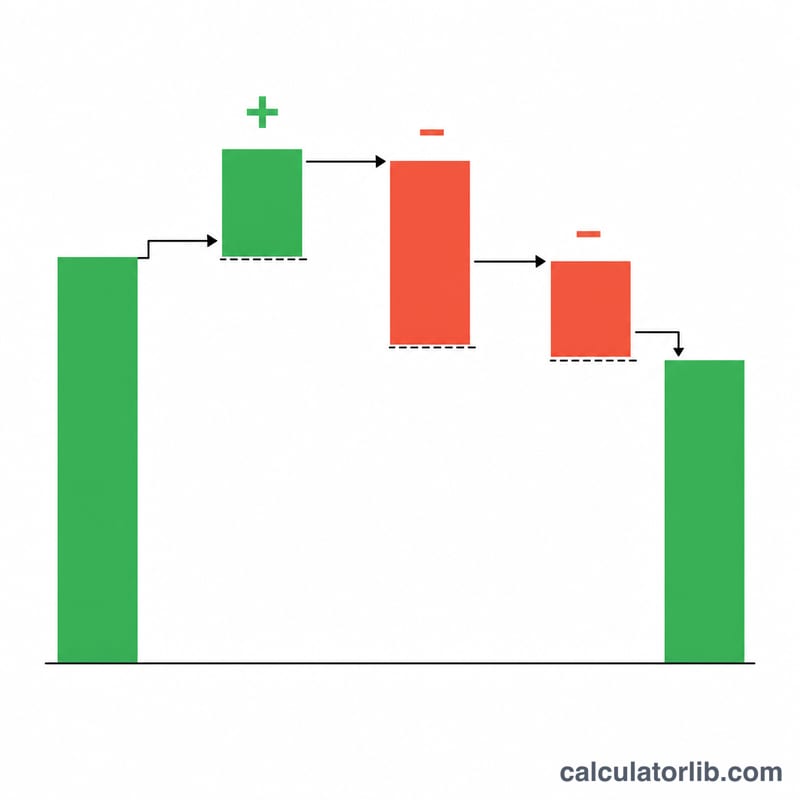
$$\text{NRR} = \frac{\text{Starting MRR} + \text{Expansion} - \text{Contraction} - \text{Churn}}{\text{Starting MRR}} \times 100\%$$ The numerator rebuilds the ending recurring revenue from the same group of customers, then divides by where they started. Multiplying by 100 turns the ratio into a percentage that you can benchmark over time.
Worked Example
Suppose you begin a month with $100,000 in MRR. Existing customers add $15,000 in upgrades, downgrade $5,000, and cancel $8,000. Ending MRR = \(100{,}000 + 15{,}000 - 5{,}000 - 8{,}000 = \$102{,}000\). $$\text{NRR} = \frac{102{,}000}{100{,}000} \times 100 = 102\%$$ Because it is above 100%, expansion more than offset losses.

FAQ
What is a good NRR? Best-in-class SaaS companies post 120%+; 100% means flat retention, and below 100% signals net shrinkage of the existing base.
How is NRR different from gross retention? Gross retention excludes expansion and is capped at 100%, measuring only how much you lose. NRR includes expansion, so it can exceed 100%.
Should I use MRR or ARR? Either works — just keep all four inputs in the same unit and period for a consistent result.