What Is the Probability Fraction Calculator?
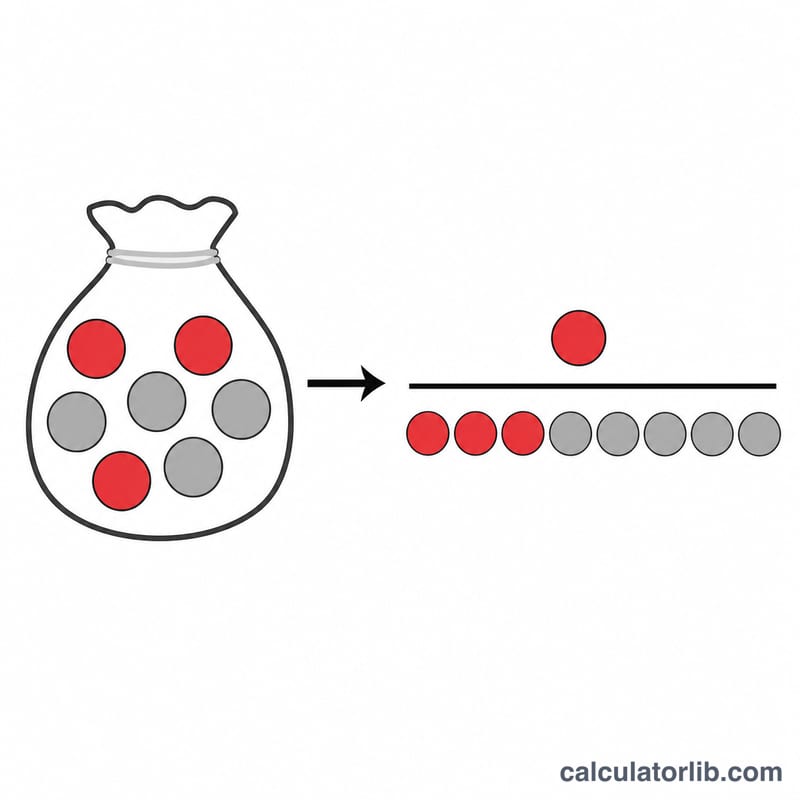
This calculator finds the probability of an event using the classic ratio of favorable outcomes to total possible outcomes. It returns the result as a decimal between 0 and 1, as a percentage, and as odds in favor. It works for any situation where outcomes are equally likely — dice rolls, coin flips, card draws, raffles, and more.
How to Use It
Enter the number of favorable outcomes (the ways your event can happen) and the total outcomes (all possible equally likely results). The calculator divides the two and converts the answer to a percentage and to odds. Total outcomes must be greater than zero.
The Formula Explained
Probability is defined as $$P = \frac{\text{Favorable}}{\text{Total}}$$ Multiplying by 100 gives the percentage chance. Odds in favor are expressed as \(\text{Favorable} : (\text{Total} - \text{Favorable})\). For example, a probability of \(0.25\) is the same as 25% and odds of \(1 : 3\) against (or \(0.333 : 1\) in favor).
Worked Example
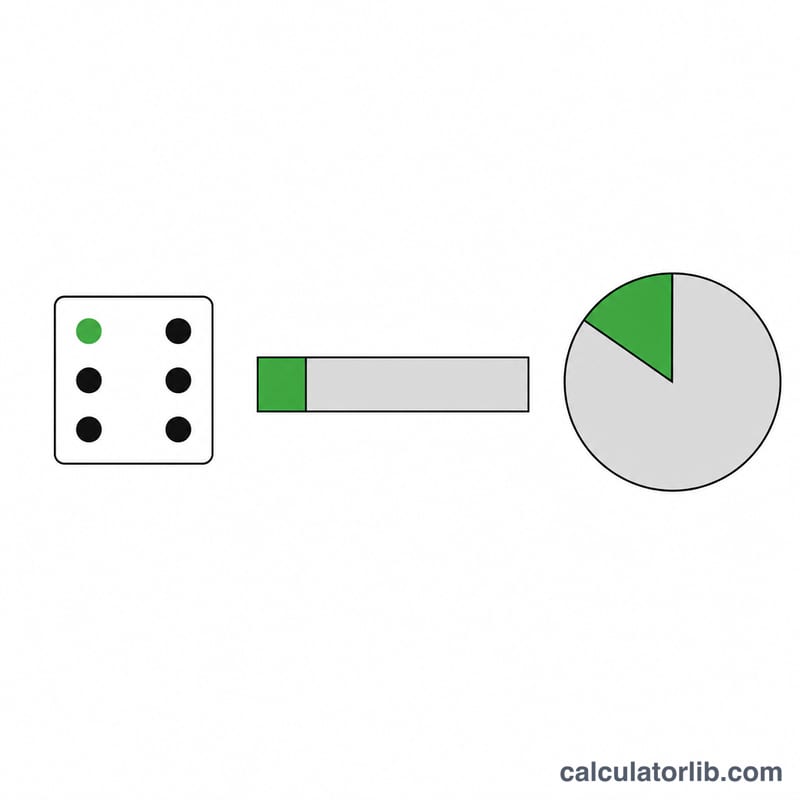
Suppose you roll a single die and want the probability of rolling a number greater than 4 (that is, a 5 or 6). There are 2 favorable outcomes and 6 total outcomes. $$P = 2 \div 6 = 0.3333$$ which is 33.33%. Odds in favor are \(2 : 4\), or \(0.5 : 1\).
More Worked Examples
Each example uses \(P = \frac{\text{Favorable}}{\text{Total}}\), then converts the result to a decimal, a percentage and odds in favor (Favorable : Total − Favorable).
Example 1: Drawing a heart from a standard 52-card deck
- Favorable outcomes = 13 hearts; total outcomes = 52 cards.
- Fraction: \(\frac{13}{52} = \frac{1}{4}\) after dividing top and bottom by 13.
- Decimal: \(13 \div 52 = \)0.25.
- Percentage: \(0.25 \times 100 = 25\%\).
- Odds in favor: \(13 : (52 - 13) = 13 : 39 = 1 : 3\).
Example 2: Drawing a red marble from 3 red and 7 blue
- Favorable = 3 red marbles; total = 3 + 7 = 10 marbles.
- Fraction: \(\frac{3}{10}\), which is already in lowest terms.
- Decimal: \(3 \div 10 = 0.30\).
- Percentage: \(0.30 \times 100 = 30\%\).
- Odds in favor: \(3 : (10 - 3) = 3 : 7\).
Example 3: At least one head in two coin flips
- List the equally likely outcomes: HH, HT, TH, TT, so the total is 4.
- Outcomes with at least one head: HH, HT, TH, so the favorable count is 3.
- Fraction: \(\frac{3}{4}\), which is already in lowest terms.
- Decimal: \(3 \div 4 = 0.75\).
- Percentage: \(0.75 \times 100 = 75\%\).
- Odds in favor: \(3 : (4 - 3) = 3 : 1\).
Common Probability Scenarios Compared
All events below assume equally likely outcomes, such as a fair coin, a fair six-sided die and a standard 52-card deck. Decimals and percentages are rounded.
| Event | Favorable/Total | Decimal | Percentage | Odds in favor |
|---|---|---|---|---|
| Fair coin lands heads | 1/2 | 0.5 | 50% | 1:1 |
| Die shows a 6 | 1/6 | 0.1667 | 16.67% | 1:5 |
| Die shows an even number | 3/6 | 0.5 | 50% | 1:1 |
| Drawing an ace from 52 cards | 4/52 = 1/13 | 0.0769 | 7.69% | 1:12 |
| Drawing a red card | 26/52 | 0.5 | 50% | 1:1 |
| A certain event | 1/1 | 1 | 100% | 1:0 |
| An impossible event | 0/6 | 0 | 0% | 0:6 |
Interpreting Your Probability Result
Probability is measured on a scale from 0 to 1 (or 0% to 100%). A value of 0 means the event is impossible, and a value of 1 means it is certain. A value of 0.5 means the event is as likely to happen as not to happen, an even chance.
A low probability means the event is unlikely, but it is still possible as long as the value is above 0. For example, drawing an ace from a standard deck has a probability of about 7.69%. Aces are drawn regularly in practice, just not often.
Odds and probability describe the same information in different ways. Odds in favor compare favorable outcomes to unfavorable ones, \(\text{Favorable} : (\text{Total} - \text{Favorable})\), while odds against reverse that order. For instance, \(P = 0.25\) gives odds in favor of 1:3, which is the same as odds against of 3:1. To convert odds \(a : b\) back to a probability, use \(P = \frac{a}{a+b}\).
The result describes a single trial in which all outcomes are equally likely. It does not predict what happens next. A fair coin that has landed tails five times in a row still has a 50% chance of heads on the next flip, and believing otherwise is known as the gambler's fallacy. Over a very large number of trials, observed frequencies tend to approach the calculated probability, but this says nothing certain about any single trial.
This is general educational information about how to read a probability value, not advice for any particular situation.
FAQ
Can probability be more than 1? No. A valid probability is always between 0 and 1 (0% to 100%). If you enter more favorable than total outcomes you are outside the valid range.
What is the difference between probability and odds? Probability compares favorable outcomes to the total, while odds compare favorable outcomes to unfavorable ones.
Do outcomes need to be equally likely? Yes — this simple ratio assumes every outcome has the same chance of occurring.