
What Is the Retirement Countdown Calculator?
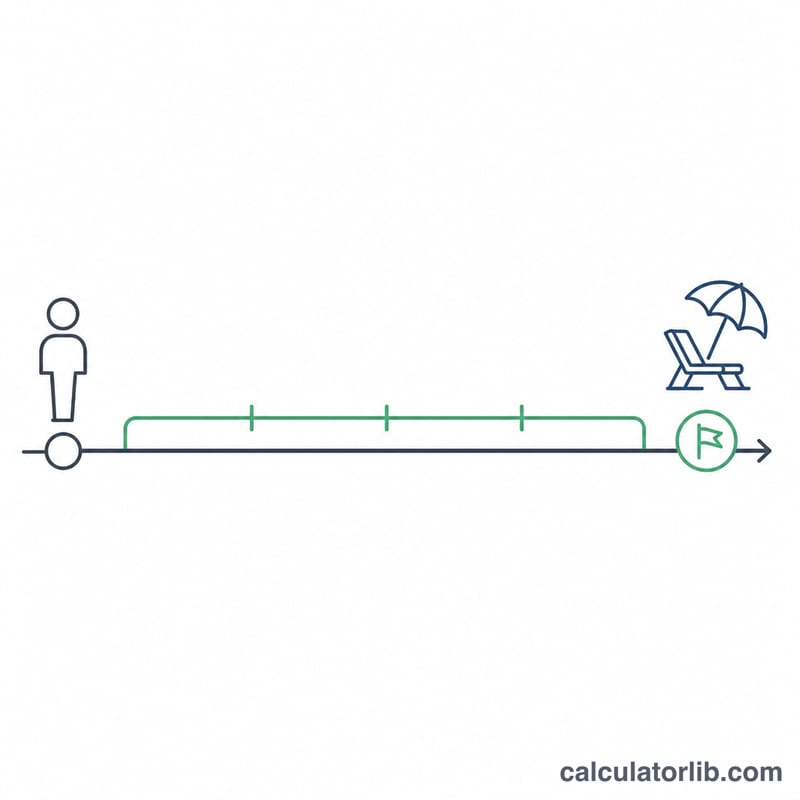
The Retirement Countdown Calculator tells you how much time stands between you and your planned retirement. Enter your current age and the age at which you intend to retire, and it instantly converts the gap into years, months, weeks, and days. It is a simple, universal tool — it works regardless of country or pension scheme because it only measures elapsed time, not benefits.
How to Use It
Type in your current age and your target retirement age, then read the results. The headline figure is the number of years remaining, with a friendly "years and months" breakdown underneath. The table converts that same span into total months, weeks, and days so you can picture the countdown however you like. If your retirement age is the same as or lower than your current age, the calculator shows zero remaining.
The Formula Explained
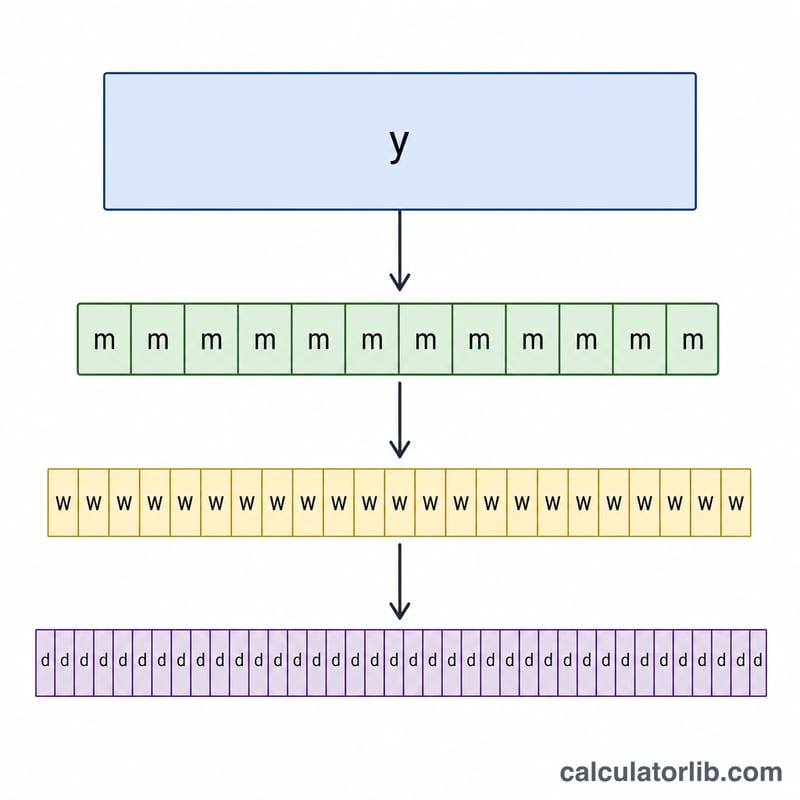
The core calculation is a straightforward subtraction: $$\text{Years Remaining} = \text{Retirement Age} - \text{Current Age}$$ From there, months are years \(\times 12\), days are years \(\times 365.25\) (the average length of a calendar year including leap years), and weeks are days \(\div 7\). Using \(365.25\) keeps multi-year countdowns accurate without needing exact birth dates.
Worked Example
Suppose you are 40 and plan to retire at 65. Years remaining = $$65 - 40 = 25 \text{ years}.$$ That is $$25 \times 12 = 300 \text{ months},$$ $$25 \times 365.25 = 9{,}131.25 \text{ days},$$ and $$9{,}131.25 \div 7 \approx 1{,}304.46 \text{ weeks}.$$ The calculator displays "25 years remaining (approx 25 yr 0 mo)" with the full breakdown in the table.
Standard Retirement Ages for Reference
This calculator is scheme-neutral: it simply counts down from your current age to whatever target age you enter. It does not know your country, your contribution record or your pension rules. The table below lists statutory ages published by the schemes themselves, which many people use as a starting point when choosing a target age.
| Country / scheme | Earliest claim age | Standard / full age | Latest deferral age | Source |
|---|---|---|---|---|
| United States — Social Security retirement benefit | 62 (permanently reduced) | 66 for births 1943–1954, rising in 2-month steps per birth year to 67 for births 1960 and later | 70 (delayed retirement credits stop accruing) | US Social Security Administration (SSA) |
| United Kingdom — State Pension | 66 (no early claim permitted) | 66; legislated to rise to 67 between 2026 and 2028, and to 68 thereafter | No upper limit — deferral increases the weekly amount | UK Department for Work and Pensions / Pensions Act |
| Canada — Old Age Security (OAS) | 65 | 65 | 70 (deferral increases the monthly amount) | Employment and Social Development Canada |
| Australia — Age Pension | 67 (for people born on or after 1 January 1957) | 67 | No deferral bonus scheme | Services Australia |
| Germany — statutory pension (gesetzliche Rente) | 63 with a long contribution record (reduced) | Rising to 67 (67 applies to births from 1964) | No fixed limit — working past the standard age raises the pension | Deutsche Rentenversicherung |
| France — régime général | 64 (legal minimum age, phased in under the 2023 reform) | 64 with the required contribution quarters; full rate granted automatically at 67 | No fixed limit — a surcote applies beyond the full-rate conditions | Assurance retraite / French pension reform legislation |
| Japan — Employees' / National Pension | 60 (permanently reduced) | 65 | 75 (since April 2022) | Japan Pension Service |
These are statutory ages as published by each national scheme and are subject to legislative change; several are mid-transition and depend on your exact birth year. Occupational and private pensions usually have their own, often earlier, access ages — for example Canada's CPP can be started between 60 and 70, separately from OAS. Check your own scheme's published schedule before fixing a target age, and treat this table as general reference information rather than personalised financial advice.
Countdown Across Common Age Scenarios
The countdown uses whole-year inputs and a single conversion chain, so every column follows from the year gap:
$$\text{Years} = \text{Retirement Age} - \text{Current Age}, \qquad \text{Months} = \text{Years} \times 12$$ $$\text{Days} = \text{Years} \times 365.25, \qquad \text{Weeks} = \frac{ {\text{Days}}}{7}$$The factor 365.25 is the average length of a calendar year including leap days, so a 40-year countdown is \(40 \times 365.25 = 14{,}610\) days rather than 14,600. Weeks and days are shown to two decimals because a whole number of years is rarely a whole number of weeks.
| Current age | Target retirement age | Years | Total months | Total weeks | Total days |
|---|---|---|---|---|---|
| 25 | 65 | 40 | 480 | 2,087.14 | 14,610.00 |
| 30 | 67 | 37 | 444 | 1,930.61 | 13,514.25 |
| 40 | 65 | 25 | 300 | 1,304.46 | 9,131.25 |
| 45 | 62 | 17 | 204 | 887.04 | 6,209.25 |
| 50 | 67 | 17 | 204 | 887.04 | 6,209.25 |
| 55 | 65 | 10 | 120 | 521.79 | 3,652.50 |
| 60 | 66 | 6 | 72 | 313.07 | 2,191.50 |
| 64 | 65 | 1 | 12 | 52.18 | 365.25 |
| 67 | 65 | 0 | 0 | 0.00 | 0.00 |
Two rows are worth comparing directly. The 45→62 and 50→67 pairs produce identical countdowns — 17 years, or \(17 \times 365.25 = 6{,}209.25\) days — even though one person is aiming at an early-claim age and the other at a full retirement age five years later. The countdown measures time, not the size or adequacy of the pension that follows it.
The final row shows the floor case: when the target age equals or is below the current age, the gap \(65 - 67 = -2\) is not reported as a negative countdown. The result is clamped to zero across all four columns, because a countdown that has already elapsed is simply over.
FAQ
Does this use my exact birth date? No — it uses whole-age inputs for simplicity. For day-precise results you would need exact dates.
Why 365.25 days per year? It averages in leap years, giving more accurate day and week totals over long spans.
What if I'm already past my retirement age? The calculator shows zero years remaining rather than a negative number.