What Is the Running Speed Calculator?
This calculator tells you how fast you ran by converting a distance and the time it took into speed. Enter the distance you covered in miles and the elapsed time in minutes, and it returns your average speed in miles per hour (mph) and kilometres per hour (km/h), plus your pace in minutes per mile. It works for any run, walk, jog, or interval session.
How to Use It
Type the distance you ran in miles and the total time in minutes. For example, if you ran for 1 hour 20 minutes, enter 80 minutes. Click calculate and the tool instantly shows your speed and pace. There are no country-specific assumptions — this is a universal physics conversion.
The Formula Explained
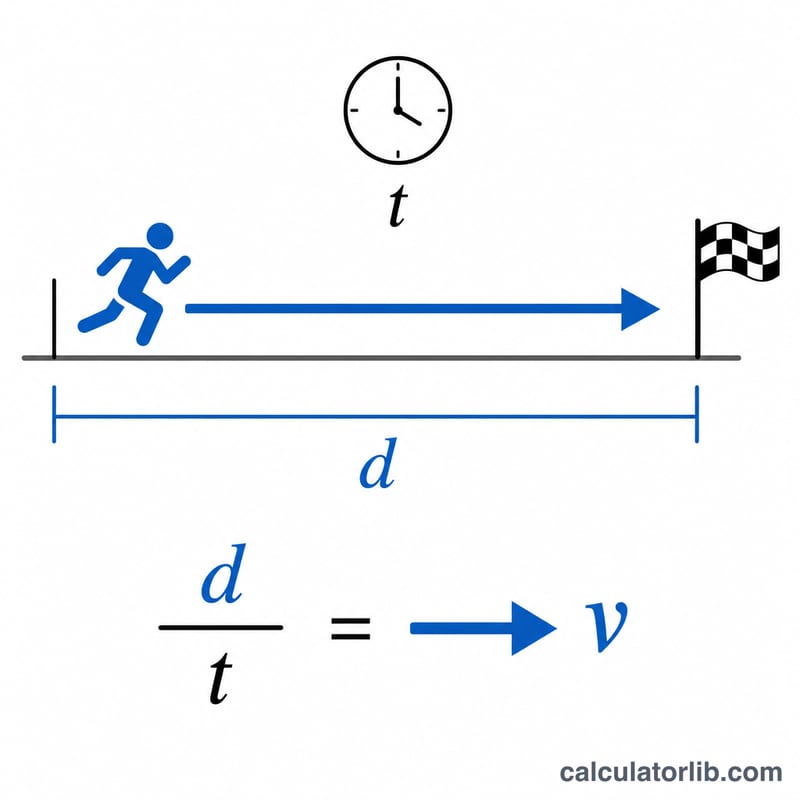
Speed is distance divided by time. Because time is entered in minutes, we first convert it to hours by dividing by 60: $$\text{Speed (mph)} = \frac{\text{Distance (mi)}}{\text{Time (min)} / 60}$$ To get km/h we multiply mph by \(1.609344\). Pace is simply the inverse measure of speed: $$\text{Pace (min/mi)} = \frac{\text{Time (min)}}{\text{Distance (mi)}}$$ which we display as minutes and seconds.
Worked Example
Suppose you ran 5 miles in 40 minutes. Convert the time: \(40 \div 60 = 0.6667\) hours. Speed:
$$\text{Speed} = \frac{5}{0.6667} = 7.5 \text{ mph}$$which equals about \(12.07\) km/h. Your pace is \(40 \div 5 = 8\) minutes per mile (8:00).
Pace to Speed Conversion Table
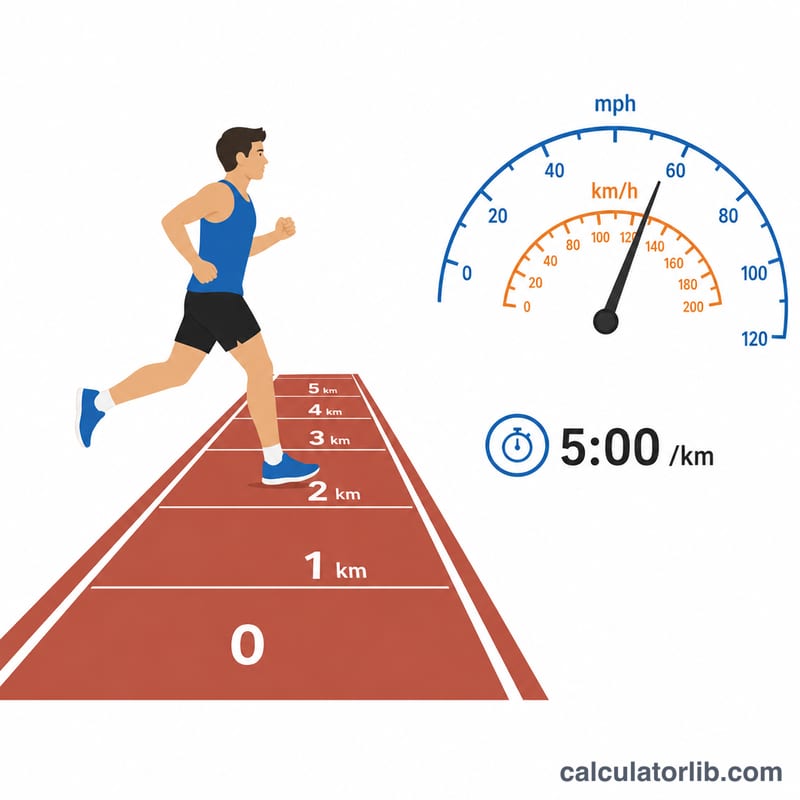
Pace is time per distance, while speed is distance per time. The conversions used are: mph = 60 ÷ pace (min/mile), km/h = mph × 1.609344, and min/km = pace ÷ 1.609344. For example, a 6:00 min/mile pace is \(60 / 6 = \)10.00 mph.
| Pace (min/mile) | Speed (mph) | Speed (km/h) | Pace (min/km) |
|---|---|---|---|
| 4:00 | 15.00 | 24.14 | 2:29 |
| 5:00 | 12.00 | 19.31 | 3:06 |
| 6:00 | 10.00 | 16.09 | 3:44 |
| 7:00 | 8.57 | 13.79 | 4:21 |
| 8:00 | 7.50 | 12.07 | 4:58 |
| 9:00 | 6.67 | 10.73 | 5:36 |
| 10:00 | 6.00 | 9.66 | 6:13 |
| 12:00 | 5.00 | 8.05 | 7:27 |
Min/km values are rounded to the nearest second.
Race Distances and Finish Times at Common Speeds
Finish time = distance ÷ speed. Distances used: 5K = 3.107 mi, 10K = 6.214 mi, half marathon = 13.109 mi, marathon = 26.219 mi. For example, a 10K at 8 mph: \(6.214 / 8 = 0.77675\) h \(\times 60 \approx 46.6\) min, or 46:36. Times are rounded to the nearest second and assume a constant speed.
| Distance | 5 mph | 6 mph | 7 mph | 8 mph | 10 mph |
|---|---|---|---|---|---|
| 5K (3.107 mi) | 37:17 | 31:04 | 26:38 | 23:18 | 18:39 |
| 10K (6.214 mi) | 1:14:34 | 1:02:08 | 53:16 | 46:36 | 37:17 |
| Half marathon (13.109 mi) | 2:37:18 | 2:11:05 | 1:52:22 | 1:38:19 | 1:18:39 |
| Marathon (26.219 mi) | 5:14:38 | 4:22:11 | 3:44:44 | 3:16:39 | 2:37:19 |
Formats are h:mm:ss for times over an hour and mm:ss otherwise.
Interpreting Your Running Speed
The bands below are rough descriptive ranges, not standards, and the boundaries overlap.
- Walking: about 3–4 mph (roughly 4.8–6.4 km/h).
- Jogging: about 5–6 mph (a pace of roughly 10:00–12:00 min/mile).
- Steady running: about 7–9 mph (roughly 6:40–8:35 min/mile).
- Fast club runners: 10 mph and above (6:00 min/mile or quicker).
- Elite marathoning: averages of about 12 mph and above.
For context, the men's marathon world record of 2:00:35 (set in 2023) works out to about 13 mph averaged over 26.219 miles. The men's mile record of 3:43.13 averages about 16.1 mph, and the men's 5K record of 12:35 averages about 14.8 mph. Shorter events allow higher average speeds.
Average speed hides a lot of variation. Hills, wind, intervals, stops at traffic lights, heat and fatigue all mean that real speed changes from moment to moment. Two runs with the same average speed can feel very different. Treat the result as a summary of one effort, not a full picture. This is general information only and not fitness or medical advice.
Conventions and edge cases
Each case below was run through this calculator; the result column is what it actually returns.
| Case | Input | Result |
|---|---|---|
| Negative distance | -100, 2 | The time must be greater than 0, and the distance cannot be negative. |
| 100 in 2 hours | 100, 2 | Running Speed: 3,000 |
| Zero time | 100, 0 | The time must be greater than 0, and the distance cannot be negative. |
Checked on 2026-11-08
FAQ
How do I enter a time like 1:30:00? Convert it to total minutes — 1 hour 30 minutes is 90 minutes.
Can I use kilometres? This version expects miles. To convert km to miles, divide by \(1.609\) before entering.
What is a good running speed? A casual jog is around 5–6 mph, while a brisk run is often 7–9 mph; elite marathoners average above 12 mph.