What the Slope Percentage Calculator Does
This tool converts a slope's two basic measurements — the rise and the run — into four useful outputs at once: slope percentage, slope as a decimal, the angle in degrees, and a simplified ratio. It is unit-agnostic, so you can enter both values in metres, feet, centimetres or inches, as long as they share the same unit. It is widely used in construction, landscaping, road and ramp design, roofing, and drainage planning anywhere in the world.
Which slope tool do you need?
- Slope calculator: slope, angle, distance and line equation between two points.
- Point-slope calculator: the slope m from two points, ready for the point-slope form y − y₁ = m(x − x₁).
- Slope-intercept calculator: the slope m and y-intercept b of the line y = mx + b through two points.
- Slope percentage calculator (this page): the percent grade from rise and run (rise ÷ run × 100).
- Slope to degrees: the angle of a slope in degrees and radians.
- Degrees to slope percent: the percent grade of an angle given in degrees.
The Two Inputs You Enter
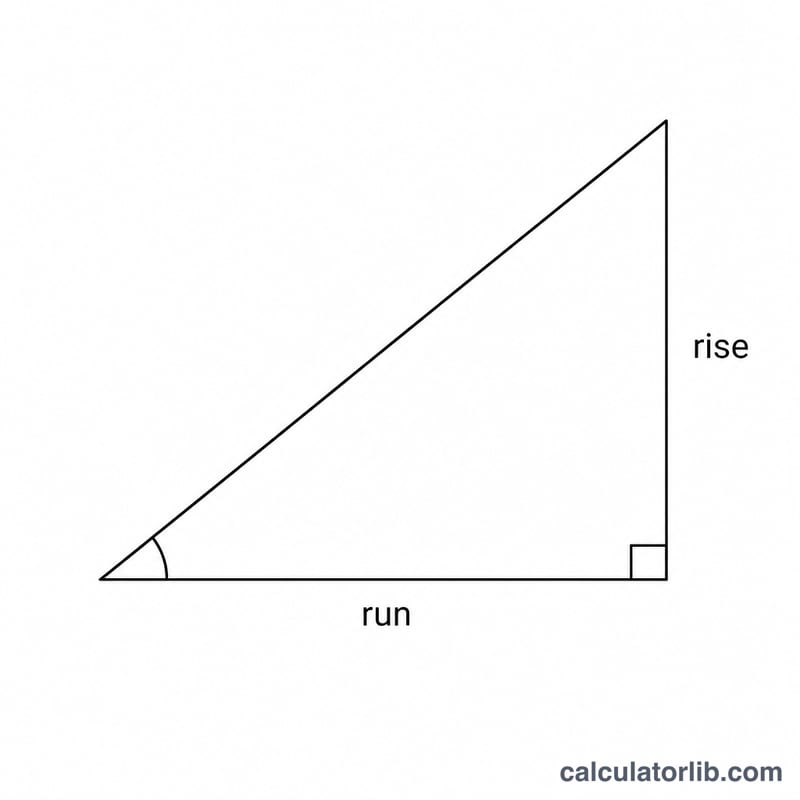
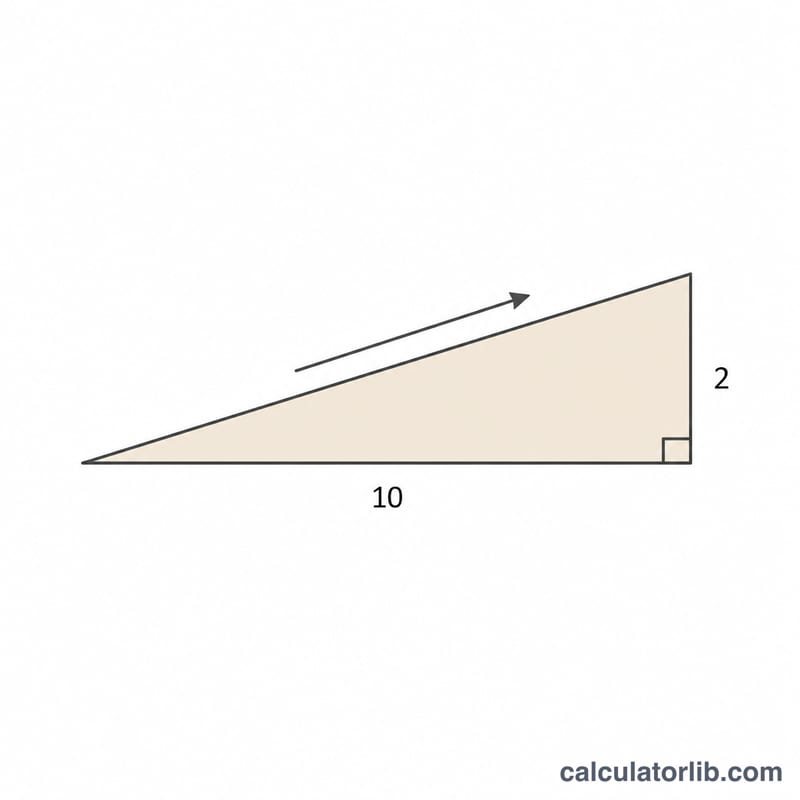
- Rise (Vertical Distance) — how much the surface goes up (or down) over the measured stretch.
- Run (Horizontal Distance) — the level, horizontal distance covered.
The Formula
The core calculation is simply:
Slope Percentage = (Rise ÷ Run) × 100
From the same two numbers the calculator also derives:
- Decimal slope = Rise ÷ Run
- Angle in degrees = arctan(Rise ÷ Run), converted to degrees
- Ratio = "1 : (Run ÷ Rise)", rounded to two decimals
Worked Example
Suppose a path climbs a rise of 2 metres over a run of 20 metres.
- Slope percentage = (2 ÷ 20) × 100 = 10%
- Decimal slope = 2 ÷ 20 = 0.1
- Angle = arctan(0.1) ≈ 5.71°
- Ratio = 1 : (20 ÷ 2) = 1:10
So a 2 m rise over 20 m is a 10% grade — a moderate but noticeable incline.
Slope Conversion Table: Percent, Degrees and Ratio
You can write the same slope as a percentage, an angle or a rise-to-run ratio. The conversions use these formulas:
$$\text{Slope \%} = \frac{\text{Rise}}{\text{Run}} \times 100$$$$\theta = \arctan\left(\frac{\text{Slope \%}}{100}\right)$$$$\text{Ratio} = 1 : \frac{100}{\text{Slope \%}}$$Example: a rise of 1 over a run of 20 gives \(\frac{1}{20} \times 100 =\) 5%. The angle is \(\arctan(0.05) \approx 2.86^\circ\) and the ratio is 1:20.
| Slope (%) | Angle (degrees) | Ratio (rise:run) |
|---|---|---|
| 1% | 0.57° | 1:100 |
| 2% | 1.15° | 1:50 |
| 5% | 2.86° | 1:20 |
| 8.33% | 4.76° | 1:12 |
| 10% | 5.71° | 1:10 |
| 15% | 8.53° | 1:6.67 |
| 20% | 11.31° | 1:5 |
| 25% | 14.04° | 1:4 |
| 33.33% | 18.43° | 1:3 |
| 50% | 26.57° | 1:2 |
| 100% | 45.00° | 1:1 |
| 200% | 63.43° | 1:0.5 |
Percent and degrees don't scale in step with each other. A 100% slope is 45°, not 90°, because the rise equals the run. As the angle gets close to 90°, the run approaches zero, so the slope percentage has no upper limit. A vertical surface has no defined percentage. For gentle slopes under about 10%, percent and degrees are roughly proportional. Above that, always convert with the arctangent.
Typical Slope Ranges in Construction and Landscaping
The table below lists commonly published reference values. Many of them come from United States standards (ADA, IRC, AASHTO), and requirements differ between countries and local jurisdictions. Always check the codes that apply to your project and location.
| Application | Typical value | Percent | Source / note |
|---|---|---|---|
| Wheelchair ramp, maximum running slope | 1:12 | 8.33% | 2010 ADA Standards for Accessible Design (US). ISO 21542 (international) uses a similar 1:12 limit for short ramps. |
| Accessible walking surface not classed as a ramp | Up to 1:20 | Up to 5% | ADA Standards (US). A running slope steeper than 1:20 counts as a ramp. |
| Accessible route, maximum cross slope | 1:48 | About 2.08% | ADA Standards (US) |
| Ground sloping away from a building foundation | Minimum 6 in fall over the first 10 ft (about 150 mm over 3 m) | 5% | International Residential Code (IRC) R401.3, used in the US |
| Paved surfaces (patios, walks, parking areas) | About 1:100 to 1:50 | About 1–2% | Common design practice so water drains off |
| Mowable lawn | Up to about 1:4 to 1:3 | About 25–33% | General landscaping guidance. Steeper banks are usually planted with ground cover instead. |
| Highway grades | Typically up to about 6% | About 6% | AASHTO guidance (US). The limit depends on terrain and design speed, and local roads may be steeper. |
To check your own project, measure the vertical rise and the horizontal run in the same units, then compare the result with the relevant row. For example, a ramp that rises 0.5 m over 6 m has a slope of \(\frac{0.5}{6} \times 100 \approx 8.33\%\), exactly at the 1:12 ADA limit. Building with a little margin below a maximum allows for construction tolerances.
Frequently Asked Questions
Is slope percentage the same as the angle in degrees? No. A 100% slope is not 90° — it is a 45° angle, because percentage is rise over run, not the angle itself. The calculator shows both so you don't have to convert manually.
What units should I use? Any length unit works, but the rise and run must use the same unit. Because the formula is a ratio, the units cancel out and the percentage stays the same.
Why does my ratio look unusual? The ratio is always written as "1 : (run ÷ rise)". For a gentle slope this gives a large second number (e.g. 1:20); for a steep slope it gives a small one (e.g. 1:2). If the rise is larger than the run, the ratio will be less than 1:1.