
What is the Texas Overtime Calculator?
This calculator applies to the United States (Texas). Texas does not have its own state overtime law, so overtime is governed by the federal Fair Labor Standards Act (FLSA). Under the FLSA, non-exempt employees must be paid at least 1.5 times their regular hourly rate for all hours worked beyond 40 in a single workweek. This tool estimates your gross weekly pay before taxes based on your hourly rate and total hours worked.
How to use it
Enter your hourly rate in dollars and the total number of hours you worked in the week. The calculator splits your hours into regular hours (up to 40) and overtime hours (anything over 40), then computes pay for each portion and adds them together. Note: Texas/FLSA overtime is based on a weekly threshold of 40 hours, not on hours over 8 per day.
The formula explained
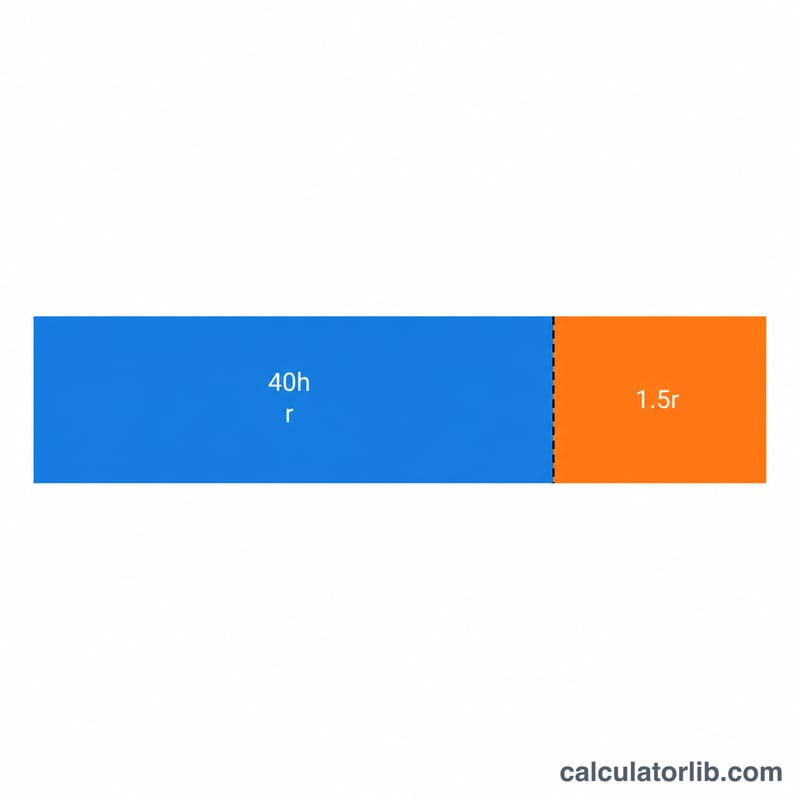
Regular pay equals your rate times the lesser of your hours or 40. Overtime pay equals your rate times 1.5 times any hours above 40. The total is the sum of the two.
$$\text{Total} = r \times \min(h, 40) + r \times 1.5 \times \max(h - 40,\ 0)$$
Worked example
Suppose you earn $20/hour and work 45 hours. Regular pay = \(20 \times 40 = \$800\). Overtime hours = \(45 - 40 = 5\). Overtime pay = \(20 \times 1.5 \times 5 = \$150\). Total weekly pay = \(800 + 150 = \$950\) gross.

Overtime Pay Across Different Hours and Rates
The table applies the federal FLSA rule used by the calculator: overtime is paid at 1.5 times the hourly rate for hours over 40 in a workweek. Formula: \(\text{Total} = r \times \min(h,40) + 1.5 \times r \times \max(h-40,0)\). All figures are gross pay before taxes and assume the hourly rate is the regular rate.
| Hourly rate | Hours worked | Regular pay | Overtime pay | Total gross pay |
|---|---|---|---|---|
| $15.00 | 40 | $600.00 | $0.00 | $600.00 |
| $15.00 | 45 | $600.00 | $112.50 | $712.50 |
| $15.00 | 50 | $600.00 | $225.00 | $825.00 |
| $15.00 | 60 | $600.00 | $450.00 | $1,050.00 |
| $20.00 | 40 | $800.00 | $0.00 | $800.00 |
| $20.00 | 45 | $800.00 | $150.00 | $950.00 |
| $20.00 | 50 | $800.00 | $300.00 | $1,100.00 |
| $20.00 | 60 | $800.00 | $600.00 | $1,400.00 |
| $25.00 | 40 | $1,000.00 | $0.00 | $1,000.00 |
| $25.00 | 45 | $1,000.00 | $187.50 | $1,187.50 |
| $25.00 | 50 | $1,000.00 | $375.00 | $1,375.00 |
| $25.00 | 60 | $1,000.00 | $750.00 | $1,750.00 |
| $30.00 | 40 | $1,200.00 | $0.00 | $1,200.00 |
| $30.00 | 45 | $1,200.00 | $225.00 | $1,425.00 |
| $30.00 | 50 | $1,200.00 | $450.00 | $1,650.00 |
| $30.00 | 60 | $1,200.00 | $900.00 | $2,100.00 |
Example check for $20 at 50 hours: \(20 \times 40 + 1.5 \times 20 \times 10 = 800 + 300 = 1{,}100\).
Key Overtime Terms Explained
- FLSA: The Fair Labor Standards Act, the US federal law that sets minimum wage, overtime pay and recordkeeping standards for covered employees. It applies in Texas.
- Workweek: A fixed, recurring period of 168 hours, made up of seven consecutive 24-hour periods. An employer sets its start day and time, and overtime is measured within each workweek separately.
- Non-exempt employee: An employee covered by the FLSA's overtime requirements, who must be paid overtime for hours over 40 in a workweek.
- Exempt employee: An employee who meets the FLSA's exemption tests (typically based on job duties and salary level) and is not entitled to overtime pay. Job title alone does not determine exempt status.
- Regular rate of pay: The hourly rate actually paid for regular work. It is calculated from all remuneration for employment in the workweek, including non-discretionary bonuses and shift differentials, divided by total hours worked, with certain statutory exclusions.
- Time-and-a-half: The overtime premium rate of 1.5 times the regular rate of pay, paid for each hour over 40 in a workweek.
- Gross pay: Total earnings before any taxes or deductions.
- Net pay: Take-home pay after taxes, withholdings and other deductions are subtracted from gross pay.
- Hours worked: Time an employee is required or permitted to work, generally including time on duty and required work activities. Paid time off, such as vacation or holidays, is generally not counted toward the 40-hour overtime threshold under the FLSA.
Interpreting Your Overtime Result
- Gross, not take-home: The result is gross weekly pay. Federal income tax withholding, Social Security and Medicare (FICA) contributions, and other deductions such as benefits are not subtracted. Texas has no state income tax on wages, but federal withholdings still apply.
- Hours over 40 in a fixed workweek: Under the FLSA, overtime is owed for hours worked over 40 in a single workweek. Hours are not averaged across two or more weeks, even if pay periods are biweekly.
- Federal rule applies in Texas: Texas follows the federal FLSA standard for most private-sector employees. Texas has no state daily overtime requirement, so working more than 8 hours in one day does not by itself create overtime.
- Result is an estimate: The calculator multiplies the hourly rate you enter by hours. If the regular rate includes non-discretionary bonuses, shift differentials or similar pay, the legally required regular rate, and therefore overtime pay, may be higher than this simple calculation.
- What it does not cover: The calculator does not determine exempt status, does not handle salaried non-exempt calculations (where the regular rate is derived from salary divided by hours the salary is meant to cover), and does not include double-time, which the FLSA does not require. Employment contracts or union agreements may provide additional premiums.
This is general information about how the calculation works, not legal or payroll advice.
Income and jobs: United States
Average income and unemployment in United States compared with the world, from the World Bank: a benchmark for the figures you enter above.
- GNI per capita 2025
- 88,810 USD
- GDP per capita, PPP 2025
- 90,027 intl. $
- World: 25,704
- Unemployment 2025
- 4.2%
- World: 4.8%
Latest change Up +7.1% 2025: 88,810 USD, against 82,910 USD in 2024. CalculatorLib computes this change from the two published figures.
In 2025, gross national income per person in United States was 88,810 US dollars a year, about 7,401 US dollars a month. World: 14,244 USD
| Year | GNI per capita (USD) | GDP per capita, PPP (intl. $) | Unemployment |
|---|---|---|---|
| 2025 | 88,810 | 90,027 | 4.2% |
| 2024 | 82,910 | 86,170 | 4.0% |
| 2023 | 79,950 | 82,587 | 3.6% |
| 2022 | 77,230 | 78,009 | 3.7% |
| 2021 | 71,510 | 71,441 | 5.3% |
| 2020 | 64,630 | 64,465 | 8.1% |
| 2019 | 65,840 | 65,228 | 3.7% |
| 2018 | 63,040 | 62,876 | 3.9% |
| 2017 | 58,860 | 60,048 | 4.4% |
| 2016 | 56,830 | 57,977 | 4.9% |
GNI per capita (Atlas method) is the average of all income in the economy, not a typical salary; PPP dollars adjust for local prices.
Income tax and social security: United States
- Top income tax rate 2025
- 43.65%
- from 8.7 × the average wage
- Employee social security 2025
- 7.65% · 1.45%
In 2025, the top statutory personal income tax rate in United States (central and local government combined) was 43.65%. It applies from 8.7 times the average wage of 73,520 USD, that is from about 642,101 USD a year.
Employee social security contribution rates for successive earnings bands, lowest band first; the band limits are not shown.
Top income tax rates in OECD countries
| Country | Top rate | Applies from (× average wage) | Year |
|---|---|---|---|
| Japan | 55.95% | 7.7 | 2025 |
| France | 55.37% | 12.9 | 2025 |
| South Korea | 49.5% | 19.0 | 2025 |
| Germany | 47.48% | 4.4 | 2025 |
| United Kingdom | 45% | 2.2 | 2025 |
| United States | 43.65% | 8.7 | 2025 |
| Türkiye | 40.76% | 5.6 | 2025 |
| Mexico | 35% | 20.6 | 2025 |
The top rate is the statutory rate on the highest earnings, not the rate most workers pay. OECD figures cover OECD member countries only.
United States and other countries
GNI per capita in current US dollars (Atlas method) — each country’s latest published year.
- United States 88,810 USD (2025)
- France 48,630 USD (2025)
- Japan 38,340 USD (2025)
- South Korea 37,880 USD (2025)
- Saudi Arabia 36,070 USD (2025)
- Türkiye 16,300 USD (2025)
- Russia 15,960 USD (2025)
- World 14,244 USD (2025)
- China 14,230 USD (2025)
- Mexico 13,730 USD (2025)
- Vietnam 4,970 USD (2025)
- India 2,760 USD (2025)
No published figure yet for Taiwan.
Years can differ between rows: each figure is shown with its own year. The same World Bank indicator for every country.
Latest figure: 2025 Data last updated 2026-10-18 · current
Source: The World Bank Group CC BY 4.0; OECD, Tax Database CC BY 4.0
Monthly figures are computed by CalculatorLib from these data. The top-rate threshold in national currency (multiple × average wage) is computed by CalculatorLib from these data.
Source details and methodology
- The World Bank Group — World Development Indicators (NY.GNP.PCAP.CD, NY.GDP.PCAP.PP.CD, SL.UEM.TOTL.ZS)
- OECD, Tax Database — Top statutory personal income tax rate; employee social security contribution rates
FAQ
Does Texas have daily overtime? No. The FLSA, which governs Texas, calculates overtime only on hours over 40 per workweek, not per day.
Are all employees eligible for overtime? No. Exempt salaried employees (such as certain executive, administrative, and professional roles) may not qualify. This tool assumes a non-exempt hourly worker.
Does this include taxes? No. The result is gross pay before federal income tax, Social Security, and Medicare withholding.