What This Wing Loading Calculator Does
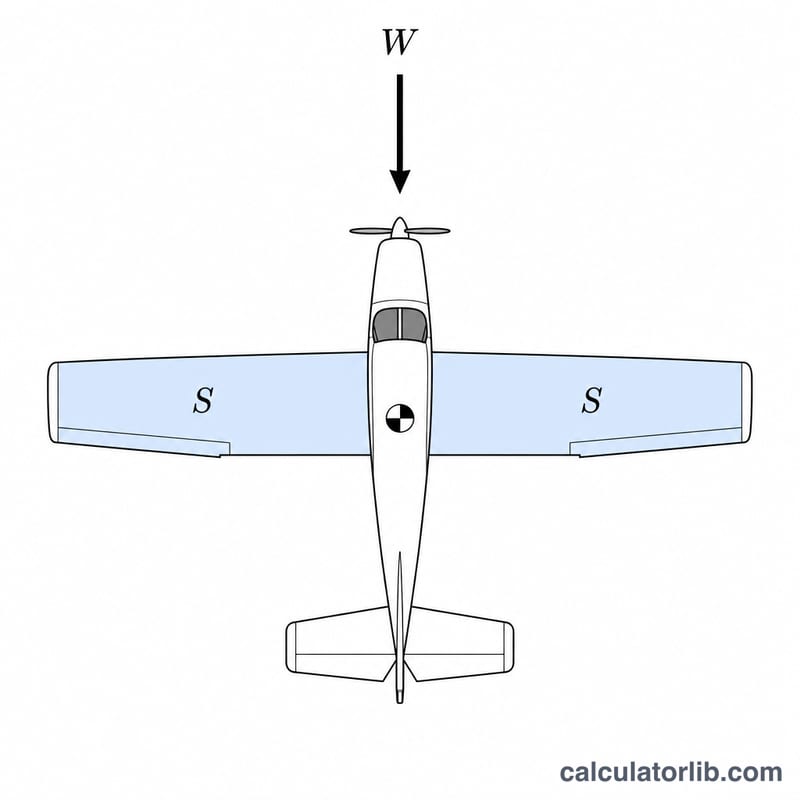
Wing loading is one of the most telling numbers in aircraft design. It tells you how much weight each square foot of wing has to support. This calculator takes two simple inputs—Aircraft Weight (lbs) and Wing Area (sq ft)—and returns the wing loading in pounds per square foot (lb/ft²). It also derives two related figures from those inputs: an estimated stall speed and a lift coefficient, so you get a quick performance snapshot rather than a single number. Units here are US customary (pounds and square feet), the convention common in general aviation in the United States.
The Formula
The core calculation is straightforward division:
- Wing Loading = Aircraft Weight ÷ Wing Area
From that result, the tool estimates a stall-related speed as the square root of (wing loading × 1.2), and then a lift coefficient as (2 × Weight) ÷ (1.225 × Wing Area × speed²), where 1.225 kg/m³ is standard sea-level air density. These secondary values are simplified indicators for comparison, not certified flight figures.
How to Use It
- Enter the total aircraft weight in pounds (use gross or loaded weight depending on the comparison you want).
- Enter the wing area in square feet—the projected planform area of the wing.
- Read the wing loading instantly, along with the derived stall speed and lift coefficient.
Worked Example
Suppose a light aircraft weighs 1,500 lbs with a wing area of 150 sq ft.
- Wing Loading = 1,500 ÷ 150 = 10 lb/ft²
- Stall speed estimate = √(10 × 1.2) = √12 ≈ 3.46
- Lift coefficient = (2 × 1,500) ÷ (1.225 × 150 × 3.46²) ≈ 1.36
A loading of 10 lb/ft² is typical of a docile trainer, while sailplanes sit much lower and jets far higher.
Typical Wing Loading by Aircraft Class
Wing loading is simply weight divided by wing area: \( W/S \). In US customary units the answer comes out in pounds per square foot (lb/ft²); most of the rest of the world quotes the same quantity in kg/m² or N/m² (1 lb/ft² ≈ 4.88 kg/m²). The figures below are at maximum gross (loaded) weight unless noted, and they use each type's published reference wing area. Real aircraft fly most of the time below gross weight, so in-flight wing loading is usually 10–25% lower than the values shown.
| Aircraft class / example | Gross weight (lbs) | Wing area (sq ft) | Wing loading (lb/ft²) |
|---|---|---|---|
| Hang glider (pilot + glider, flying weight) | ~300 | ~160 | ~1.9 |
| Ultralight (e.g. a US FAR Part 103-class single-seater) | ~500 | ~150 | ~3.3 |
| Two-seat sailplane (Schleicher ASK 21 class) | ~1,320 | ~193 | ~6.8 |
| Cessna 172 (Skyhawk, typical late models) | 2,450 | 174 | 14.08 |
| Piper Cherokee (PA-28-180 class) | 2,400 | 160 | 15.0 |
| Cirrus SR22 | ~3,400 | ~145 | ~23.4 |
| Light business jet (Learjet 45 class) | ~21,500 | ~312 | ~69 |
| Boeing 737-800 (at MTOW) | 174,200 | 1,341 | 129.9 |
| F-16 fighter (typical mission weight ~30,000 lb, 300 sq ft wing) | ~30,000 | 300 | ~100 |
Published weights and wing areas vary by model, year and certification basis, so treat these as class-representative rather than as data for any one serial number. For the aircraft you actually fly, take the maximum gross weight and reference wing area from its Pilot's Operating Handbook or type certificate data sheet and enter those.
Key Terms and Variables Explained
Two values are inputs to this calculator (weight and wing area), one is the output (wing loading), and the rest are context you need in order to use the output sensibly.
| Term (symbol) | Units | Role | Meaning |
|---|---|---|---|
| Wing loading (\(W/S\)) | lb/ft² (US); kg/m² or N/m² elsewhere | Output | Weight carried per unit of wing area: \( W/S = W \div S \). The single number that most strongly drives stall speed, ride quality and runway requirements. |
| Weight (\(W\)) | lbs | Input | The weight you choose to analyse. Gross / loaded weight is the aircraft as actually flown (empty weight + fuel + occupants + baggage). Empty weight excludes usable fuel and payload. MTOW (maximum takeoff weight) is the certified upper limit. Wing loading is only meaningful when you state which weight you used. |
| Wing area (\(S\)) | ft² | Input | Reference (gross) planform area: the wing projected onto a horizontal plane, conventionally including the carry-through portion inside the fuselage. Some sources instead quote net or exposed area, which is smaller and will inflate the computed wing loading — use the handbook's reference area for consistency. |
| Stall speed (\(V_s\)) | knots or mph (calibrated) | Context | The minimum steady-flight speed at a given weight, configuration and load factor. It rises with the square root of wing loading. Certified values (\(V_{s0}\) landing configuration, \(V_{s1}\) clean) come from the POH/AFM. |
| Lift coefficient (\(C_L\)), maximum (\(C_{L,\max}\)) | dimensionless | Context | How much lift the wing generates for a given dynamic pressure and area. \(C_{L,\max}\) is the value at the stall — roughly 1.2–1.6 clean and 1.8–2.8 with effective flaps for typical light aircraft, depending on airfoil and high-lift design. |
| Air density (\(\rho\)) | slug/ft³ (US); kg/m³ (SI) | Context | ISA sea-level standard is 0.002377 slug/ft³ (1.225 kg/m³). Density falls with altitude and temperature, so true stall and takeoff speeds rise on hot, high days even though indicated stall speed stays about the same. |
| Aspect ratio (\(AR\)) | dimensionless | Context | \( AR = b^2 / S \), where \(b\) is wingspan. High aspect ratio (sailplanes, 20–35) reduces induced drag; low aspect ratio (fighters, 2–4) favours roll rate and structural simplicity. Two aircraft with identical wing loading can behave very differently if their aspect ratios differ. |
| Span loading (\(W/b\)) | lb/ft | Context | Weight per unit span. It governs induced drag at a given speed better than wing loading does, which is why long-span gliders climb and glide so well. |
Interpreting Your Wing Loading Result
Wing loading is a ratio, not a verdict — the same number is excellent for one mission and unacceptable for another. Read your result along these axes.
Stall speed scales with the square root
From steady level flight, lift equals weight, so the stall speed follows
$$ V_s = \sqrt{ \frac{2 \, (W/S)}{\rho \, C_{L,\max}} } $$
Because \(W/S\) sits under a square root, doubling wing loading raises stall speed by only about 41% (\(\sqrt{2} \approx 1.414\)), and a 21% weight increase raises it about 10%. This is why a 14 lb/ft² trainer and a 130 lb/ft² airliner differ in stall speed by roughly a factor of three, not a factor of nine.
Takeoff and landing distance
Ground roll varies roughly with the square of liftoff or touchdown speed, so distance grows close to linearly with wing loading (other things equal). Higher wing loading means faster approaches, longer runways, more energy to dissipate in the brakes, and less tolerance for short or soft fields. Low wing loading is what lets ultralights and bush aircraft operate from a few hundred feet of grass.
Gust response and ride quality
A vertical gust changes angle of attack and therefore load factor; the resulting acceleration is inversely proportional to wing loading. Low-wing-loading aircraft get tossed around in thermals and low-level turbulence, while high-wing-loading jets ride through the same air smoothly. This is the single clearest everyday consequence of the number you just computed.
Turn rate, manoeuvring and cruise efficiency
Lower wing loading allows a tighter sustained turn radius at a given speed and lower minimum sink — decisive for sailplanes circling in thermals and for aerobatic aircraft. Higher wing loading favours fast, stable cruise: a smaller wing means less friction drag at high speed, which is why jets and racing designs carry a lot of weight on a little wing, and why sailplanes carry water ballast to raise wing loading for fast cross-country runs and dump it before landing.
About the stall-speed and lift-coefficient figures shown
If this tool displays a stall-speed number alongside the wing loading, treat it as a simplified comparative index, not a calibrated airspeed. It is a derived indicator based only on the weight and area you entered; it is not in certified knots or mph, and it should never be used for flight planning, approach speeds or performance calculations. Likewise, any lift coefficient shown is back-calculated from that same index rather than measured — it is an internal consistency figure, not a wind-tunnel or flight-test value for your wing.
Real stall speed depends on things this calculator does not know: \(C_{L,\max}\) for your specific airfoil and planform, configuration (flap and slat setting, gear, power, ice or contamination), centre of gravity, load factor in the manoeuvre, and density altitude. The only authoritative stall speeds for a certified aircraft are the \(V_{s0}\) and \(V_{s1}\) values published in its Pilot's Operating Handbook or Aircraft Flight Manual, and the corresponding markings on the airspeed indicator.
This page is general engineering and educational information about a design parameter; it is not flight instruction, airworthiness guidance, or a substitute for the approved flight manual and a qualified instructor or engineer.
FAQ
Why does wing loading matter? Lower wing loading generally means gentler stall behaviour, shorter takeoff/landing runs and better low-speed maneuverability. Higher wing loading gives a smoother ride in turbulence and higher cruise speeds.
What's a typical wing loading value? Gliders may be 5–8 lb/ft², light single-engine aircraft around 10–20 lb/ft², and airliners well over 100 lb/ft².
Should I use empty or gross weight? Use gross (loaded) weight for worst-case performance estimates; use empty weight only when comparing structural design baselines.