What this calculator does
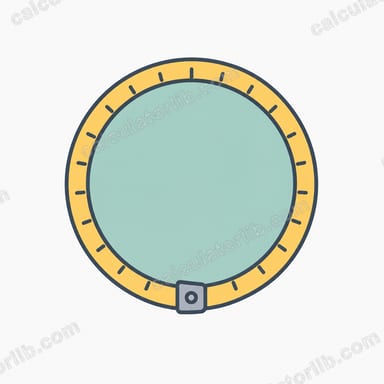
The Circle Perimeter Calculator finds the circumference (the distance around the edge) of a circle directly from its radius. You enter one number, choose a unit, and it returns the perimeter instantly — along with two useful extras: the diameter and the area. It works with any unit of length and uses the exact mathematical constant π (pi), so the result is as accurate as the radius you provide.
The inputs you provide
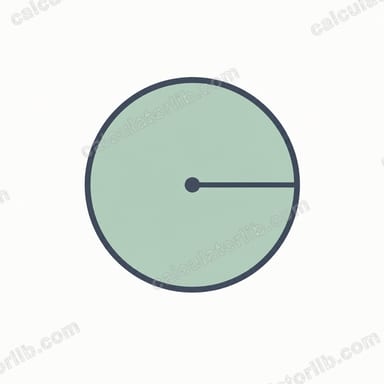
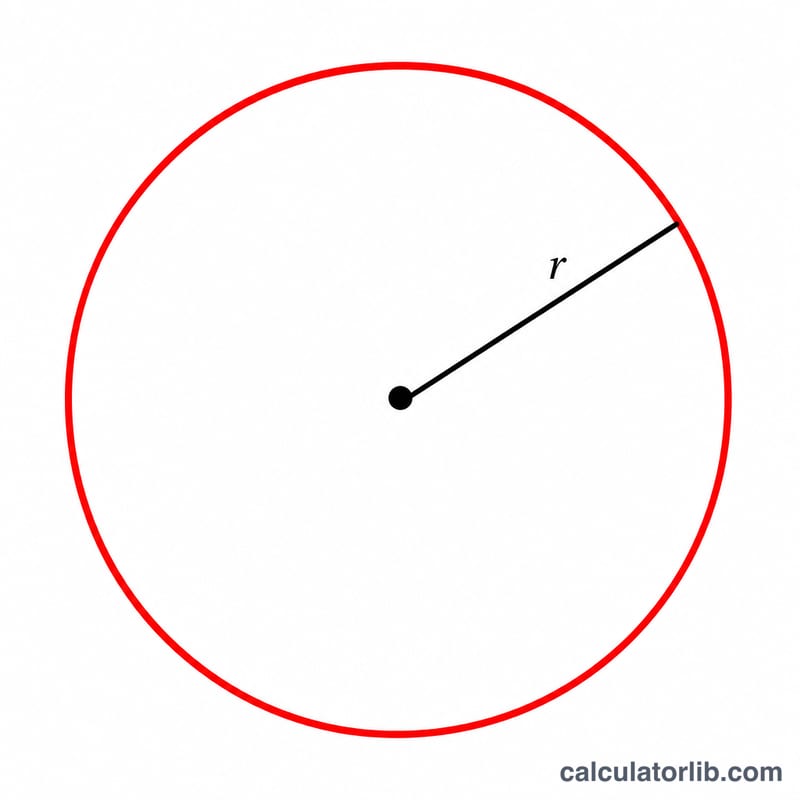
- Radius — the distance from the centre of the circle to its edge. This is the only measurement you need.
- Unit — pick from centimeters (cm), meters (m), inches (in), or feet (ft). The result is reported in the same unit you choose, so a radius in metres gives a perimeter in metres.
The formula explained
The perimeter of a circle is calculated with:
$$P = 2\pi r$$
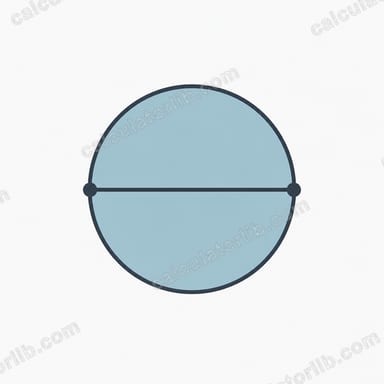
Here r is the radius and \(\pi \approx 3.14159\). Because the diameter is twice the radius (\(d = 2r\)), this is the same as the familiar \(P = \pi d\). Behind the scenes the tool also computes:
- Diameter \(= 2 \times r\)
- Area \(= \pi \times r^2\)
So a single radius entry gives you three results at once.
Worked example
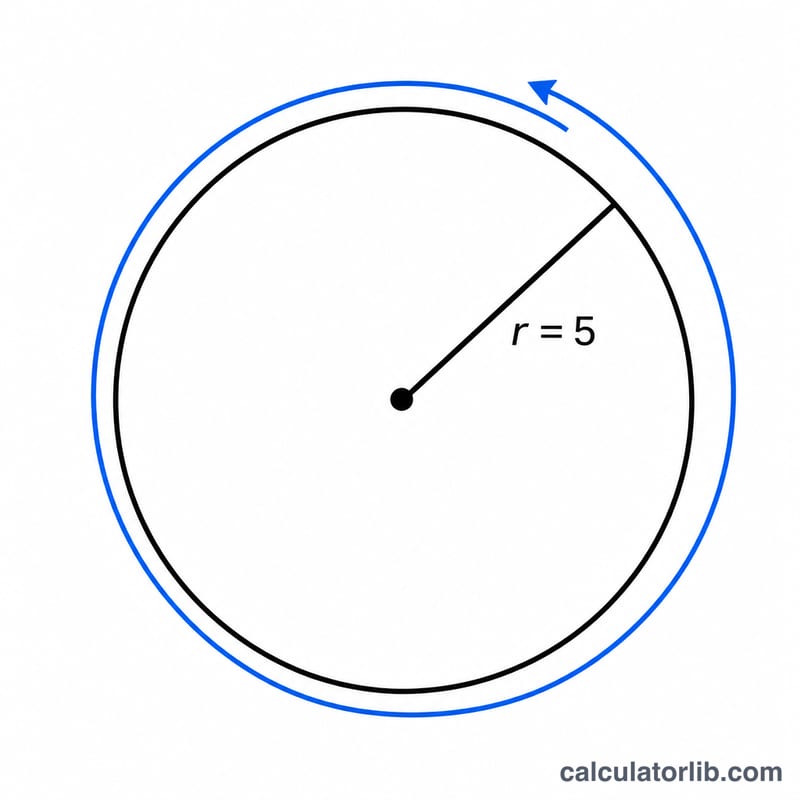
Suppose you enter a radius of 5 cm:
- Perimeter \(= 2 \times \pi \times 5 = 31.4159\) cm
- Diameter \(= 2 \times 5 = 10\) cm
- Area \(= \pi \times 5^2 = 78.5398\) cm²
So a circle with a 5 cm radius has a circumference of about 31.42 cm.
Quick Reference: Circumference for Common Radii
The circumference (perimeter) of a circle follows directly from its radius:
$$C = 2 \pi r \qquad\text{and}\qquad A = \pi r^2$$The table below is unit-neutral: read the radius in any single length unit (cm, m, in, or ft) and the diameter and circumference come out in that same unit, while the area comes out in the corresponding square unit. All values use \(\pi = 3.14159265\) and are rounded to 2 decimal places.
| Radius (r) | Diameter (2r) | Circumference (2πr) | Area (πr²) |
|---|---|---|---|
| 0.5 | 1 | 3.14 | 0.79 |
| 1 | 2 | 6.28 | 3.14 |
| 2 | 4 | 12.57 | 12.57 |
| 2.5 | 5 | 15.71 | 19.63 |
| 3 | 6 | 18.85 | 28.27 |
| 5 | 10 | 31.42 | 78.54 |
| 10 | 20 | 62.83 | 314.16 |
| 15 | 30 | 94.25 | 706.86 |
| 20 | 40 | 125.66 | 1256.64 |
| 25 | 50 | 157.08 | 1963.50 |
| 50 | 100 | 314.16 | 7853.98 |
| 100 | 200 | 628.32 | 31415.93 |
How the two outputs scale. Circumference is linear in the radius: double the radius and the circumference doubles exactly (r = 5 → C = 31.42; r = 10 → C = 62.83). Area is quadratic: double the radius and the area quadruples (r = 5 → A = 78.54; r = 10 → A = 314.16, which is 4 × 78.54). A useful consequence is that the ratio \(C / d\) is always \(\pi \approx 3.1416\), no matter how large or small the circle is — a quick way to sanity-check any row above.
One interesting checkpoint in the table: at \(r = 2\) the circumference and the area have the same numerical value (12.57), because \(2 \pi r = \pi r^2\) when \(r = 2\). Below that radius the circumference number is larger; above it the area number grows away rapidly. The two quantities are not comparable physically — one is a length, the other an area — so this is a numerical coincidence, not an equality of magnitudes.
Length Unit Conversions (cm, m, in, ft)
This calculator accepts the radius in centimetres, metres, inches, or feet and returns the circumference in the same unit. If you need the answer in a different unit, use the factors below. The inch and foot values here are the international inch and foot, defined by the 1959 international yard-and-pound agreement as exactly 1 in = 2.54 cm; the survey foot used in some older US land records differs by about 2 parts per million and is not used here.
| From | = cm | = m | = in | = ft |
|---|---|---|---|---|
| 1 cm | 1 | 0.01 | 0.393701 | 0.0328084 |
| 1 m | 100 (exact) | 1 | 39.3701 | 3.28084 |
| 1 in | 2.54 (exact) | 0.0254 (exact) | 1 | 0.0833333 (= 1/12) |
| 1 ft | 30.48 (exact) | 0.3048 (exact) | 12 (exact) | 1 |
Why the factor applies directly to the circumference. Circumference is a length, exactly like the radius you typed in. Converting it means multiplying by the plain (first-power) factor — there is no squaring, and no need to re-run the calculation:
$$C_{\text{new unit}} = C_{\text{old unit}} \times k, \qquad k = \text{the factor from the table}$$Area is the exception. If you also use the bonus area output \(A = \pi r^2\), the conversion factor must be squared, because an area spans two dimensions:
- 1 in² = 2.54² cm² = 6.4516 cm² (exact)
- 1 ft² = 0.3048² m² = 0.09290304 m² ≈ 0.092903 m² (exact value 0.09290304)
- 1 ft² = 144 in² (exact)
- 1 m² = 10,000 cm² (exact)
One-line example. A radius of 5 in gives \(C = 2\pi(5) = \) 31.42 in, and converting that length once gives \(31.4159 \times 2.54 = 79.80\) cm. The matching area converts with the squared factor: \(A = \pi(5)^2 = 78.54\) in² \(\times\, 6.4516 = 506.71\) cm².
A practical tip: pick the unit you will actually measure or cut in before you calculate, and keep the full unrounded result for any further arithmetic. Rounding the circumference to 2 decimals and then converting introduces a small error that compounds if you divide the circumference into equal segments — for example when marking bolt holes or cutting edge banding.
Conventions and edge cases
Each case below was run through this calculator; the result column is what it actually returns.
| Case | Input | Result |
|---|---|---|
| Decimal value (2.5) | 2.5 | Circle Perimeter: 15.71 cm |
| Negative length | -5 | A length cannot be negative. Enter 0 or a positive number. |
| Typical value (10) | 10 | Circle Perimeter: 62.83 cm |
| Zero: a degenerate circle | 0 | Circle Perimeter: 0 cm |
Checked on 2026-11-08
Frequently asked questions
What is the difference between perimeter and circumference? For a circle they are the same thing — "circumference" is simply the specific name for the perimeter of a circle.
I only know the diameter, not the radius. What do I do? Divide the diameter by 2 to get the radius, then enter that value. For example, a 10 cm diameter means a 5 cm radius.
Why is the answer never an exact whole number? Because π is an irrational number, the circumference of most circles is a non-terminating decimal. The calculator uses a high-precision value of π, so you can round the result to as many decimal places as your task requires.