What Is This Calculator?
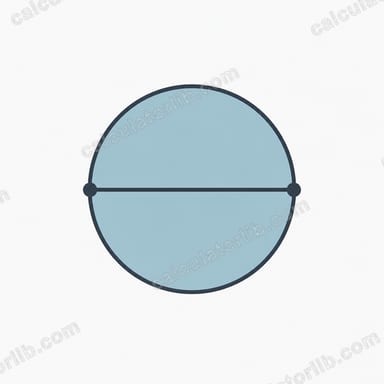
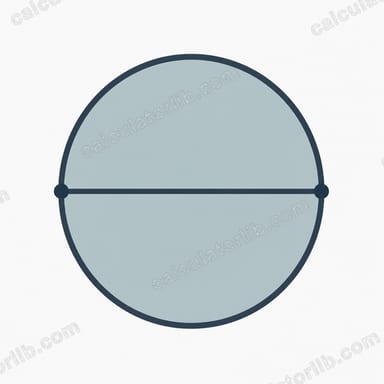
The Circle Perimeter from Diameter Calculator finds the perimeter of a circle — more commonly called its circumference — directly from the diameter. The perimeter is the total distance around the edge of the circle. Because the diameter passes straight through the center, this is the quickest way to measure or estimate the size of a round object such as a pipe, wheel, plate, or table.
How to Use It
Enter the diameter of your circle in any unit you like (cm, inches, meters, feet). The calculator returns the circumference using the formula \(C = \pi d\), and also shows the radius (half the diameter) and the area as bonus results. Whatever unit you put in, the circumference comes out in the same unit and the area in that unit squared.
The Formula Explained
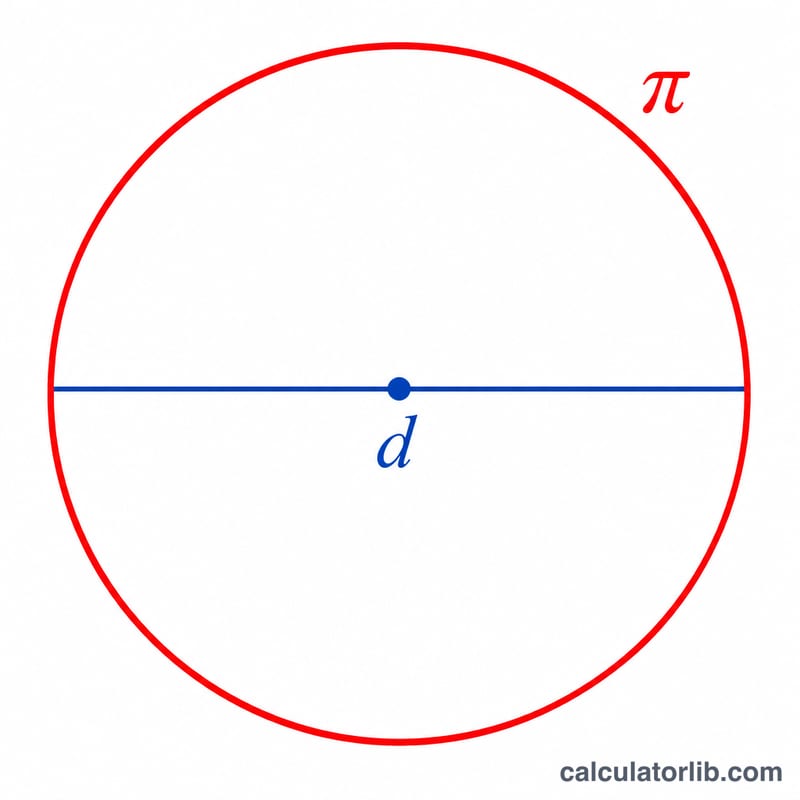
The relationship between a circle's circumference and its diameter is constant for every circle — that constant is \(\pi\) (pi \(\approx 3.14159\)). This gives the famous formula:
$$C = \pi \times d$$
where \(C\) is the circumference (perimeter) and \(d\) is the diameter. If you only know the radius, just double it to get the diameter, since \(d = 2r\).
Worked Example
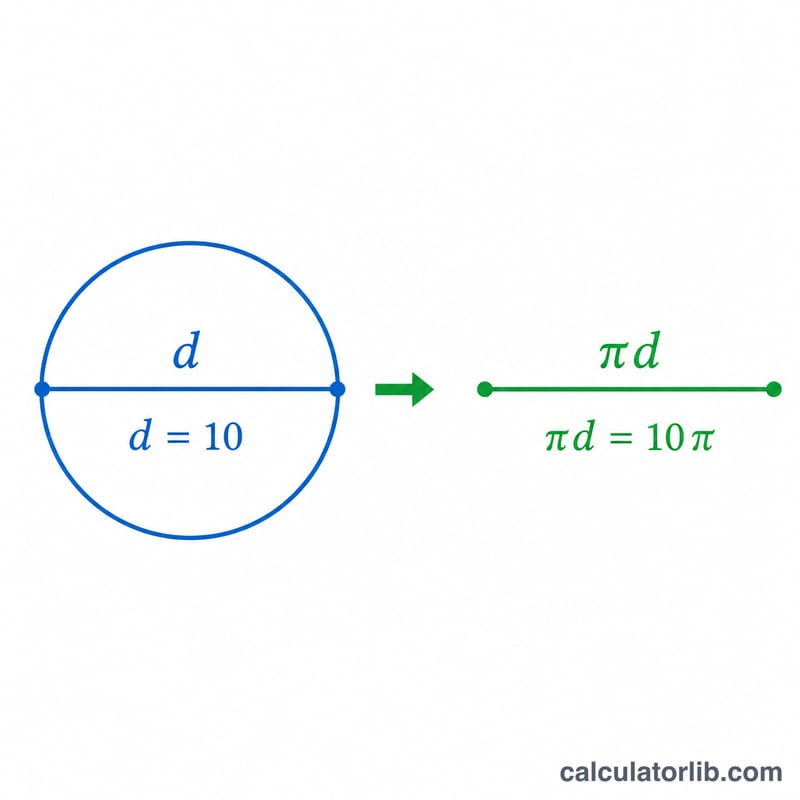
Suppose a circular tabletop has a diameter of 10 units. Then:
$$C = \pi \times 10 = 3.14159 \times 10 \approx \textbf{31.42 units}.$$
The radius is \(10 \div 2 = 5\) units, and the area is \(\pi \times 5^2 \approx 78.54\) square units.
More Worked Examples
Each example below uses \(C = \pi d\), \(r = d/2\) and \(A = \pi r^2\), with \(\pi \approx 3.14159265\). Values are worked out at full precision and rounded only at the end, to 2 decimal places. The answer is always in the same unit as the diameter you start with. Area is in that unit squared.
Example 1: A 26-inch bicycle wheel
- Circumference: $$C = \pi \times 26 = 81.6814\ldots \approx 81.68\ \text{in}$$ Rounded to 2 decimals, the circumference is 81.68 inches.
- Radius: $$r = \frac{26}{2} = 13\ \text{in}$$
- Area: $$A = \pi \times 13^2 = \pi \times 169 = 530.9291\ldots \approx 530.93\ \text{in}^2$$
In practice, one full turn of a wheel with an outer diameter of 26 in moves the bike about 81.68 in, or roughly 6.81 ft. "26-inch" is a nominal size, though. The real outer diameter depends on the tire, so measure it if you need an exact figure.
Example 2: A pipe with a 2.5 cm diameter
- Circumference: $$C = \pi \times 2.5 = 7.8539\ldots \approx 7.85\ \text{cm}$$ The result is 7.85 cm.
- Radius: $$r = \frac{2.5}{2} = 1.25\ \text{cm}$$
- Area: $$A = \pi \times 1.25^2 = \pi \times 1.5625 = 4.9087\ldots \approx 4.91\ \text{cm}^2$$
A strip of tape or insulation wrapped once around the outside of this pipe needs about 7.85 cm, plus any overlap. Use the outer diameter for wrapping. Use the inner diameter for the flow cross-section.
Example 3: Working backward from a measured circumference
Suppose you wrap a tape measure around a tree trunk or a round tank and read \(C = 100\ \text{cm}\). Rearrange \(C = \pi d\) to solve for the diameter:
- Diameter: $$d = \frac{C}{\pi} = \frac{100}{3.14159265} = 31.8309\ldots \approx 31.83\ \text{cm}$$
- Radius: $$r = \frac{31.8309}{2} = 15.9155\ldots \approx 15.92\ \text{cm}$$
- Area, using the unrounded diameter: $$A = \frac{C^2}{4\pi} = \frac{10000}{12.5664} = 795.7747\ldots \approx 795.77\ \text{cm}^2$$
Check: \(\pi \times 31.8309 \approx 100.00\ \text{cm}\). Measuring the circumference and dividing by π is often easier than measuring the diameter directly, especially for large or solid objects.
Circumference of Common Diameters
Circumference is \(C = \pi d\) and area is \(A = \dfrac{\pi d^2}{4}\). All values are rounded to 2 decimal places.
| Diameter (d) | Circumference (πd) | Area (πd²/4) |
|---|---|---|
| 1 | 3.14 | 0.79 |
| 2 | 6.28 | 3.14 |
| 5 | 15.71 | 19.63 |
| 10 | 31.42 | 78.54 |
| 12 | 37.70 | 113.10 |
| 20 | 62.83 | 314.16 |
| 24 | 75.40 | 452.39 |
| 50 | 157.08 | 1963.50 |
| 100 | 314.16 | 7853.98 |
Everyday objects
| Object | Diameter | Circumference | Area |
|---|---|---|---|
| 12-inch pizza | 12 in | 37.70 in | 113.10 in² |
| Standard CD / DVD disc | 120 mm | 376.99 mm | 11,309.73 mm² |
| 700c road wheel rim (ISO/ETRTO bead seat diameter) | 622 mm | 1954.07 mm | 303,857.98 mm² |
Units carry through unchanged. If the diameter is in inches, the circumference is in inches and the area is in square inches. The same applies to millimetres, centimetres, metres or feet. The numbers in the first table work for any unit. For example, a 10 cm diameter gives 31.42 cm, and a 10 ft diameter gives 31.42 ft.
The 622 mm figure is the rim's bead seat diameter under the ISO 5775 (ETRTO) tire and rim sizing system. A mounted tire adds to the outer diameter, so the rolling circumference of a 700c wheel is noticeably larger than 1954 mm. Measure the tire itself if you need it for a bike computer setting.
The Value of Pi Used in the Calculation
The calculator uses the circumference formula \(C = \pi d\), where \(\pi\) is the ratio of any circle's circumference to its diameter. To about 10 decimal places, \(\pi \approx 3.1415926536\).
| Value | Decimal | Approx. relative error |
|---|---|---|
| π (10 decimal places) | 3.1415926536 | negligible for everyday use |
| 22/7 | 3.142857… | about 0.04% too high |
| 3.14 | 3.14 | about 0.05% too low |
- Pi is irrational: its decimal expansion never ends or repeats, so no fraction or finite decimal equals it exactly.
- Pi is dimensionless: it is a ratio of two lengths, so it has no unit.
- \(C = \pi d\) holds for every circle, whatever its size, because circumference is always proportional to diameter.
- The unit of C matches the unit of d. A diameter in centimetres gives a circumference in centimetres, and a diameter in inches gives a circumference in inches.
Example: for a diameter of 10 cm, \(C = \pi \times 10 \approx \)31.4159 cm. Using 3.14 instead gives 31.4 cm, which is about 0.05% lower.
Diameter, Radius, Circumference and Area Conversions
Diameter d, radius r, circumference C and area A are linked by the relationships below. If you know any one of them, you can find the other three.
| To find | From | Formula |
|---|---|---|
| Diameter | Radius | \(d = 2r\) |
| Radius | Diameter | \(r = \frac{d}{2}\) |
| Diameter | Circumference | \(d = \frac{C}{\pi}\) |
| Radius | Circumference | \(r = \frac{C}{2\pi}\) |
| Diameter | Area | \(d = 2\sqrt{\frac{A}{\pi}}\) |
| Circumference | Radius | \(C = 2\pi r\) |
| Circumference | Area | \(C = 2\sqrt{\pi A}\) |
| Area | Diameter | \(A = \frac{\pi d^2}{4}\) |
| Area | Circumference | \(A = \frac{C^2}{4\pi}\) |
Unit conversions: Length conversions such as 1 in = 2.54 cm, 1 ft = 12 in and 1 m = 100 cm do not change the π factor. Convert d first and then apply \(C = \pi d\), or compute C and convert it. Both routes give the same answer. Area units scale by the square of the length factor. For example, 1 ft² = 12² = 144 in², and 1 m² = 100² = 10,000 cm².
Conventions and edge cases
Each case below was run through this calculator; the result column is what it actually returns.
| Case | Input | Result |
|---|---|---|
| Decimal value (2.5) | 2.5 | Circle Perimeter: 7.85 |
| Negative length | -5 | A length cannot be negative. Enter 0 or a positive number. |
| Typical value (10) | 10 | Circle Perimeter: 31.42 |
| Zero: a degenerate circle | 0 | Circle Perimeter: 0 |
Checked on 2026-11-08
FAQ
Is perimeter the same as circumference? Yes. "Perimeter" is the general term for the distance around any shape; for a circle that distance has the special name circumference.
What if I know the radius instead? Multiply the radius by 2 to get the diameter, then enter it — or use \(C = 2\pi r\), which gives the same answer.
What value of pi is used? The calculator uses the full-precision value of \(\pi\) built into the math library, so results are accurate to many decimal places.