What is the dilution factor?
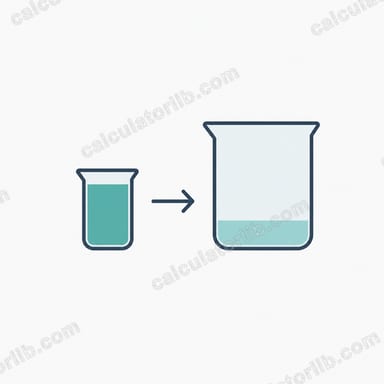
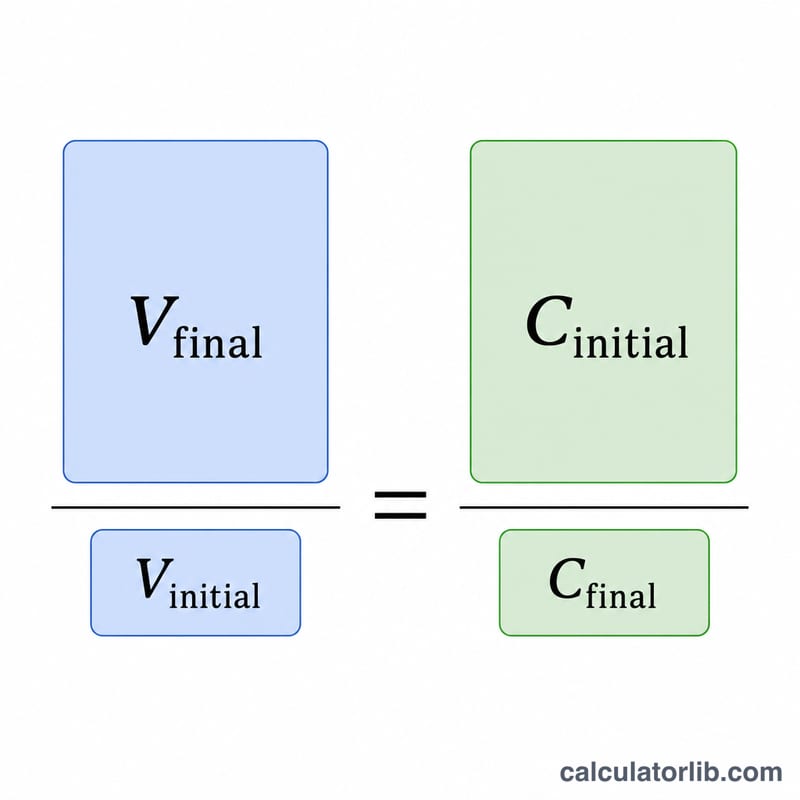
The dilution factor (DF) tells you how many times a sample has been diluted. It equals the final (total) volume divided by the initial sample volume. Because diluting reduces concentration in proportion to the increase in volume, the dilution factor also equals the ratio of the original concentration to the diluted concentration. A dilution factor of 10 (often written 1:10) means one part sample was made up to ten parts total.
How to use this calculator
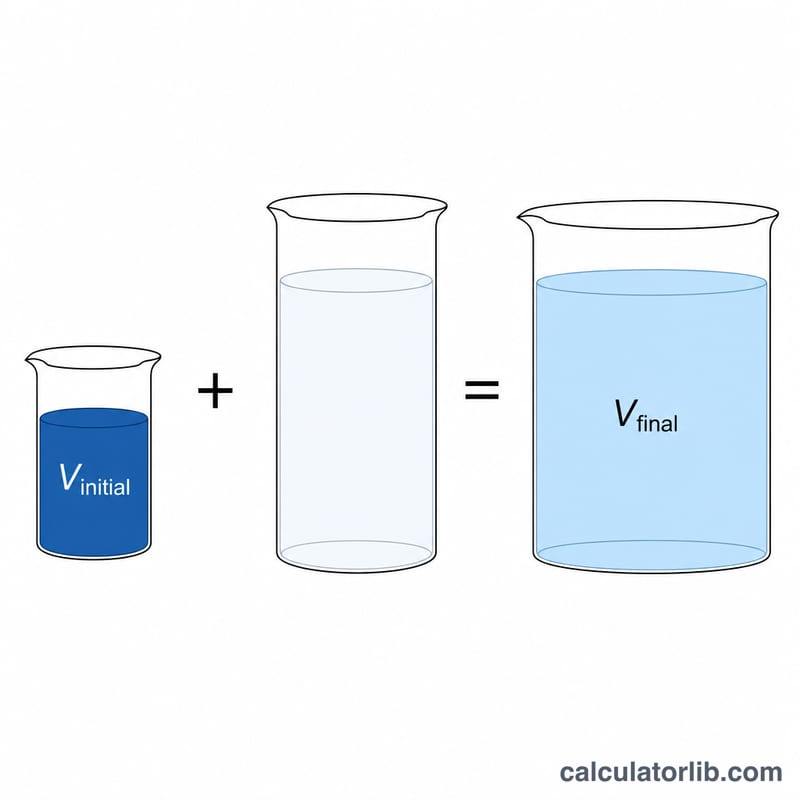
Enter the initial (sample) volume — the amount of your concentrated stock — and the final (total) volume after adding solvent. Use the same units for both (mL, µL, L). The calculator returns the dilution factor, the equivalent fold dilution, and the volume of diluent (solvent) you need to add to reach the final volume.
The formula explained
The core equation is $$\text{DF} = \frac{V_{\text{final}}}{V_{\text{initial}}}.$$ The volume of solvent required is simply the final volume minus the sample volume. If you know the dilution you want and your stock concentration, you can rearrange to find the diluted concentration: \(C_{\text{final}} = C_{\text{initial}} \div \text{DF}\).
Worked example
You take 2 mL of a stock solution and add buffer until the total volume is 50 mL. The dilution factor is $$50 \div 2 = 25$$ (a 1:25 dilution). You added \(50 - 2 = 48\ \text{mL}\) of diluent. If the stock was 100 mg/mL, the diluted solution is \(100 \div 25 = 4\ \text{mg/mL}\).
Common Dilutions Compared
The table below assumes a final volume of 10 mL and uses the sample:total convention, where \(\text{DF} = \frac{V_{\text{final}}}{V_{\text{sample}}}\). The diluent volume is the final volume minus the sample volume.
| Dilution (sample:total) | Dilution factor (DF) | Sample volume | Diluent volume | Concentration (% of stock) |
|---|---|---|---|---|
| 1:2 | 2 | 5 mL | 5 mL | 50% |
| 1:5 | 5 | 2 mL | 8 mL | 20% |
| 1:10 | 10 | 1 mL | 9 mL | 10% |
| 1:100 | 100 | 0.1 mL (100 µL) | 9.9 mL | 1% |
| 1:1000 | 1000 | 0.01 mL (10 µL) | 9.99 mL | 0.1% |
Notation warning: in the table, 1:N means 1 part sample in N total parts (sample:total), so DF = N. Some labs and protocols instead write 1:N as a sample:diluent ratio, meaning 1 part sample plus N parts diluent. Under that convention 1:10 gives DF = 11, not 10. Always check which convention a protocol uses, or state the dilution factor and volumes explicitly.
Very small sample volumes (such as 10 µL into 10 mL) are hard to pipette accurately. For high dilutions it is usually better to use a serial dilution in several steps; the overall DF is the product of the individual step DFs.
Dilution Terms and Notation
- Stock / initial solution
- The original, more concentrated solution or sample that is being diluted.
- Diluent
- The liquid added to reduce the concentration, such as water, buffer, saline, or growth medium. It should not contain the analyte being measured.
- Dilution factor (DF)
- The ratio of the final volume to the initial sample volume: \(\text{DF} = \frac{V_{\text{final}}}{V_{\text{initial}}}\). It is also the ratio of the starting concentration to the final concentration, so it is always 1 or greater.
- Fold dilution
- Another way of stating the dilution factor. A 10-fold dilution has DF = 10, meaning the concentration is reduced to one tenth of the stock.
- Final volume
- The total volume after the sample and diluent are combined: \(V_{\text{final}} = V_{\text{sample}} + V_{\text{diluent}}\).
- Aliquot
- A measured portion taken from a larger sample or solution, for example the 1 mL of stock transferred into a tube for dilution.
- Serial dilution
- A stepwise series of dilutions in which each tube is made from the previous one. The total dilution factor is the product of the steps; for example, three successive 1:10 steps give \(10 \times 10 \times 10 = 1000\).
Ratio notation: 1:10 versus 1+9
- 1:10 (sample:total) means 1 part sample in 10 total parts, so DF = 10.
- 1+9 means 1 part sample plus 9 parts diluent, which also gives 10 total parts and DF = 10.
- The ambiguous form is a sample:diluent ratio written as 1:10, which would mean 1 part sample and 10 parts diluent, a total of 11 parts and DF = 11. The "+" notation avoids this confusion.
Relation to C1V1 = C2V2
The dilution equation \(C_1 V_1 = C_2 V_2\) assumes the amount of solute is unchanged by dilution. Rearranging it gives
$$\frac{C_1}{C_2} = \frac{V_2}{V_1} = \text{DF}$$
where \(C_1\) and \(V_1\) are the stock concentration and the volume taken, and \(C_2\) and \(V_2\) are the final concentration and final volume. So the dilution factor tells you how many times the concentration drops, and \(C_2 = C_1 / \text{DF}\). This assumes volumes are additive, which is a good approximation for dilute aqueous solutions.
FAQ
Is a dilution factor of 10 the same as 1:10? Yes. A DF of 10 means the sample is one tenth of the final volume, written as 1:10.
What units should I use? Any volume unit works, as long as the initial and final volumes use the same unit — the factor is dimensionless.
How do I do serial dilutions? Multiply the individual dilution factors. Three successive 1:10 steps give a total DF of \(10 \times 10 \times 10 = 1000\).