What Is Volumetric Flow Rate?
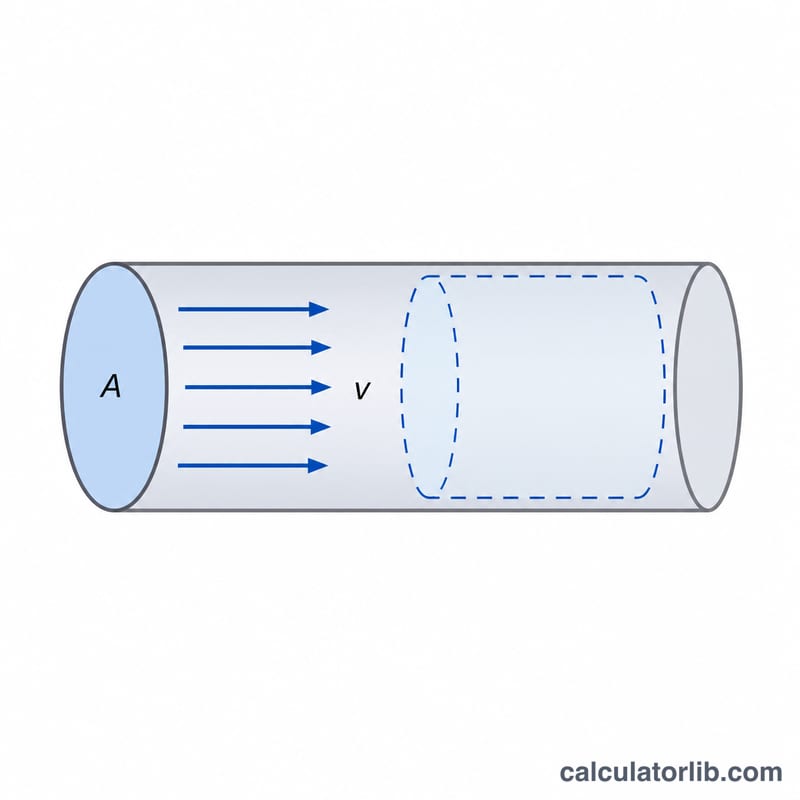
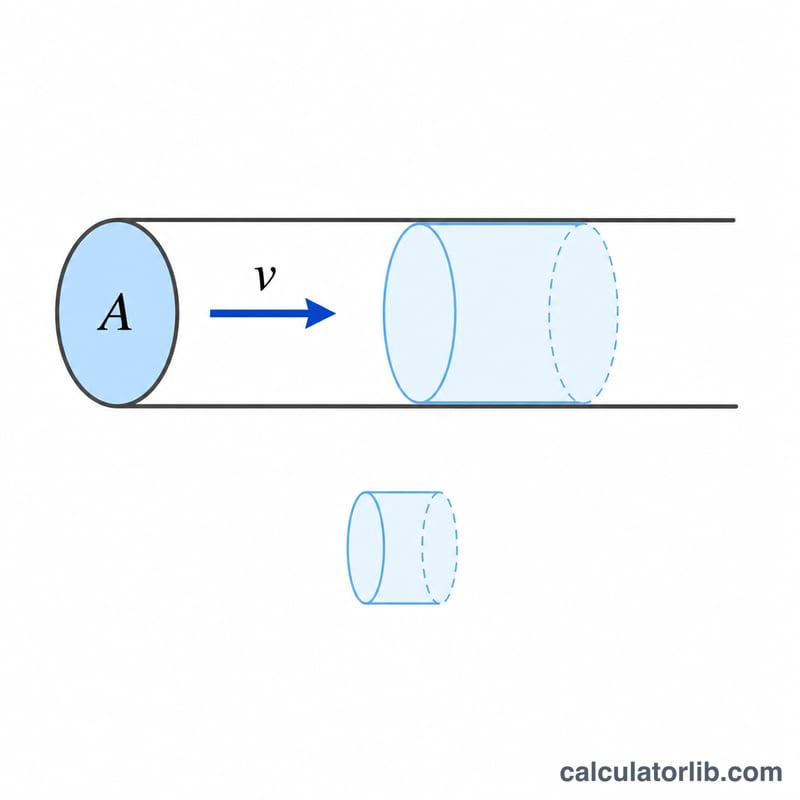
Volumetric flow rate (Q) measures the volume of fluid that passes through a given cross-section per unit of time. It is fundamental in fluid mechanics, plumbing, HVAC, hydraulics, and process engineering. The simplest relationship comes from the continuity principle: the flow rate equals the cross-sectional area of the pipe or channel multiplied by the average velocity of the fluid moving through it.
The Formula
The governing equation is $$Q = A \cdot v$$, where:
\(Q\) = volumetric flow rate (m³/s), \(A\) = cross-sectional area perpendicular to flow (m²), and \(v\) = average flow velocity (m/s). Because this calculator works in SI units, the result is in cubic meters per second, which we also convert to liters per minute (×60,000) and US gallons per minute (×15,850.32) for convenience.
How to Use This Calculator
Enter the cross-sectional area of the pipe or duct in square meters and the average flow velocity in meters per second. For a circular pipe, compute the area as \(A = \pi \cdot r^2\) where \(r\) is the inner radius. Press calculate to get the flow rate in three common units.
Worked Example
Suppose water flows through a pipe with a cross-sectional area of 0.05 m² at an average velocity of 2 m/s. Then $$Q = 0.05 \times 2 = 0.1 \text{ m}^3/\text{s}.$$ Converting: \(0.1 \times 60{,}000 = 6{,}000\) L/min and \(0.1 \times 15{,}850.32 \approx 1{,}585\) GPM.
Flow Rate Unit Conversion Table
The calculator gives Q in m³/s. The table below converts 1 m³/s into other common volumetric flow units. GPM here means US gallons per minute (1 US gallon = 3.785411784 L). CFM means cubic feet per minute.
| Unit | Equivalent of 1 m³/s |
|---|---|
| Litres per second (L/s) | 1,000 |
| Litres per minute (L/min) | 60,000 |
| Cubic metres per hour (m³/h) | 3,600 |
| US gallons per minute (GPM) | ≈ 15,850.32 |
| Cubic feet per minute (CFM) | ≈ 2,118.88 |
| Cubic feet per second (ft³/s) | ≈ 35.3147 |
Reverse factors, converting to m³/s:
| 1 unit | In m³/s |
|---|---|
| 1 L/min | ≈ 1.6667 × 10⁻⁵ |
| 1 US GPM | ≈ 6.3090 × 10⁻⁵ |
| 1 m³/h | ≈ 2.7778 × 10⁻⁴ |
Typical Flow Velocities in Pipes and Ducts
The ranges below are commonly cited general engineering rules of thumb for choosing a velocity \(v\) when sizing a pipe or duct from \(A = Q / v\). They are not strict limits.
| Application | Typical velocity (m/s) |
|---|---|
| Water, pump suction lines | ≈ 0.5 – 1.5 |
| Water, discharge / distribution lines | ≈ 1.5 – 3 |
| Municipal water mains | ≈ 0.6 – 2 |
| HVAC main ducts | ≈ 5 – 10 |
| Compressed air lines | ≈ 6 – 20 |
Recommended limits vary by standard, fluid, pipe material, noise requirements, pressure drop and application. Always check the applicable design code or manufacturer guidance for your case.
Flow Rate Comparison for Common Pipe Sizes
For a full circular pipe, the area is \(A = \pi d^2 / 4\), where \(d\) is the inner diameter. Then \(Q = A \cdot v\). For example, a 100 mm pipe at 1 m/s: \(A = \pi (0.1)^2 / 4 \approx 0.007854\ \text{m}^2\), so \(Q = 0.007854 \times 1 = \) 0.007854 m³/s (about 471.2 L/min).
| Inner diameter | Area (m²) | Velocity (m/s) | Q (m³/s) | Q (L/min) | Q (US GPM) |
|---|---|---|---|---|---|
| 25 mm | 0.000491 | 1 | 0.000491 | 29.45 | 7.78 |
| 25 mm | 0.000491 | 2 | 0.000982 | 58.90 | 15.56 |
| 50 mm | 0.001963 | 1 | 0.001963 | 117.81 | 31.12 |
| 50 mm | 0.001963 | 2 | 0.003927 | 235.62 | 62.24 |
| 100 mm | 0.007854 | 1 | 0.007854 | 471.24 | 124.49 |
| 100 mm | 0.007854 | 2 | 0.015708 | 942.48 | 248.97 |
| 200 mm | 0.031416 | 1 | 0.031416 | 1,884.96 | 497.95 |
| 200 mm | 0.031416 | 2 | 0.062832 | 3,769.91 | 995.89 |
Doubling the diameter quadruples the cross-sectional area, so at the same velocity the flow rate is also four times larger. Doubling the velocity at a fixed diameter doubles the flow rate. Values are rounded and assume a full pipe with uniform average velocity.
FAQ
How do I find the area of a round pipe? Use \(A = \pi \times (\text{diameter}/2)^2\). For a 0.2 m diameter pipe, \(A = \pi \times 0.1^2 \approx 0.0314\) m².
What velocity should I use? Use the average (mean) velocity across the cross-section, not the peak centerline velocity, which is higher in laminar flow.
Does this account for friction or turbulence? No. \(Q = A \cdot v\) is the ideal continuity relation. Pressure losses and friction require additional equations like Darcy-Weisbach.