What This Geometric Sequence Calculator Does
A geometric sequence is a list of numbers where each term is found by multiplying the previous term by a fixed value called the common ratio. This calculator takes three inputs and instantly builds the full sequence, identifies the nth (last) term, and adds every term together to give you the total sum.
- First Term (a): the starting value of the sequence (a₁).
- Common Ratio (r): the number each term is multiplied by to get the next one.
- Number of Terms (n): how many terms you want the calculator to generate.
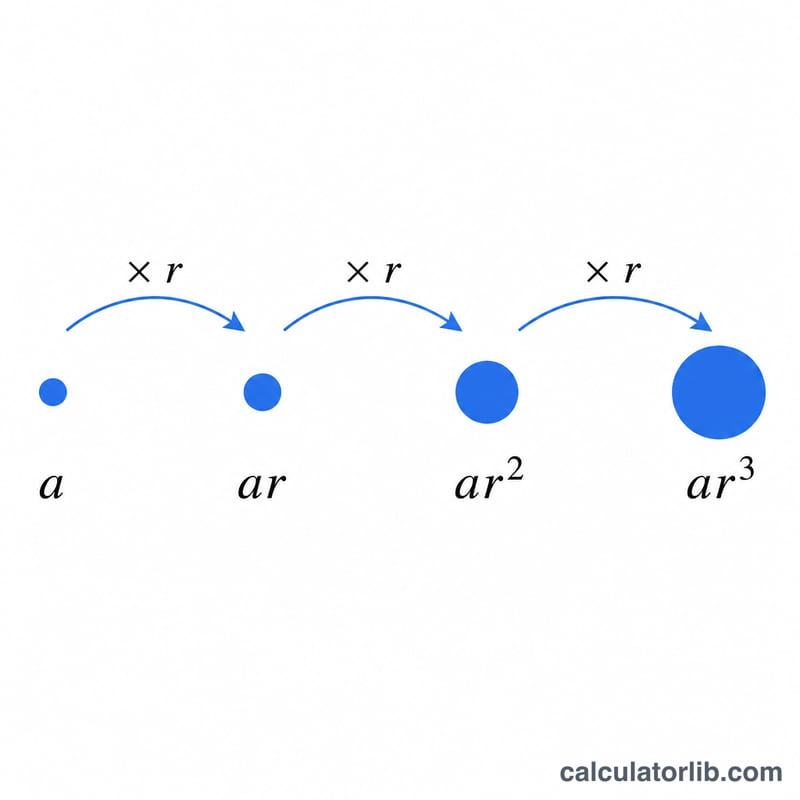
The Formula Behind It
The calculator finds any term using the standard geometric sequence formula:
aₙ = a₁ · r^(n−1)
Internally, the tool loops from the 1st through the nth term, computing each value as first term × ratio raised to its position index. It collects every term into the displayed sequence, sets the last computed value as the nth term, and keeps a running total to produce the sum. Very large or very small results (above 1,000,000 or below 0.000001) are shown in scientific notation for readability.
Worked Example
Suppose you enter a First Term of 3, a Common Ratio of 2, and 5 for the Number of Terms.
- Term 1: 3 × 2⁰ = 3
- Term 2: 3 × 2¹ = 6
- Term 3: 3 × 2² = 12
- Term 4: 3 × 2³ = 24
- Term 5: 3 × 2⁴ = 48
The sequence is 3, 6, 12, 24, 48. The nth (5th) term is 48, and the sum of all terms is 93.
How to Calculate a Geometric Sequence by Hand
A geometric sequence is a list of numbers in which every term is the previous term multiplied by the same fixed number, the common ratio \(r\). Only two formulas are needed: one for a single term, one for the running total. Work through them in this order.
- Identify \(a_1\), \(r\) and \(n\). \(a_1\) is the first term, \(r\) is the constant multiplier, and \(n\) is the position of the term you want (or, for a sum, the number of terms you are adding). In the sequence 3, 6, 12, 24, 48 the first term is \(a_1 = 3\).
- Confirm the ratio by division. Divide any term by the term immediately before it: $$r = \frac{a_{k+1}}{a_k}$$ For 3, 6, 12, 24, 48 this gives \(6/3 = 2\), \(12/6 = 2\) and \(24/12 = 2\). If the quotient is not the same every time, the sequence is not geometric and these formulas do not apply. (Checking at least two consecutive pairs is what catches a mis-typed term.)
- Compute the nth term. $$a_n = a_1 \cdot r^{\,n-1}$$ The exponent is \(n-1\), not \(n\), because the first term has already been "reached" without any multiplication: \(a_1 = a_1 \cdot r^0\). Using \(n\) by mistake is the single most common error and inflates the answer by one extra factor of \(r\).
- Compute the sum of the first n terms. For \(r \neq 1\): $$S_n = \frac{a_1\left(1 - r^{\,n}\right)}{1 - r}$$ Here the exponent is \(n\), the full count of terms. If \(r = 1\) the formula divides by zero, but the sequence is simply \(a_1, a_1, a_1, \dots\), so $$S_n = a_1 \cdot n$$
- Worked arithmetic — \(a_1 = 3\), \(r = 2\), \(n = 5\).
Term: $$a_5 = 3 \cdot 2^{\,5-1} = 3 \cdot 2^{4} = 3 \cdot 16 = 48$$ Sum: $$S_5 = \frac{3\left(1 - 2^{5}\right)}{1 - 2} = \frac{3(1 - 32)}{-1} = \frac{3 \cdot (-32 + 1)}{-1} = \frac{-93}{-1} = 93$$ Check by adding the terms directly: \(3 + 6 + 12 + 24 + 48 = 93\). The fifth term is 48 and the sum of the five terms is 93.
Infinite sums. If you keep adding terms forever, the total settles on a finite value only when the terms shrink — that is, when \(|r| < 1\). In that case \(r^{\,n} \to 0\) and the sum formula collapses to $$S_\infty = \frac{a_1}{1 - r}$$ For example, \(a_1 = 100\) with \(r = 0.5\) gives \(S_\infty = 100 / 0.5 = 200\). When \(|r| \ge 1\) the series diverges: the terms never shrink to zero, so the partial sums grow without bound (\(|r| > 1\)) or oscillate without settling (\(r = -1\)), and no finite infinite sum exists. The case \(r = 1\) likewise diverges, since \(S_n = a_1 n\) grows forever.
More Worked Examples
The three cases below cover the ratios that trip people up: a fraction (terms shrink), a negative number (signs alternate), and a decimal just above 1 (compound growth). Each one substitutes into \(a_n = a_1 \cdot r^{\,n-1}\) and then into \(S_n = a_1(1 - r^{\,n})/(1 - r)\).
Example 1 — Fractional ratio: \(a_1 = 100\), \(r = 0.5\), \(n = 6\)
The terms are 100, 50, 25, 12.5, 6.25, 3.125 — each one half of the one before.
Sixth term: $$a_6 = 100 \cdot 0.5^{\,6-1} = 100 \cdot 0.5^{5} = 100 \cdot 0.03125 = 3.125$$
Sum of six terms: $$S_6 = \frac{100\left(1 - 0.5^{6}\right)}{1 - 0.5} = \frac{100(1 - 0.015625)}{0.5} = \frac{100 \cdot 0.984375}{0.5} = \frac{98.4375}{0.5} = 196.875$$
Both results are exact — no rounding is needed, because 0.5 raised to a whole power is always an exact decimal. The sum of the six terms is 196.875. Since \(|r| = 0.5 < 1\), continuing forever would converge to \(S_\infty = 100/(1 - 0.5) = 200\), and indeed 196.875 is already close to that ceiling.
Example 2 — Negative ratio: \(a_1 = 2\), \(r = -3\), \(n = 5\)
The terms are 2, −6, 18, −54, 162 — the sign flips at every step because \(r\) is negative, while the magnitude triples.
Fifth term: $$a_5 = 2 \cdot (-3)^{\,5-1} = 2 \cdot (-3)^{4} = 2 \cdot 81 = 162$$ The exponent 4 is even, so the result is positive. Keep the parentheses around \(-3\): \((-3)^4 = 81\), whereas \(-3^4 = -81\).
Sum of five terms: $$S_5 = \frac{2\left(1 - (-3)^{5}\right)}{1 - (-3)} = \frac{2\left(1 - (-243)\right)}{1 + 3} = \frac{2 \cdot 244}{4} = \frac{488}{4} = 122$$
Direct check: \(2 - 6 + 18 - 54 + 162 = 122\). The sum is 122. Both values are exact. Because \(|r| = 3 > 1\), this series has no infinite sum.
Example 3 — Decimal growth: \(a_1 = 1000\), \(r = 1.05\), \(n = 10\)
A ratio of 1.05 means each term is 5% larger than the last — the pattern behind compound growth, where \(a_1\) is the starting amount and \(a_n\) is its value after \(n-1\) growth periods.
Tenth term: $$a_{10} = 1000 \cdot 1.05^{\,10-1} = 1000 \cdot 1.05^{9} = 1000 \cdot 1.551328\ldots \approx 1551.33$$
Sum of ten terms: $$S_{10} = \frac{1000\left(1 - 1.05^{10}\right)}{1 - 1.05} = \frac{1000(1 - 1.628895\ldots)}{-0.05} = \frac{-628.8946\ldots}{-0.05} \approx 12\,577.89$$
Rounding note: \(1.05^{9}\) and \(1.05^{10}\) are non-terminating in decimal form, so carry at least six decimal places through the working and round only the final answer — here to two decimals, giving a tenth term of about 1551.33 and a ten-term total of about 12,577.89. Rounding the power to two decimals first would shift the sum by several units.
Frequently Asked Questions
Can the common ratio be a fraction or negative? Yes. A ratio between 0 and 1 (like 0.5) creates a shrinking sequence, while a negative ratio (like −2) produces terms that alternate between positive and negative values.
What if the ratio is 1? Every term equals the first term, so the sequence is constant and the sum is simply a₁ × n.
Why are some results shown with an "E"? When values become extremely large or extremely small, the calculator switches to scientific notation (for example, 1.2345E7) so the numbers stay easy to read instead of running on with many digits.