
What This Calculator Does
This calculator tells you exactly how much interest you will earn on a sum of money when it grows with compound interest. You provide the amount you're investing or depositing, the annual interest rate, how long you'll leave it, and how often interest compounds. It returns the total interest earned plus the final balance.
How to Use It
Enter your principal (the starting amount), the annual interest rate as a percentage, the number of years you'll hold the money, and the compounding frequency. Monthly compounding is the most common for savings accounts, while many bonds use semi-annual or annual compounding. Press calculate to see your results instantly.
The Formula Explained
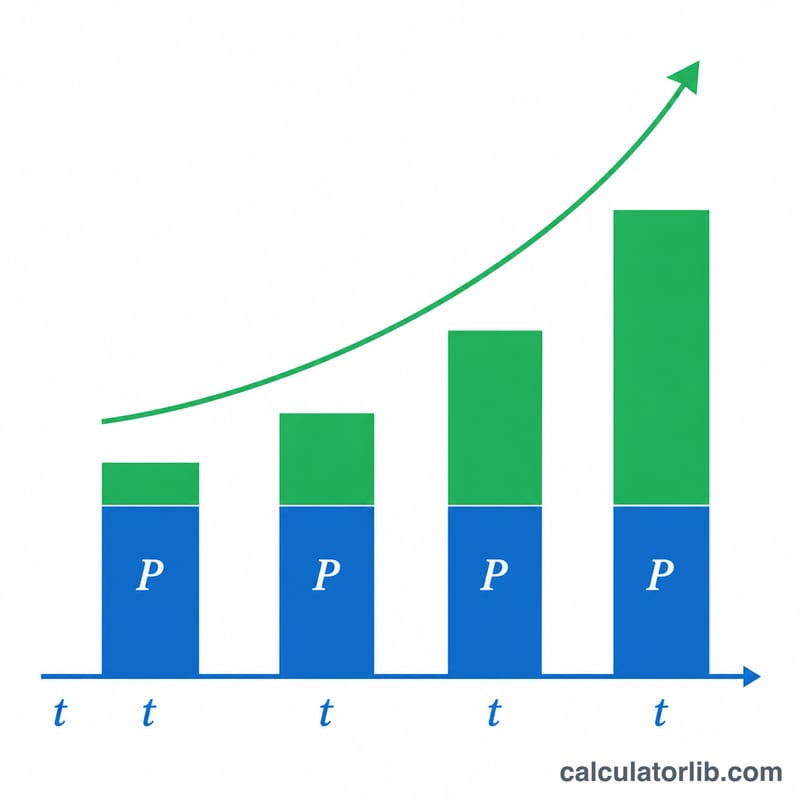
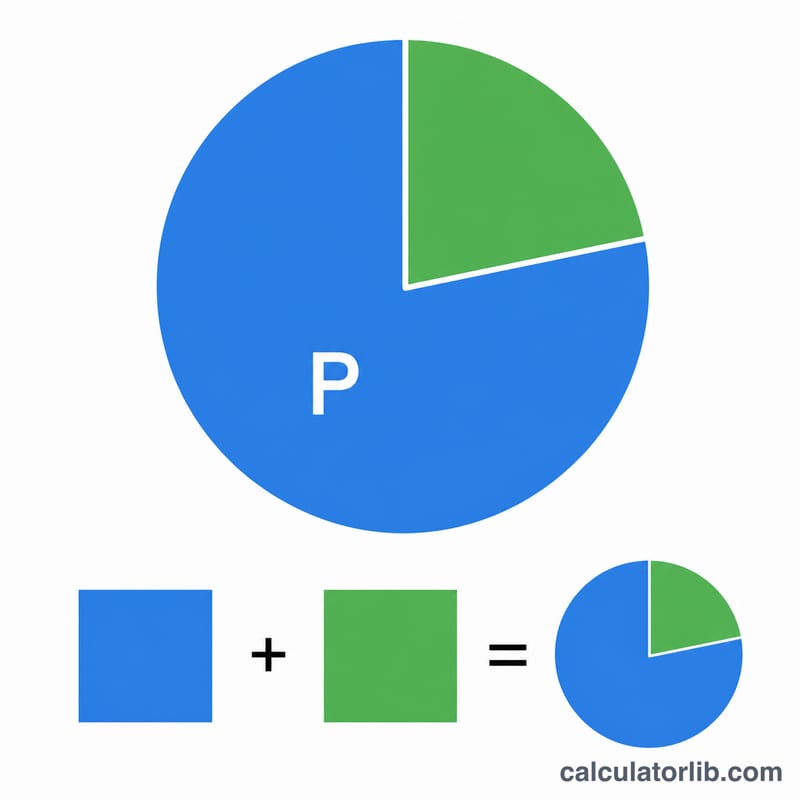
Compound interest follows the equation $$A = P\left(1 + \frac{r}{n}\right)^{n\,t}$$ where A is the future value, P is the principal, r is the decimal annual rate, n is the number of compounding periods per year, and t is the time in years. The interest you actually earn is simply the future value minus what you started with: $$\text{Interest} = A - P$$ More frequent compounding produces slightly more interest because you earn interest on previously credited interest sooner.
Worked Example
Suppose you deposit $10,000 at a 5% annual rate, compounded monthly, for 10 years. Here \(n = 12\) and \(t = 10\), so the exponent is 120. The future value is $$10{,}000 \times \left(1 + \frac{0.05}{12}\right)^{120} \approx \$16{,}470.09$$ Subtracting the $10,000 principal, you earn about $6,470.09 in interest.
FAQ
Does more frequent compounding always earn more? Yes, but the difference shrinks at higher frequencies. Daily compounding earns only marginally more than monthly at typical rates.
Is this the same as APY? The effective return here is the APY when \(t = 1\) year. APY already bakes in the compounding frequency.
Does this account for taxes or inflation? No. The result is nominal interest before any taxes or inflation adjustments.