What This Calculator Does
Most loan calculators start with a loan amount and tell you the monthly payment. This one works in reverse: you tell it the monthly payment you can comfortably afford, the annual interest rate, and the loan term, and it tells you the maximum loan amount you could borrow. It's perfect for budgeting a mortgage, car loan, or personal loan around your cash flow rather than around a sticker price.
How to Use It
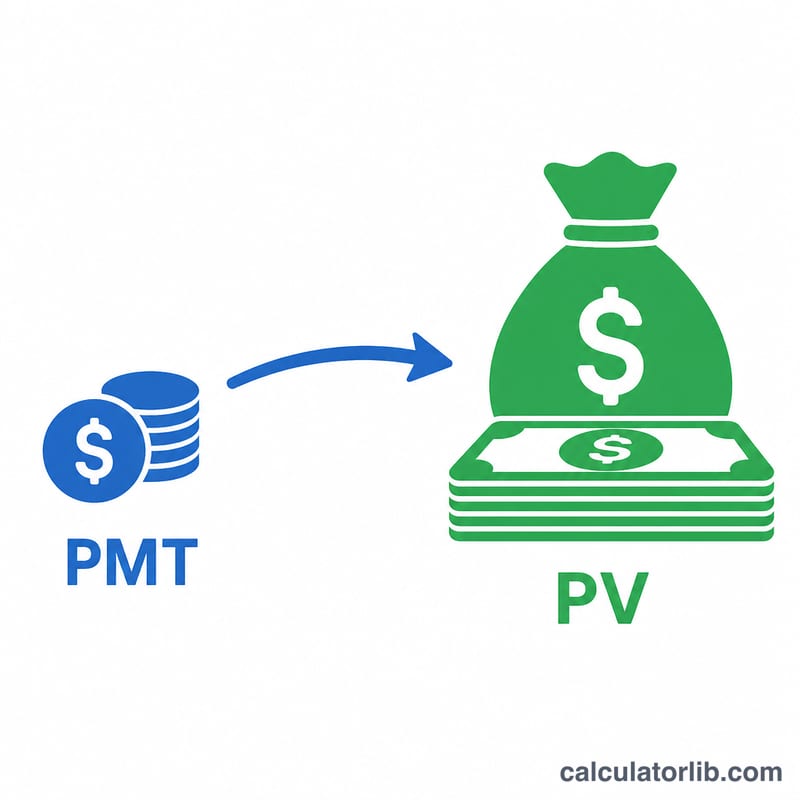
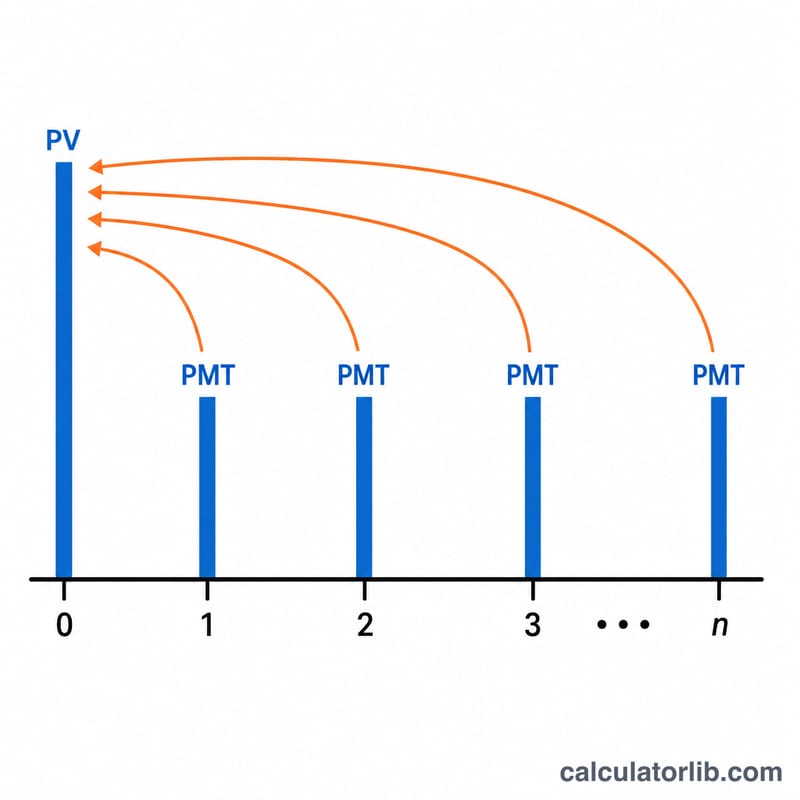
Enter the monthly payment you're willing to make, the annual interest rate offered by your lender (as a percentage), and the loan term in years. The calculator converts these into a monthly interest rate and a total number of payments, then computes the present value of that stream of payments — which is exactly the loan principal you can support.
The Formula Explained
The math is the present value of an ordinary annuity: $$PV = PMT \times \frac{1 - (1+i)^{-n}}{i}$$ Here PV is the loan amount, PMT is the monthly payment, \(i\) is the monthly interest rate (annual rate ÷ 12), and \(n\) is the number of monthly payments (years × 12). When the interest rate is 0%, the formula simplifies to \(PV = PMT \times n\).
Worked Example
Suppose you can pay $1,500 per month, the annual rate is 6%, and the term is 30 years. Then \(i = 0.06/12 = 0.005\) and \(n = 360\). $$PV = 1500 \times \frac{1 - 1.005^{-360}}{0.005} \approx \$250{,}187$$ Over the loan you'd pay \(\$1{,}500 \times 360 = \$540{,}000\), meaning roughly $289,813 in interest.
Borrowing Amount at Different Rates and Terms
The table fixes the monthly payment at $1,500 and applies \(PV = PMT \times \frac{1-(1+i)^{-n}}{i}\), where \(i\) is the annual rate divided by 12 and \(n\) is the number of monthly payments. Values are rounded to the nearest dollar.
| Term | 4% annual rate | 6% annual rate | 8% annual rate |
|---|---|---|---|
| 15 years (n = 180) | ≈ $202,788 | ≈ $177,755 | ≈ $156,961 |
| 20 years (n = 240) | ≈ $247,533 | ≈ $209,371 | ≈ $179,331 |
| 30 years (n = 360) | ≈ $314,192 | ≈ $250,187 | ≈ $204,425 |
Worked check for the 6%, 30-year cell: \(i = 6/1200 = 0.005\) and \(n = 12 \times 30 = 360\). Then \(PV = 1500 \times \frac{1-(1.005)^{-360}}{0.005} \approx 1500 \times 166.7916 \approx 250{,}187\).
Reading across a row shows how a higher rate shrinks the supported loan. Reading down a column shows how a longer term increases it, with diminishing gains at longer terms.
Interpreting Your Result
The result is the maximum principal that a level monthly payment can fully repay over the chosen term at the chosen rate. It assumes a fully amortizing loan: each payment covers that month's interest first, and the rest reduces the balance until it reaches zero after \(n\) payments.
Total interest over the life of the loan is the total of all payments minus the principal:
$$\text{Total interest} = PMT \times n - PV$$
For example, $1,500 a month at 6% for 30 years supports about $250,187 and involves \(1500 \times 360 = 540{,}000\) in payments, so total interest is about \(540{,}000 - 250{,}187 = 289{,}813\). For 15 years at the same rate, the principal is about $177,755, payments total \(1500 \times 180 = 270{,}000\), and interest is about $92,245.
A lower rate or a longer term raises the principal a given payment can support. A longer term also increases total interest, because the balance stays outstanding for more months.
The figure covers principal and interest only. It does not include origination or closing fees, property taxes, insurance, mortgage insurance, or other charges. It also does not reflect lender underwriting limits such as debt-to-income ratios, credit requirements, or maximum loan-to-value rules, so the amount a lender actually offers may differ from this result.
Key Terms
- Principal / present value (PV)
- The amount borrowed today, which is the lump sum equal in value to the stream of future payments at the given rate.
- Monthly payment (PMT)
- The fixed amount paid each month, covering both interest and principal repayment.
- Annual rate vs. monthly periodic rate
- The annual rate is the yearly quoted percentage. The monthly periodic rate is \(i = \text{annual rate} \div 12\), so 6% becomes 0.5% per month. This calculator divides the percentage by 1200 to get that decimal.
- Term and number of payments (n)
- The loan length. With monthly payments, \(n = 12 \times \text{years}\), so a 30-year term has 360 payments.
- Amortization
- Gradually paying off a loan through scheduled payments. Early payments are mostly interest, and later payments are mostly principal.
- Ordinary annuity
- A series of equal payments made at the end of each period. The present-value formula used here assumes this timing.
- Total interest
- The cost of borrowing over the whole term, equal to \(PMT \times n - PV\).
Central bank policy rates today
The latest official policy rates of major central banks, updated automatically — the benchmark that bank deposit and loan rates follow.
- Federal Reserve · United States
- 3.75–4.00%
- As of
- 2026-11-12
- Change in 1 year
- 0 pp
Latest change Up +25 bp Federal Reserve changed its rate on 2026-09-17: from 3.50–3.75% to 3.75–4.00%.
| Central bank | Policy rate | As of | Change in 1 year |
|---|---|---|---|
| Banco Central do Brasil (Selic) · Brazil | 13.75% | 2026-11-15 | −1.25 pp |
| Banco de México · Mexico | 6.25% | 2026-11-10 | −1.00 pp |
| Federal Reserve · United States | 3.75–4.00% | 2026-11-12 | 0 pp |
| ECB | 2.50% | 2026-11-16 | +0.50 pp |
| Sveriges Riksbank · Sweden | 2.00% | 2026-11-16 | +0.25 pp |
| Saudi Central Bank (SAMA) · Saudi Arabia | 4.50% | 2026-10-29 | 0 pp |
| Reserve Bank of Australia · Australia | 4.60% | 2026-10-31 | +1.00 pp |
| Central Bank of the Republic of Türkiye · Türkiye | 36.00% | 2026-11-06 | −3.50 pp |
| Bank of Russia · Russia | 14.00% | 2026-11-10 | −2.50 pp |
| People’s Bank of China · China | 3.00% | 2026-11-10 | 0 pp |
| Bank of Canada · Canada | 2.50% | 2026-11-12 | +0.25 pp |
| Reserve Bank of India · India | 5.50% | 2026-10-19 | 0 pp |
| Bank of England · United Kingdom | 4.00% | 2026-11-16 | 0 pp |
| Bank of Japan · Japan | 1.25% | 2026-11-10 | +0.75 pp |
| Bank of Korea · South Korea | 3.00% | 2026-11-02 | +0.50 pp |
Federal Reserve: key rates and overnight market rates
The rates that frame monetary policy and the overnight market rate they steer, each with the date of its latest published value.
| Rate | Level | As of | Change in 1 year |
|---|---|---|---|
| Federal funds target range | 3.75–4.00% | 2026-11-12 | 0 pp |
| Effective federal funds rate (EFFR) | 3.88% | 2026-11-12 | +0.01 pp |
| Secured Overnight Financing Rate (SOFR) | 3.90% | 2026-11-12 | −0.08 pp |
Each rate keeps the date of its own latest published value; overnight market rates are published on the next business day.
Latest figure: 2026-11-12 Data last updated 2026-11-16 · current
Source: Banco Central do Brasil ODbL; Bank for International Settlements (BIS) Terms of permitted use of BIS statistics; Federal Reserve Bank of New York New York Fed Terms of Use; Board of Governors of the Federal Reserve System Public domain (U.S. government work); European Central Bank ECB reuse policy; Sveriges Riksbank Riksbank open data terms; The World Bank Group CC BY 4.0; Reserve Bank of Australia 2026 RBA copyright terms (Cash Rate); Bank of Canada Bank of Canada terms of use; Bank of England Open Government Licence v3.0
The one-year change is computed by CalculatorLib from these data. The EFFR and SOFR are subject to the Terms of Use posted at newyorkfed.org. The New York Fed is not responsible for publication of the EFFR and SOFR by CalculatorLib, does not sanction or endorse any particular republication, and has no liability for your use.
Source details and methodology
- Banco Central do Brasil
- Bank for International Settlements (BIS) — Central bank policy rates
- Federal Reserve Bank of New York — Reference rates (EFFR, SOFR)
- Board of Governors of the Federal Reserve System
- European Central Bank
- Sveriges Riksbank
- The World Bank Group — World Development Indicators (FR.INR.LEND, FR.INR.RINR)
- Reserve Bank of Australia 2026
- Bank of Canada
- Bank of England
FAQ
Does this include taxes and insurance? No. It calculates the loan principal only. For a mortgage, set aside extra room in your budget for property tax, insurance, and HOA fees.
Is the payment principal and interest only? Yes. The result reflects a fully amortizing loan of principal and interest, with no escrow or fees added.
What if my rate is 0%? The calculator handles that automatically — your borrowing power simply equals the payment multiplied by the number of payments.